
Cars BMW Cars Volkswagen Cars Chevrolet Cars Land Rover Cars Lada Cars Honda Cars Peugeot
English Русский
Български
Беларускі
Український
Српски
Hrvatski
Română
Polski
Slovenský
Magyar
Bookmark News and articles Sitemap Feedback Site search
MercedesMan.ru


A-Class C-Class E-Class G-Class M-Class S-Class Others
W123 (1976-1985) W124 (1984-1995) W210 (1996-2002)
  • Main
  • E-Class
  • W210 (1996-2002)
  • Chassis
  • Brake system
  • Replacing the front brake pads

Replacing the front brake pads (Mercedes-Benz E-Class W210)

0
Only use original or branded (for example, ATE) spare parts can guarantee the required braking distance, service life of these parts, and the absence of squeaks. The brake pads are manufactured with different degrees of hardness. For example, harder ones are used for taxis, since service life is more important than optimal braking from high speed with little effort on the pedal. On the contrary, brake pads for sports cars are softer. Mercedes has developed an optimal ratio between service life and comfort level during braking specifically for this car through numerous tests. The following should be taken into account each time the brake pads are replaced:

1. All four pads on one axle should be replaced to ensure uniform braking performance.

2. The wear and condition of the brake discs should be checked. They should not have any scratches or deep grooves (see "Replacing brake discs").

3. It is necessary to check the condition of the protective boot, as well as how freely the piston moves in the brake cylinder.

4. When the brake pads are removed, do not press the brake pedal under any circumstances, otherwise the brake cylinder pistons will come out of their holes.

Sequence of works


1. Place the car on supports and secure it. Remove the front wheel.


2. Use your hand to pull the caliper bracket outward, to do this, press the brake piston slightly into the hole.

3. Use a screwdriver to pry off the plastic cover of the brake pad wear sensor connector. Remove the cover and pull out the connector.

4. Use a screwdriver to pry the retaining clip away from the caliper.

5. Use a screwdriver to remove the protective caps from the guide pins.
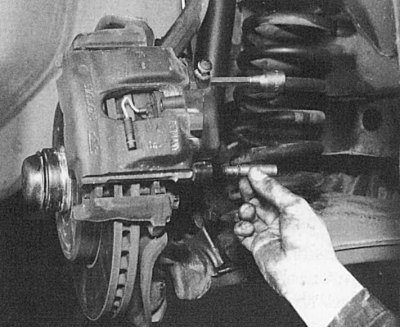
Fig. 8.13. Using an Allen key to loosen and remove the guide pins from the supports

Fig. 8.13. Using an Allen key to loosen and remove the guide pins from the supports


6. Unscrew the guide pins (Fig. 8.13) from the upper and lower supports of the caliper, holding the hexagonal slot near the rubber boot with an open-end wrench.

7. Remove the caliper and hang it on a wire so that the brake hose does not stretch out.
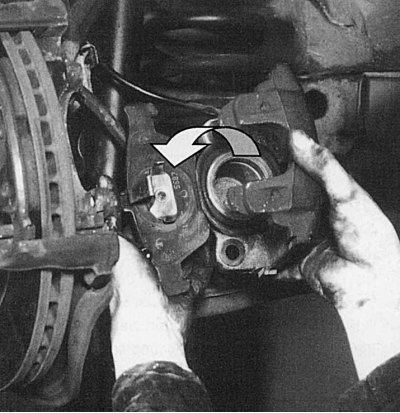
Fig. 8.14. The inner shoe is mounted on the caliper piston (arrow) via a return spring. Thus, when…

Fig. 8.14. The inner shoe is mounted on the caliper piston (arrow) via a return spring. Thus, when the brake pedal is released, the brake disc again gets free play
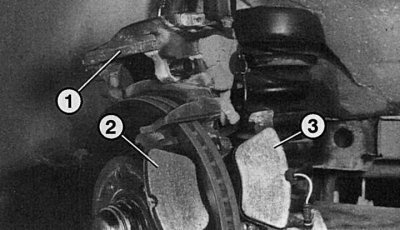


Fig. 8.15. Replacing the front brake pads: 1 – caliper bracket (removed and hung on a wire); 2 –…

Fig. 8.15. Replacing the front brake pads: 1 – caliper bracket (removed and hung on a wire); 2 – outer brake shoe; 3 – inner brake shoe (the brake pads are removed from the bracket, a wear sensor is installed on the inner pad)


8. Remove the inner shoe from the brake piston (Fig. 8.14). It is secured with a retaining clip (Fig. 8.15).

9. Remove the wear sensor from the inner pad.

10. Remove the outer shoe from the bracket.
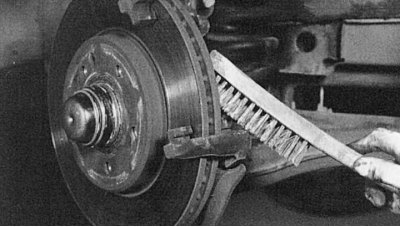
Fig. 8.16. After long-term use, the caliper parts and pad guides become covered with brake dust. To…

Fig. 8.16. After long-term use, the caliper parts and pad guides become covered with brake dust. To ensure proper operation, clean the bracket and caliper with a wire brush before installing new pads


11. Before assembly, clean the caliper parts with a soft metal bristle brush (Fig. 8.16) or a cloth soaked in alcohol. Do not use mineral solvents or tools with sharp edges. Brake dust deposits and corrosion on the caliper parts can lead to uneven wear of the pads.


12. Check the condition of the brake piston mud boot. If any damage is found, replace it, as dirt penetration will quickly cause the piston to seize.
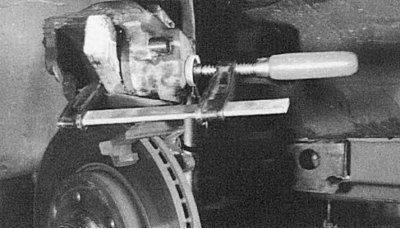
Fig. 8.17. Pressing the brake piston into the cylinder using a clamp. To protect the piston from…

Fig. 8.17. Pressing the brake piston into the cylinder using a clamp. To protect the piston from damage, it is necessary to place wooden blocks. You can also use an old shoe


(Information copied from the website MercedesMan.ru)

13. Press the piston into the cylinder (Fig. 8.17). Use a wooden mallet or a special clamp to do this. Be careful not to damage the piston surface or the mudguard.

14. When the piston is pressed, the brake fluid from the cylinder will be forced into the reservoir. If necessary, pump out excess fluid.

15. Install the brake pads.

16. Install the wear sensor.

17. Install the caliper and tighten the new self-locking guide pins to a torque of 35 Nm.

18. Place the protective covers on the guide pins.

19. Connect the sensor connector. Pay attention to the wire routing and close the connector protective cover.

20. Install the caliper retaining bracket. After installing the bracket in both holes, secure it by pressing it under the caliper bracket. If installed incorrectly, the brake pedal travel will increase.


21. Install the front wheel, lower the vehicle and tighten the wheel mounting bolts to 110 Nm.

22. Replace the brake pads on the other side of the car.

23. With the vehicle stationary, press the brake pedal several times to ensure that the pads are in the correct position.

24. Check the brake fluid level.
This article is available at: russian, bulgarian, belarusian, ukrainian, serbian, croatian, romanian, polish, slovak, hungarian
The article has been verified: Polyakov Zakhar Grigorievich
Share with friends:
◀ Previous
E-Class W210 / Brake system
Next ▶

Checking the condition of the brake discs
Checking the thickness of the pads
Checking the brake booster
Checking the brake system for leaks and damage
Checking the brake fluid level
Replacing rear brake pads
Removal the brake caliper
Removal the brake disc
Removal the brake hose
Removal brake pipes
More similar articles for repairing other models

☛ Brake pads — checking residual thickness Mercedes W168 (1997-2004)
☛ Replacing the front disc brake pads Mercedes W203 (2000-2007)
☛ Checking the condition and replacing brake pads Mercedes W463 (1999-2019)
☛ Assessing the degree of wear and replacing brake pads Mercedes W163 (1997-2005)
☛ Replacing the front brake pads Mercedes W116 (1972-1980, petrol)
☛ Replacing the front brake pads Mercedes Sprinter (1995-2000, diesel)
Link in different formats to this article
Comments and feedback from visitors
No comments yet


How much will 47 + 30 ?


W210 (1996-2002) 
  • General information
  • Vehicle description
  • Working conditions and tools
  • Car care
  • Diesel engines
  • Engine repair
  • Lubrication system
  • Cooling system
  • Injection system
  • Supply system
  • Exhaust system
  • Gasoline engines
  • Engine repair
  • Lubrication system
  • Cooling system
  • Control system
  • Power and exhaust system
  • Transmission
  • Clutch
  • Mechanical gearbox
  • Automatic gearbox
  • Drive shafts
  • Chassis
  • Car suspension
  • Steering
  • Tires and wheels
  • Brake system
  • Body
  • Exterior (external elements)
  • Interior (internal elements)
  • Doors and windows
  • Heating and ventilation
  • Electrical equipment
  • Equipment and devices
  • Power devices
  • Lighting and signaling
  • Electrical circuits
W124 (1984-1995) 
  • General information
  • Governing bodies
  • Driving and operation
  • Weekly care
  • Maintenance (gasoline)
  • Maintenance (diesel)
  • Troubleshooting
  • Power unit
  • I4 petrol engine
  • V6 petrol engine (SOHC)
  • V6 petrol engine (DOHC)
  • Diesel engines
  • Engine overhaul
  • Cooling system
  • Heating and ventilation
  • Fuel system (carburetor)
  • Injection system «Bosch CIS-E»
  • Injection system «Bosch HFM»
  • Diesel fuel system
  • Supply system
  • Starting and charging system
  • Ignition system (I4)
  • Ignition system (V6)
  • Preheating
  • Transmission
  • Clutch
  • Mechanical gearbox
  • Automatic gearbox
  • Drive shafts
  • Chassis
  • Brake system
  • Car suspension
  • Steering
  • Body
  • Exterior (external elements)
  • Interior (internal elements)
  • Doors, locks and windows
  • Electrical equipment
  • Equipment and devices
  • Switches
  • Headlights and lighting
  • Electrical circuits
W123 (1976-1985) 
  • General information
  • Introduction to the guide
  • Power unit
  • Engine device
  • Repair M102 engines
  • Repair M110 and M123 engines
  • Cooling and lubrication (M102)
  • Cooling (M110 and M123)
  • Ignition system
  • Power system «Stromberg»
  • Power system «Solex 4A1»
  • Fuel injection «K-Jetronic»
  • Fuel injection «L-Jetronic»
  • Transmission
  • Clutch
  • Mechanical gearbox
  • Automatic gearbox
  • Cardan and rear axle
  • Chassis
  • Front suspension
  • Rear suspension
  • Steering
  • Brake system
  • Body
  • Exterior (external elements)
  • Interior (internal elements)
  • Doors, locks and windows
  • Electrical equipment
  • Equipment and devices
  • Power devices
  • Electrical circuits
 
MercedesMan.ru © 2017–2026 · Mobile version · Read about Mercedes · Sitemap: EN BG BY UA RS HR RO PL SK HU · Feedback · Site search · Bookmark A-Class (W168) · C-Class (W201) · C-Class (W202) · C-Class (W203) · E-Class (W123) · E-Class (W124) · E-Class (W210) · G-Class (W463) · M-Class (W163) · S-Class (W116, petrol) · S-Class (W126, petrol) · S-Class (W140) · S-Class (W220) · Sprinter · Vito 1 · Vito 2 · Vario 814D ·
 
We only use cookies without which some of the site's features may not be available.