
Cars BMW Cars Volkswagen Cars Chevrolet Cars Land Rover Cars Lada Cars Honda Cars Peugeot
English Русский
Български
Беларускі
Український
Српски
Hrvatski
Română
Polski
Slovenský
Magyar
Bookmark News and articles Sitemap Feedback Site search
MercedesMan.ru


A-Class C-Class E-Class G-Class M-Class S-Class Others
W123 (1976-1985) W124 (1984-1995) W210 (1996-2002)
  • Main
  • E-Class
  • W210 (1996-2002)
  • Chassis
  • Brake system
  • Removal the brake caliper

Removal the brake caliper (Mercedes-Benz E-Class W210)

0

Sequence of works


1. Raise the car, secure it and remove the wheel.

2. On the front wheel: Release the wear sensor wire and remove its connector.

3. Open the bleed nipple, press the brake pedal once and hold it in this position.

4. Disconnect the brake hose from the brake line on the body.

5. Unscrew the wheel speed sensor.

6. Unscrew the two hex bolts securing it to the steering knuckle and remove the caliper together with the bracket.

7. When assembling, always use new self-locking bolts to secure the bracket.
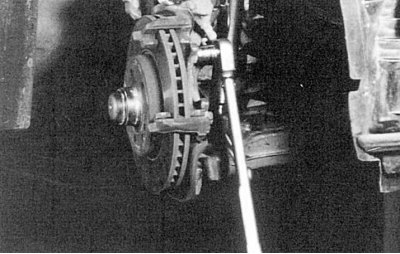
Fig. 8.20. When tightening the bolts that secure the caliper bracket to the steering knuckle, a…

Fig. 8.20. When tightening the bolts that secure the caliper bracket to the steering knuckle, a torque wrench is required


8. On the front wheels, tighten the bracket mounting bolts to the steering knuckle to a torque of 115 N·m using a torque wrench (Fig. 8.20), on the rear wheels - to a torque of 50 N·m (or 70 N·m on vehicles with ASR).


9. If the bolts are difficult to tighten, remove the remaining locking compound with a thread-cutting die (on the front wheels - M12); on the rear ones - M10).

10. If the caliper is removed only to replace the disc, there is no need to disconnect the brake hose. In this case, you should only unscrew the bolts securing the bracket to the steering knuckle. Do not leave the caliper hanging on the brake hose, but tie it up with wire.

11. If the brake hose has been removed and the system has become depressurized, bleed the brake mechanism after assembly.
This article is available at: russian, bulgarian, belarusian, ukrainian, serbian, croatian, romanian, polish, slovak, hungarian
The article has been verified: Polyakov Zakhar Grigorievich
Share with friends:
◀ Previous
E-Class W210 / Brake system
Next ▶

Replacing rear brake pads
Replacing the front brake pads
Checking the condition of the brake discs
Checking the thickness of the pads
Checking the brake booster
Removal the brake disc
Removal the brake hose
Removal brake pipes
Bleeding the brake system
Replacing brake fluid
More similar articles for repairing other models

☛ Brake fluid — checking the level Mercedes W168 (1997-2004)
☛ Front Brake Caliper — Removal, Repair and Installation Mercedes 190 (W201) (1982-1993)
☛ Emergency Brake Booster (BAS) Mercedes W463 (1999-2019)
☛ Emergency Brake Booster (BAS) Mercedes W163 (1997-2005)
☛ Removal and installation the brake caliper Mercedes W140 (1991-1998)
☛ Removal and installation the front brake caliper Mercedes Sprinter (1995-2000, diesel)
Link in different formats to this article
Comments and feedback from visitors
No comments yet


How much will 43 + 25 ?


W210 (1996-2002) 
  • General information
  • Vehicle description
  • Working conditions and tools
  • Car care
  • Diesel engines
  • Engine repair
  • Lubrication system
  • Cooling system
  • Injection system
  • Supply system
  • Exhaust system
  • Gasoline engines
  • Engine repair
  • Lubrication system
  • Cooling system
  • Control system
  • Power and exhaust system
  • Transmission
  • Clutch
  • Mechanical gearbox
  • Automatic gearbox
  • Drive shafts
  • Chassis
  • Car suspension
  • Steering
  • Tires and wheels
  • Brake system
  • Body
  • Exterior (external elements)
  • Interior (internal elements)
  • Doors and windows
  • Heating and ventilation
  • Electrical equipment
  • Equipment and devices
  • Power devices
  • Lighting and signaling
  • Electrical circuits
W124 (1984-1995) 
  • General information
  • Governing bodies
  • Driving and operation
  • Weekly care
  • Maintenance (gasoline)
  • Maintenance (diesel)
  • Troubleshooting
  • Power unit
  • I4 petrol engine
  • V6 petrol engine (SOHC)
  • V6 petrol engine (DOHC)
  • Diesel engines
  • Engine overhaul
  • Cooling system
  • Heating and ventilation
  • Fuel system (carburetor)
  • Injection system «Bosch CIS-E»
  • Injection system «Bosch HFM»
  • Diesel fuel system
  • Supply system
  • Starting and charging system
  • Ignition system (I4)
  • Ignition system (V6)
  • Preheating
  • Transmission
  • Clutch
  • Mechanical gearbox
  • Automatic gearbox
  • Drive shafts
  • Chassis
  • Brake system
  • Car suspension
  • Steering
  • Body
  • Exterior (external elements)
  • Interior (internal elements)
  • Doors, locks and windows
  • Electrical equipment
  • Equipment and devices
  • Switches
  • Headlights and lighting
  • Electrical circuits
W123 (1976-1985) 
  • General information
  • Introduction to the guide
  • Power unit
  • Engine device
  • Repair M102 engines
  • Repair M110 and M123 engines
  • Cooling and lubrication (M102)
  • Cooling (M110 and M123)
  • Ignition system
  • Power system «Stromberg»
  • Power system «Solex 4A1»
  • Fuel injection «K-Jetronic»
  • Fuel injection «L-Jetronic»
  • Transmission
  • Clutch
  • Mechanical gearbox
  • Automatic gearbox
  • Cardan and rear axle
  • Chassis
  • Front suspension
  • Rear suspension
  • Steering
  • Brake system
  • Body
  • Exterior (external elements)
  • Interior (internal elements)
  • Doors, locks and windows
  • Electrical equipment
  • Equipment and devices
  • Power devices
  • Electrical circuits
 
MercedesMan.ru © 2017–2026 · Mobile version · Read about Mercedes · Sitemap: EN BG BY UA RS HR RO PL SK HU · Feedback · Site search · Bookmark A-Class (W168) · C-Class (W201) · C-Class (W202) · C-Class (W203) · E-Class (W123) · E-Class (W124) · E-Class (W210) · G-Class (W463) · M-Class (W163) · S-Class (W116, petrol) · S-Class (W126, petrol) · S-Class (W140) · S-Class (W220) · Sprinter · Vito 1 · Vito 2 · Vario 814D ·
 
We only use cookies without which some of the site's features may not be available.