



Note: Before starting work, read the warning at the beginning of paragraph 8 about the dangers of hydraulic fluid and the warning at the beginning paragraph 4 about the dangers of asbestos dust.
Removal
Note: New caliper pin bolts will be required for installation.
1. Apply the parking brake, then raise the front of the vehicle with a jack and support it on stands (see "Lifting the car and placing it on supports"). Remove the corresponding wheel.
2. Reduce fluid loss by first removing the master cylinder reservoir cap and then covering it tightly with a piece of polyethylene to create an airtight seal. You can clamp the flexible brake hose with a suitable clamp (see fig. 8.2).
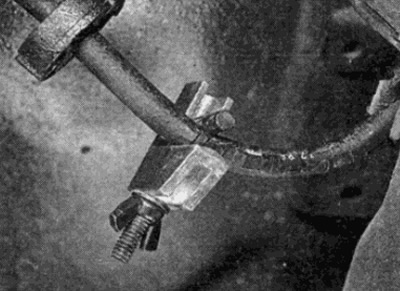
Fig. 8.2. Use a clamp to pinch the flexible brake hose
3. Clean the area around the nipple, then loosen the brake hose union nut on the caliper.
4. Remove the pads as described in paragraph 4.
5. Loosen and remove the upper guide pin bolt, then unscrew the caliper and remove it from the disc (see fig. 8.5).
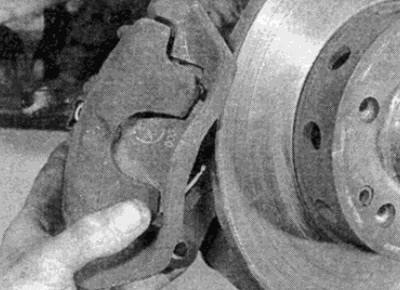
Fig. 8.5. Remove the brake caliper
Repair
6. With the support on the workbench, wipe off all traces of dust and dirt, but avoid inhaling the dust as it is harmful to health.
7. Remove the partially protruding piston from the caliper body and remove the dust cover.
Tip: If the piston cannot be pulled out by hand, it can be pushed out by air pressure, feeding it into the hole of the brake hose nipple. Minor pressure is required, which can be created using a foot pump. Place a wooden block between the end of the piston and the caliper body so as not to damage the piston when it jumps out of the hole - also protect your fingers so that they are not crushed by the piston.
8. Using a soft blunt instrument, such as the end of a pen cap, remove the piston hydraulic seal, taking care not to damage the cylinder surface (see fig. 8.8).
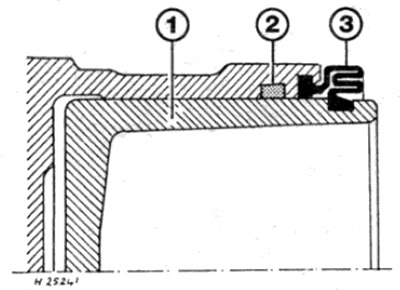
Fig. 8.8. Sectional view of piston, caliper housing and seal
1 Piston
2 Piston seal
3 Dust cover
9. Clean all parts thoroughly with methylated or isopropyl alcohol or clean brake fluid. Never use gasoline or kerosene based solvents as they will attack the rubber parts of the hydraulic system components. Dry the parts immediately with compressed air or a clean, lint-free cloth. Use compressed air to blow out the fluid passages.
10. Check the condition of the parts and replace any that are worn or damaged. Check especially the cylinder bores and pistons; they need to be replaced (please note that the entire unit is changed) if they are scratched, worn or corroded. Likewise, check the condition of the pins and their bushings; both fingers must be intact, and (when thoroughly cleaned) fit tightly into the bushings. If there is any doubt about the condition of any part, replace it.
11. If the unit can be used again, purchase the appropriate repair kit from your Mercedes-Benz dealer. All rubber seals must be replaced; they cannot be reused.
12. When assembling, ensure that the parts are clean and dry.
13. Soak the piston and new piston seal in clean hydraulic fluid. Lubricate the cylinder bore surface with clean fluid.
14. Install the new piston seal using your fingers (without fixture), to install the seal into the groove in the cylinder.
15. Install a new dust boot on the back of the piston and install the outer edge of the seal into the groove on the caliper body. Carefully, using rotational movements, push the piston without tilting it into the cylinder bore. Press the piston until it stops and install the inner edge of the dust boot into the groove in the piston.
16. If the caliper guide pins are being replaced, lubricate the pin shafts with the grease supplied in the repair kit and install the boots in the grooves of the pins. Insert the pins into the caliper bracket and install the boots in the grooves of the bracket.
Installation
17. Remove all traces of old locking compound from the threaded holes of the guide pins/bolts (depending on what is used), having passed the thread with the appropriate tap.
Tip: If you don't have the required tap, go through the threads using an old bolt with a split groove on the thread.
18. Screw the flexible hose fitting into the caliper until it stops.
19. Place the caliper against the bracket and install the new pin bolt, tightening it to the required torque.
20. Tighten the brake hose nipple nut to the required torque and remove the clamp from the hose or the plastic bag from the reservoir (depends on what you used).
21. Install the brake shoes as described in paragraph 4 and bleed the hydraulic system as described in paragraph 2. Please note that if the recommended measures to reduce fluid loss have been taken, only the corresponding front brake should be bled.
22. Install the wheels, then lower the vehicle to the ground and tighten the wheel bolts to the specified torque. Check the fluid level as described in "Weekly check". Check the brakes thoroughly before driving on the road.