
Cars BMW Cars Volkswagen Cars Chevrolet Cars Land Rover Cars Lada Cars Honda Cars Peugeot
English Русский
Български
Беларускі
Український
Српски
Hrvatski
Română
Polski
Slovenský
Magyar
Bookmark News and articles Sitemap Feedback Site search
MercedesMan.ru


A-Class C-Class E-Class G-Class M-Class S-Class Others
190 (W201) (1982-1993) W202 (1993-2000) W203 (2000-2007)
  • Main
  • C-Class
  • W201 (1982-1993)
  • Chassis
  • Brake system
  • Parking brake shoes — removal and installation

Parking brake shoes — removal and installation (Mercedes-Benz C-Class W201)

0
Contents: Removal ↡ Installation ↡

Removal


1. Remove the rear brake disc as described in paragraph 7, recording the correct placement of all parts (see fig. 14.1).
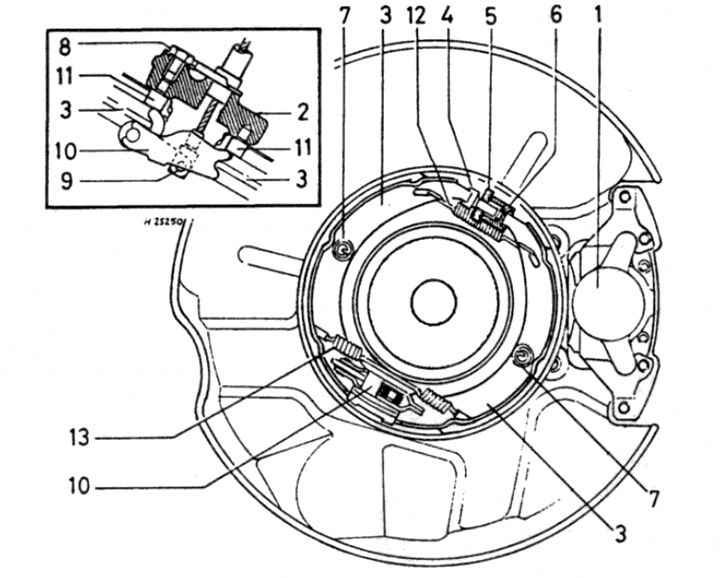
Fig. 14.1. Parking brake parts (left side shown)

Fig. 14.1. Parking brake parts (left side shown)
1 Brake cylinder
2 Rear hub holder
3 Parking brake shoes
4 Regulator pin
5 Knurled adjustment ring
6 Regulator body
7 Fastening spring
8 Cable mounting bolt
9 Cable tip
11 Mounting bolts
12 Upper return spring
13 Lower return spring


2. Using pliers, compress the shoe mounting springs, then turn them 90° and remove them from the lower brake plate. Access to the springs is through the holes in the hub flange (see fig. 14.2).
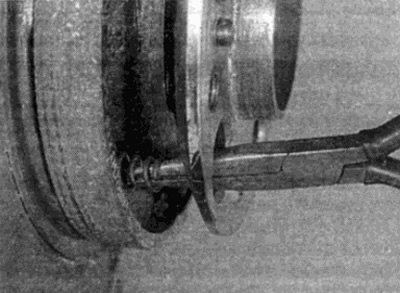
Fig. 14.2. Remove the mounting springs...

Fig. 14.2. Remove the mounting springs...


3. Carefully unhook and remove the lower return spring of the parking brake shoe, remembering how it is installed - it is not symmetrical (see fig. 14.3).
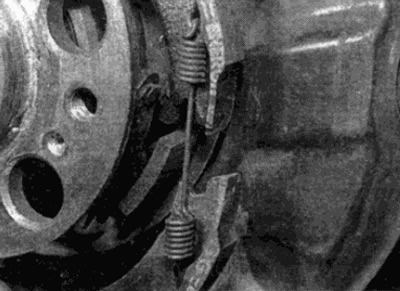


Fig. 14.3. ...then unhook the lower return spring, paying attention to which cut it is installed...

Fig. 14.3. ...then unhook the lower return spring, paying attention to which cut it is installed...


4. Separate the lower ends of the pads from the expansion mechanism and remove the unit from the vehicle (see fig. 14.4).
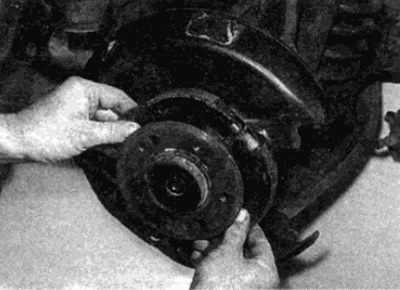
Fig. 14.4. ...and remove the parking brake shoe assembly from the vehicle

Fig. 14.4. ...and remove the parking brake shoe assembly from the vehicle


5. With the assembly on the workbench, make sure each part is in the correct position, then unhook the upper return spring and separate the shoe adjustment mechanism.

6. Inspect the pads. If they are worn or dirty, replace them. It is also recommended to replace the tension springs. Mercedes-Benz does not set a wear limit for the parking brake pads, but pads with a friction material thickness of about 1.5 mm should be replaced.


7. If the pads are to be changed, clean and check the condition of the pad adjuster and expansion mechanisms. If wear or damage is detected, replace them. If everything is normal, apply a fresh layer of brake paste to the adjuster threads and the sliding surfaces of the expansion mechanism (mercedes-Benz recommends Molykote Paste U or G-Rapid). Do not allow the paste to come into contact with the friction material of the pads.

Installation


8. Before installation, clean the base and apply a thin layer of high-temperature brake paste (see item 7) or "anti-seize" compound to all surfaces of the base that come into contact with the brake pads. Avoid getting the paste on the friction linings.

9. Assemble the shoes and adjuster mechanism, taking into account that the adjuster must be installed with the knurled adjuster ring at the front. Pull the adjuster out completely and install the upper return spring.

[Information copied from the website: MERCEDESMAN]

10. Install the assembly into place and align the lower ends of each shoe with the expansion mechanism.

11. Install the lower tension spring so that the longer hook is attached to the upper shoe (see fig. 14.11).
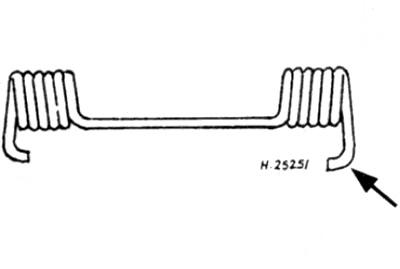
Fig. 14.11. Longer hook of the lower return spring (shown by arrow) must be installed on the upper…

Fig. 14.11. Longer hook of the lower return spring (shown by arrow) must be installed on the upper parking brake shoe


12. Make sure the pads are positioned correctly and secure them with the retaining springs.


13. Check that all parts are installed correctly and center the parking brake shoes.

14. Install the brake disc as described in paragraph 17. Before installing the wheel, adjust the parking brake as described in paragraph 13.
This article is available at: russian, bulgarian, belarusian, ukrainian, serbian, croatian, romanian, polish, slovak, hungarian
The article has been verified: Lukyanov Nikita Ilyich
Share with friends:
◀ Previous
C-Class 190 (W201) / Brake system
Next ▶

Parking brake — adjustment
Brake booster vacuum valve — removal, inspection and installation
Vacuum brake booster — checking, removal and installation
Master Cylinder — Removal, Repair and Installation
Rear Brake Caliper — Removal, Repair and Installation
Parking brake cable — removal and installation
Brake Light Switch — Removal and Installation
Anti-lock braking system (ABS) — basic provisions
ABS System Parts — Removal and Installation
Brake Vacuum Pump (Diesel Models) — Checking, Removing and Installing
More similar articles for repairing other models

☛ Brake shoes of drum brake mechanism — removal and installation Mercedes W168 (1997-2004)
☛ Parking brake — general description Mercedes W123 (1976-1985)
☛ Replacing the parking brake shoes Mercedes W463 (1999-2019)
☛ Replacing the parking brake shoes Mercedes W163 (1997-2005)
☛ Removal and installation parking brake shoes Mercedes W140 (1991-1998)
☛ Adjusting the parking brake shoes Mercedes Sprinter (1995-2000, diesel)
Link in different formats to this article
Comments and feedback from visitors
No comments yet


How much will 11 + 44 ?


W203 (2000-2007) 
  • General information
  • Introduction to guide
  • User manual
  • Maintenance
  • Power unit
  • Gasoline engines
  • Diesel engines
  • Cooling system
  • Ventilation and heating
  • Supply system
  • Injection system (gasoline)
  • Injection system (diesel)
  • Exhaust system
  • Ignition and control system
  • Charge and launch systems
  • Transmission
  • Mechanical gearbox
  • Automatic gearbox
  • Clutch and drive shafts
  • Differential
  • Chassis
  • Brake system
  • Car suspension
  • Steering
  • Body
  • Exterior (external elements)
  • Interior (internal elements)
  • Electrical equipment
  • Equipment and devices
  • Lighting system
  • Electrical diagrams (2000)
  • Electrical diagrams (since 2001)
W202 (1993-2000) 
  • General information
  • User manual
  • Driving a car
  • Car care
  • Maintenance
  • Power unit
  • Gasoline engines
  • Diesel engines
  • Lubrication system
  • Cooling system
  • Heating and ventilation
  • Ignition system
  • Fuel system
  • Injection system (gasoline)
  • Injection system (diesel)
  • Exhaust system
  • Transmission
  • Clutch
  • Car gearbox
  • Chassis
  • Suspension, wheels and tires
  • Steering
  • Brake system
  • Body
  • Exterior (external elements)
  • Interior (internal elements)
  • Doors and windows
  • Electrical equipment
  • Equipment and devices
  • Power devices
  • Lighting system
  • Electrical circuits
190 (W201) (1982-1993) 
  • General information
  • Introduction to the guide
  • Operation and care
  • Maintenance (gasoline)
  • Maintenance (diesel)
  • Troubleshooting
  • Power unit
  • Petrol engine I4
  • Petrol engine V6
  • Diesel engines
  • Engine overhaul
  • Cooling and heating
  • Power system (carburetor)
  • Injection system (gasoline)
  • Injection system (diesel)
  • Exhaust system
  • Charge and start system
  • Ignition system (I4)
  • Ignition system (V6)
  • Diesel heating system
  • Transmission
  • Clutch
  • Mechanical gearbox
  • Automatic gearbox
  • Cardan shaft and axle shafts
  • Chassis
  • Brake system
  • Car suspension
  • Steering
  • Body
  • Exterior (external elements)
  • Interior (internal elements)
  • Doors, locks and windows
  • Electrical equipment
  • Equipment and devices
  • Electrical circuits
 
MercedesMan.ru © 2017–2026 · Mobile version · Read about Mercedes · Sitemap: EN BG BY UA RS HR RO PL SK HU · Feedback · Site search · Bookmark A-Class (W168) · C-Class (W201) · C-Class (W202) · C-Class (W203) · E-Class (W123) · E-Class (W124) · E-Class (W210) · G-Class (W463) · M-Class (W163) · S-Class (W116, petrol) · S-Class (W126, petrol) · S-Class (W140) · S-Class (W220) · Sprinter · Vito 1 · Vito 2 · Vario 814D ·
 
We only use cookies without which some of the site's features may not be available.