
Cars BMW Cars Volkswagen Cars Chevrolet Cars Land Rover Cars Lada Cars Honda Cars Peugeot
English Русский
Български
Беларускі
Український
Српски
Hrvatski
Română
Polski
Slovenský
Magyar
Bookmark News and articles Sitemap Feedback Site search
MercedesMan.ru


A-Class C-Class E-Class G-Class M-Class S-Class Others
W123 (1976-1985) W124 (1984-1995) W210 (1996-2002)
  • Main
  • E-Class
  • W123 (1976-1985)
  • Chassis
  • Brake system
  • Removal, disassembly and installation of the brake caliper

Removal, disassembly and installation of the brake caliper (Mercedes-Benz E-Class W123)

0
Contents: Removal the wheel brake mechanism ↡ Disassembly ↡

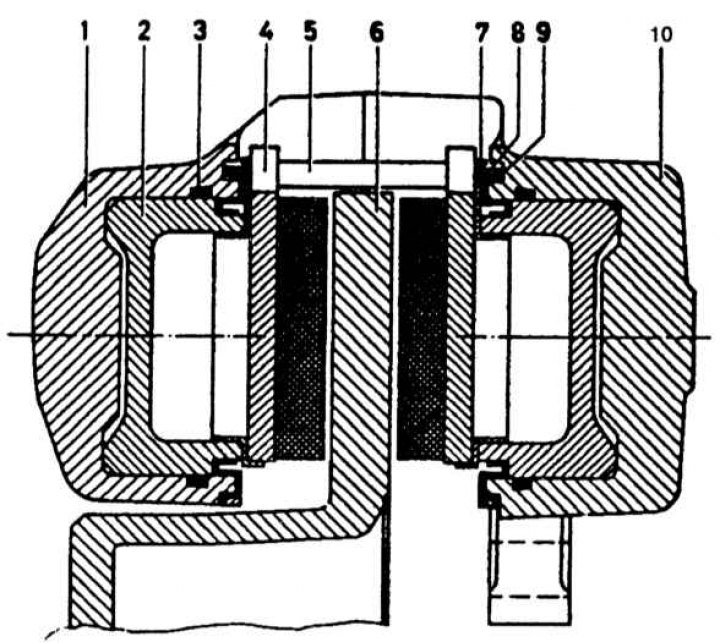
Brake caliper


1, 10 - bracket; 2 - piston; 3 - seal; 4 - brake shoe; 5 - mounting pin; 6 - brake disc; 7 -…

1, 10 - bracket; 2 - piston; 3 - seal; 4 - brake shoe; 5 - mounting pin; 6 - brake disc; 7 - heat-protective cap; 8 - retaining ring; 9 - anther


Removal the wheel brake mechanism


Front wheel brake mechanism
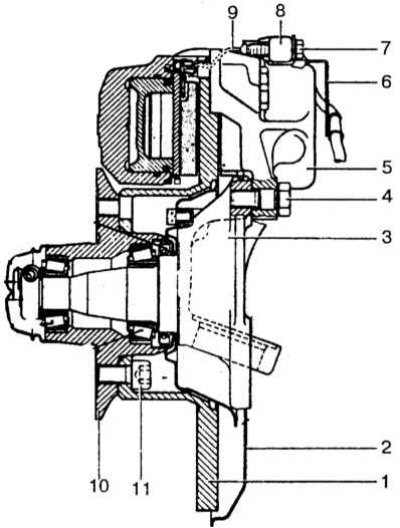


1 - brake disc; 2 - protective cover; 3 - steering knuckle; 4 - self-locking bolt; 5 - brake…

1 - brake disc; 2 - protective cover; 3 - steering knuckle; 4 - self-locking bolt; 5 - brake caliper; 6 - wire holder; 7 - bolt; 8 - connector; 9 - sensor mounting clamp; 10 - front wheel hub; 11 - self-locking bolt


(Publication reprinted from this resource: www.MercedesMan.ru)

1. Prepare the vehicle and remove the desired front wheel.

2. Remove the brake pads (as stated earlier).

3. Unscrew the cap of the brake fluid reservoir of the master brake cylinder, place a gasket made of sheet polyethylene under it, screw the cap tightly in order to reduce fluid loss during further operations.


4. Unscrew the bolt securing the brake pad wear sensor from the caliper.

5. Loosen the brake hose connection on the brake caliper.

6. Unscrew the mounting bolts and remove the brake caliper from the steering knuckle, unscrew the union nut of the flexible hose.

7. To remove the rear wheel brake mechanism, the operations are carried out in a similar manner, only lift the rear of the car and remove the brake caliper from the wheel hub.

Disassembly
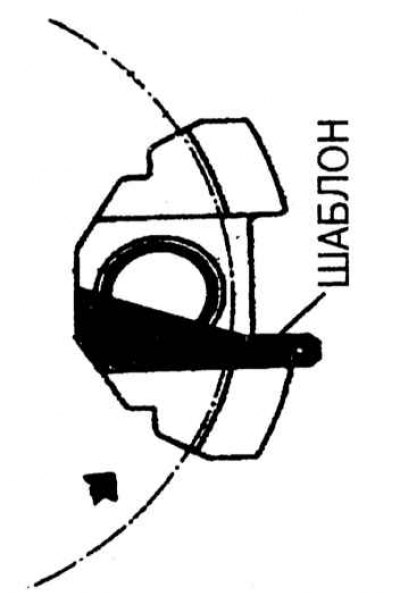


Control of the recess position

Control of the recess position


1. Remove the dust caps, but do not damage the pressed ring.

2. Using air pressure from a tire pump connected to the hydraulic inlet fitting on the brake caliper, push one of the pistons out while holding the opposite piston.

3. Blocking the hole of the removed piston (thick rubber), similarly push out the second piston.

4. Mark the pistons and corresponding cylinders to avoid confusion during assembly.

5. Perform a defect inspection of the piston and cylinder surfaces. The presence of scoring, seizure, and abrasions requires replacement of the entire brake caliper.

6. Remove the sealing rings from the cylinder grooves and install new sealing rings, cleaning them with clean brake fluid. The rings are installed manually.


7. Lubricate the pistons with brake fluid and insert them into the corresponding cylinders. Turn the pistons so that their recesses are at an angle of 20° relative to the bottom of the caliper and check their position with a template.

8. Push the pistons in as far as they will go and install the dust caps.

9. Press on the heat shield caps and make sure that the piston drive part protrudes at least 0.1 mm above the surface of the heat shield cap. The caps of the outer and inner pistons are different and are not interchangeable.

10. Installation is carried out in the reverse order of removal. Bleed air from the hydraulic drive.
This article is available at: russian, bulgarian, belarusian, ukrainian, serbian, croatian, romanian, polish, slovak, hungarian
The article has been verified: Levin Kirill Glebovich
Share with friends:
◀ Previous
E-Class W123 / Brake system
Next ▶

Checking and replacing disc brake pads
Design and technical characteristics of the brake system
Inspection, removal and installation of the brake disc
Removal, disassembly and installation of the master brake cylinder
Bleeding air from the master cylinder
Bleeding the brake system
Replacing brake fluid
More similar articles for repairing other models

☛ Brake fluid — checking the level Mercedes W168 (1997-2004)
☛ Front Brake Caliper — Removal, Repair and Installation Mercedes 190 (W201) (1982-1993)
☛ Emergency Brake Booster (BAS) Mercedes W463 (1999-2019)
☛ Emergency Brake Booster (BAS) Mercedes W163 (1997-2005)
☛ Removal and installation the brake caliper Mercedes W140 (1991-1998)
☛ Removal and installation the front brake caliper Mercedes Sprinter (1995-2000, diesel)
Link in different formats to this article
Comments and feedback from visitors
No comments yet


How much will 41 + 30 ?


W210 (1996-2002) 
  • General information
  • Vehicle description
  • Working conditions and tools
  • Car care
  • Diesel engines
  • Engine repair
  • Lubrication system
  • Cooling system
  • Injection system
  • Supply system
  • Exhaust system
  • Gasoline engines
  • Engine repair
  • Lubrication system
  • Cooling system
  • Control system
  • Power and exhaust system
  • Transmission
  • Clutch
  • Mechanical gearbox
  • Automatic gearbox
  • Drive shafts
  • Chassis
  • Car suspension
  • Steering
  • Tires and wheels
  • Brake system
  • Body
  • Exterior (external elements)
  • Interior (internal elements)
  • Doors and windows
  • Heating and ventilation
  • Electrical equipment
  • Equipment and devices
  • Power devices
  • Lighting and signaling
  • Electrical circuits
W124 (1984-1995) 
  • General information
  • Governing bodies
  • Driving and operation
  • Weekly care
  • Maintenance (gasoline)
  • Maintenance (diesel)
  • Troubleshooting
  • Power unit
  • I4 petrol engine
  • V6 petrol engine (SOHC)
  • V6 petrol engine (DOHC)
  • Diesel engines
  • Engine overhaul
  • Cooling system
  • Heating and ventilation
  • Fuel system (carburetor)
  • Injection system «Bosch CIS-E»
  • Injection system «Bosch HFM»
  • Diesel fuel system
  • Supply system
  • Starting and charging system
  • Ignition system (I4)
  • Ignition system (V6)
  • Preheating
  • Transmission
  • Clutch
  • Mechanical gearbox
  • Automatic gearbox
  • Drive shafts
  • Chassis
  • Brake system
  • Car suspension
  • Steering
  • Body
  • Exterior (external elements)
  • Interior (internal elements)
  • Doors, locks and windows
  • Electrical equipment
  • Equipment and devices
  • Switches
  • Headlights and lighting
  • Electrical circuits
W123 (1976-1985) 
  • General information
  • Introduction to the guide
  • Power unit
  • Engine device
  • Repair M102 engines
  • Repair M110 and M123 engines
  • Cooling and lubrication (M102)
  • Cooling (M110 and M123)
  • Ignition system
  • Power system «Stromberg»
  • Power system «Solex 4A1»
  • Fuel injection «K-Jetronic»
  • Fuel injection «L-Jetronic»
  • Transmission
  • Clutch
  • Mechanical gearbox
  • Automatic gearbox
  • Cardan and rear axle
  • Chassis
  • Front suspension
  • Rear suspension
  • Steering
  • Brake system
  • Body
  • Exterior (external elements)
  • Interior (internal elements)
  • Doors, locks and windows
  • Electrical equipment
  • Equipment and devices
  • Power devices
  • Electrical circuits
 
MercedesMan.ru © 2017–2026 · Mobile version · Read about Mercedes · Sitemap: EN BG BY UA RS HR RO PL SK HU · Feedback · Site search · Bookmark A-Class (W168) · C-Class (W201) · C-Class (W202) · C-Class (W203) · E-Class (W123) · E-Class (W124) · E-Class (W210) · G-Class (W463) · M-Class (W163) · S-Class (W116, petrol) · S-Class (W126, petrol) · S-Class (W140) · S-Class (W220) · Sprinter · Vito 1 · Vito 2 · Vario 814D ·
 
We only use cookies without which some of the site's features may not be available.