Cars BMW Cars Volkswagen Cars Chevrolet Cars Land Rover Cars Lada Cars Honda Cars Peugeot
English Русский
Български
Беларускі
Український
Српски
Hrvatski
Română
Polski
Slovenský
Magyar
Bookmark News and articles Sitemap Feedback Site search
MercedesMan.ru


A-Class C-Class E-Class G-Class M-Class S-Class Others
W123 (1976-1985) W124 (1984-1995) W210 (1996-2002)
  • Main
  • E-Class
  • W123 (1976-1985)
  • Chassis
  • Brake system
  • Design and technical characteristics of the brake system

Design and technical characteristics of the brake system (Mercedes-Benz E-Class W123)

0
Contents: Wheel brake mechanisms ↡ Vacuum booster ↡ Tightening torques of main threaded…↡
The brake system is designed as a separate two-circuit scheme for the front and rear wheels. The brake mechanism is of the disc type with a hydraulic drive and self-regulation of the pad wear compensation. Each circuit has its own reservoir on the main brake cylinder. To increase efficiency, the brake system is made with a vacuum booster (gain factor - three).

Some cars of recent years were equipped with an anti-lock braking system (ABS).

The parking brake is a mechanical (cable) drum-type drive and acts on the rear wheels, with the drums being structurally mounted on the rear discs. The clearances of the pads are adjusted manually every 48,000 km.

After any work involving disconnecting the brake hydraulic lines or loss of brake fluid, it is necessary to bleed the brake system.

The final stage of work on the brake system is running-in (functional check). Brakes should be checked at both high and low speeds.

Note: The operation of the braking system is affected by the condition of the tires and the vehicle load (its centering). Inspection frequency for leaks every 16,000 km. Replace brake fluid once a year.


Wheel brake mechanisms


Brake disc


Characteristic

Meaning

Outer disc diameter, mm

  • front

278+0,2

  • rear

279+0,2

Disc thickness, mm

  • front

12,6

  • rear

10,0

Minimum disc thickness, mm

  • front

10,6

  • rear

8,3

Axial runout of the working surface of the disk, no more than, mm

0,12


Brake caliper


Characteristic

Meaning

Brand

Teves, Bendix, Girling

Piston diameter, mm

54,00

Wheel cylinder diameter, mm

54,00—54,05

Thickness of new brake pads, mm

front brakes

  • until 1979.

15,0

  • since 1979.

17,5

rear brakes

  • until 1979.

15,0

  • since 1979.

15,5

Minimum thickness of brake shoe linings, mm

2,0

Brake pad area, cm²

  • front

206 (type T269 or T226)

  • rear

100 (type T223)


Vacuum booster


Characteristic

Meaning

Brand

ATE T52/225

Piston diameter, mm

228,6

Piston stroke, mm

35

Gain factor

3,0—4,5

Ovality of the main brake cylinder cavity, no more than, mm

0.03

Parking brake drum diameter, mm

160+0,2

Parking brake lining thickness, mm

new

4,0

minimal

1,5

Brake shoe width, mm

25,0

Total number of teeth per segment, pcs.

12

Average braking force (when moving the drive mechanism by 4-6 teeth of the sector), kgf

30,0

Parking brake starts to apply, clicks

1—2


Tightening torques of main threaded connections, kgf·m


Connection type

Meaning

Fastening the disc to the front hub

11,5

Fastening the caliper to the steering knuckle

11,0

Fastening the caliper to the trailing arm of the suspension

9,0

Fastening the master cylinder to the vacuum booster

1,5

Hydraulic hose coupling nut

1,5

Flexible hose connection nipple

0,9

Vacuum booster mount

3,0

Attaching a vacuum tube to an amplifier

3,0

Parking brake shoe holder mount

5,0

Master cylinder lock screw

0,4—0,8

Master cylinder plug

1,5—3,0

Pressure sensor

1,5—1,9


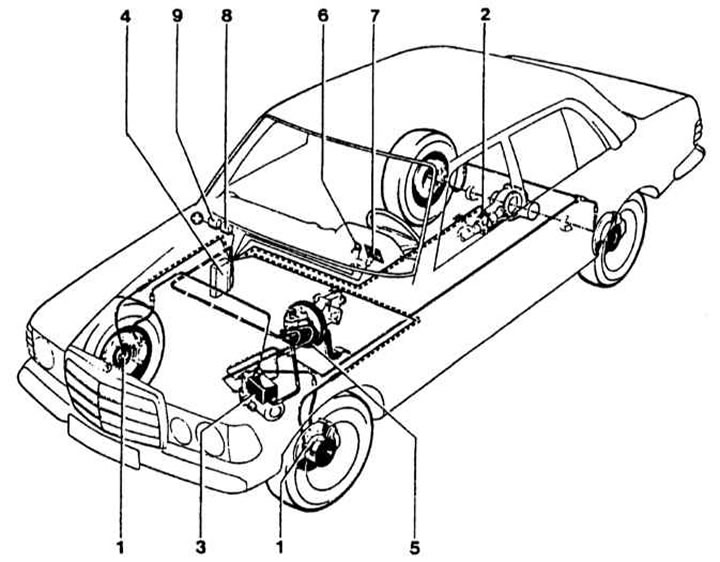
Anti-lock braking system ABS


1 - front wheel speed sensor; 2 - rear wheel speed sensor; 3 - hydraulic system; 4 - electronic…

1 - front wheel speed sensor; 2 - rear wheel speed sensor; 3 - hydraulic system; 4 - electronic control system; 5 - brake booster; 6 - steering wheel lock; 7 - ABS malfunction indicator lamp; 8 - safety device; 9 - relay


Original can be found on the website (MercedesMAN.ru)
This article is available at: russian, bulgarian, belarusian, ukrainian, serbian, croatian, romanian, polish, slovak, hungarian
The article has been verified: Levin Kirill Glebovich
Share with friends:
◀ Previous
E-Class W123 / Brake system
Next ▶

 
Checking and replacing disc brake pads
Removal, disassembly and installation of the brake caliper
Inspection, removal and installation of the brake disc
Removal, disassembly and installation of the master brake cylinder
Bleeding air from the master cylinder
More similar articles for repairing other models

☛ Brake system specifications Mercedes W168 (1997-2004)
☛ Design and description of the brake system Mercedes W203 (2000-2007)
☛ Anti-lock brake system (ABS) Mercedes W463 (1999-2019)
☛ Anti-lock brake system (ABS) Mercedes W163 (1997-2005)
☛ Anti-lock brake system (ABS) Mercedes W140 (1991-1998)
☛ Design of the brake system Mercedes Sprinter (1995-2000, diesel)
Link in different formats to this article
Comments and feedback from visitors
No comments yet


How much will 33 + 18 ?


W210 (1996-2002) 
  • General information
  • Vehicle description
  • Working conditions and tools
  • Car care
  • Diesel engines
  • Engine repair
  • Lubrication system
  • Cooling system
  • Injection system
  • Supply system
  • Exhaust system
  • Gasoline engines
  • Engine repair
  • Lubrication system
  • Cooling system
  • Control system
  • Power and exhaust system
  • Transmission
  • Clutch
  • Mechanical gearbox
  • Automatic gearbox
  • Drive shafts
  • Chassis
  • Car suspension
  • Steering
  • Tires and wheels
  • Brake system
  • Body
  • Exterior (external elements)
  • Interior (internal elements)
  • Doors and windows
  • Heating and ventilation
  • Electrical equipment
  • Equipment and devices
  • Power devices
  • Lighting and signaling
  • Electrical circuits
W124 (1984-1995) 
  • General information
  • Governing bodies
  • Driving and operation
  • Weekly care
  • Maintenance (gasoline)
  • Maintenance (diesel)
  • Troubleshooting
  • Power unit
  • I4 petrol engine
  • V6 petrol engine (SOHC)
  • V6 petrol engine (DOHC)
  • Diesel engines
  • Engine overhaul
  • Cooling system
  • Heating and ventilation
  • Fuel system (carburetor)
  • Injection system «Bosch CIS-E»
  • Injection system «Bosch HFM»
  • Diesel fuel system
  • Supply system
  • Starting and charging system
  • Ignition system (I4)
  • Ignition system (V6)
  • Preheating
  • Transmission
  • Clutch
  • Mechanical gearbox
  • Automatic gearbox
  • Drive shafts
  • Chassis
  • Brake system
  • Car suspension
  • Steering
  • Body
  • Exterior (external elements)
  • Interior (internal elements)
  • Doors, locks and windows
  • Electrical equipment
  • Equipment and devices
  • Switches
  • Headlights and lighting
  • Electrical circuits
W123 (1976-1985) 
  • General information
  • Introduction to the guide
  • Power unit
  • Engine device
  • Repair M102 engines
  • Repair M110 and M123 engines
  • Cooling and lubrication (M102)
  • Cooling (M110 and M123)
  • Ignition system
  • Power system «Stromberg»
  • Power system «Solex 4A1»
  • Fuel injection «K-Jetronic»
  • Fuel injection «L-Jetronic»
  • Transmission
  • Clutch
  • Mechanical gearbox
  • Automatic gearbox
  • Cardan and rear axle
  • Chassis
  • Front suspension
  • Rear suspension
  • Steering
  • Brake system
  • Body
  • Exterior (external elements)
  • Interior (internal elements)
  • Doors, locks and windows
  • Electrical equipment
  • Equipment and devices
  • Power devices
  • Electrical circuits
 
MercedesMan.ru © 2017–2026 · Mobile version · Read about Mercedes · Sitemap: EN BG BY UA RS HR RO PL SK HU · Feedback · Site search · Bookmark A-Class (W168) · C-Class (W201) · C-Class (W202) · C-Class (W203) · E-Class (W123) · E-Class (W124) · E-Class (W210) · G-Class (W463) · M-Class (W163) · S-Class (W116, petrol) · S-Class (W126, petrol) · S-Class (W140) · S-Class (W220) · Sprinter · Vito 1 · Vito 2 · Vario 814D ·
 
We only use cookies without which some of the site's features may not be available.