



Sectional view of standard type brake master cylinder
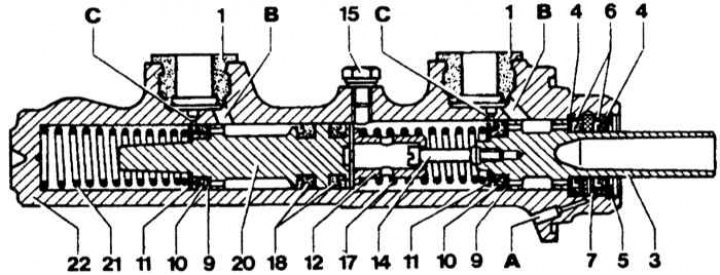
1 - sealing plug; 3 - piston (primary circuit); 4 - thrust washer; 5 - retaining ring; 6 - secondary and vacuum bushing; 7 - intermediate ring; 9 - spacer washer; 10 - primary bushing; 11 - support ring; 12 - spring holder; 14 - connecting screw; 15 - lock screw; 17— compression spring; 18 - separator sleeve; 20 - piston (secondary circuit); 21 - compression spring; 22 - body; A - hole for removing leaks; B - filler hole; C - compensating hole
Sectional view of the master brake cylinder with differential pressure sensor
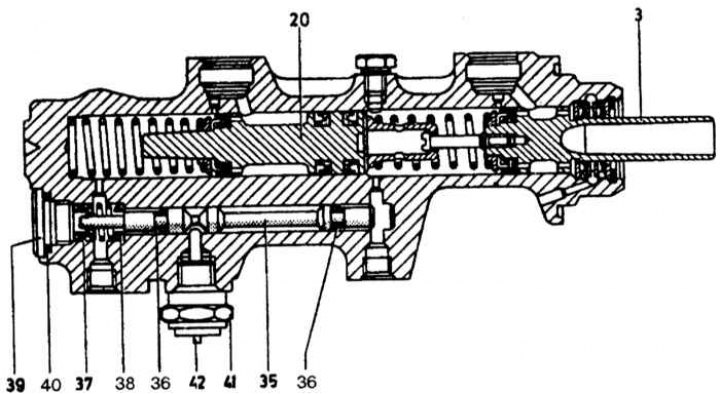
3 - piston (primary circuit); 20 - piston (secondary circuit); 35 - control piston; 36 - annular bushing; 37 - spring; 38 - spring holder; 39 - screw; 40 - sealing ring; 41 - sensor; 42 - shut-off rod
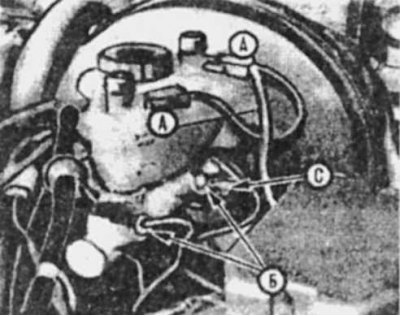
Electrical (A) and hydraulic (B) connections of the brake master cylinder and fastening nut (C)
1. Prepare the work area to prevent brake fluid from getting on the paintwork surfaces.
2. Disconnect and immediately close with a plug (with sticky tape) hydraulic line from the master cylinder.
3. Disconnect the wire from the differential pressure sensor.
4. Disconnect the hydraulic hose of the clutch drive mechanism from the reservoir (for cars with manual transmission).
5. Unscrew the nuts and remove the master cylinder from the end of the vacuum booster.
6. Remove the sealing ring from the groove of the master cylinder flange.
7. Clean the outside surfaces of the master cylinder using denatured alcohol or brake cleaner.
8. Remove the brake fluid reservoir together with the sealing plug.
9. Drain the brake fluid from the reservoir into a clean container.
10. Slightly depress the main piston and unscrew the lock screw.
11. Remove the snap ring, piston, lock washers, intermediate ring, auxiliary and vacuum couplings; to remove, lightly tap on a wooden surface.
12. Remove the differential pressure sensor by unscrewing the end plug and lightly tapping the control piston.
13. Unscrew the brake fluid reservoir cap and remove the mesh filter.
14. Clean the parts and check for defects. Pay special attention to the surfaces of the pistons and cylinders; replace if necessary.
15. Install new seals onto the pistons by hand.
16. Lubricate the inside surfaces of the master cylinder and dip the master, slave and pilot pistons in clean brake fluid.
17. Using the assembly mandrel, insert the parts of the 1st and 2nd contours into the cylinder. When performing the operation manually, pay special attention to the entry of the seals; bending is not allowed.
18. Apply light pressure to the main piston rod, insert and tighten the lock screw with a new seal.
19. Insert the control piston in the same way, tighten the end plug with a new seal.
20. Clean the filter in fresh (clean) brake fluid, insert it into the reservoir and screw on the filler plug.
21. Press the sealing plugs into the master cylinder and install the reservoir on it, pressing it first on one plug, then turning it 180° and pressing on the other plug.
22. Connect the wire to the differential pressure indicator and low fluid level indicator.
23. Connect the hoses and tighten the connecting nuts.
See also Vacuum brake booster.