



Car suspension repair Mercedes E-Class (W124)

Technical characteristics of suspension and steering
Front suspension Type Independent with coil springs, telescopic shock absorbers and anti-roll bar Rear suspension Type Independent with coil springs, telescopic shock...
Front suspension Type Independent with coil springs, telescopic shock absorbers and anti-roll bar Rear suspension Type Independent with coil springs, telescopic shock...

General information about suspension and steering
Main parts of the front suspension 1 – lower arm; 2 – steering knuckle; 3 – steering lever; 4 – shock absorber; 5 – protective cover; 6 – upper shock absorber support; 7...
Main parts of the front suspension 1 – lower arm; 2 – steering knuckle; 3 – steering lever; 4 – shock absorber; 5 – protective cover; 6 – upper shock absorber support; 7...

Front Hub Bearing — Checking and Adjusting
Examination Using a dial indicator to measure front wheel bearing end play 1. Apply the parking brake, then raise the front of the vehicle and secure it on stands....
Examination Using a dial indicator to measure front wheel bearing end play 1. Apply the parking brake, then raise the front of the vehicle and secure it on stands....
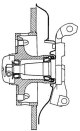
Front Wheel Hub — Removal and Installation
Attention! The front wheel hub bearing is pressed into the steering knuckle, so when removing it there is a high probability of damage and it may need to be replaced....
Attention! The front wheel hub bearing is pressed into the steering knuckle, so when removing it there is a high probability of damage and it may need to be replaced....

Steering knuckle — removal and installation
Removal Unscrewing the nut securing the ball joint of the steering rod end to the steering knuckle 1. Apply the parking brake, then raise the front of the vehicle and...
Removal Unscrewing the nut securing the ball joint of the steering rod end to the steering knuckle 1. Apply the parking brake, then raise the front of the vehicle and...
Front suspension shock absorber — removal and installation
Removal 1. Apply the parking brake, then raise the front of the vehicle and secure it on stands. Remove the affected front wheel. 2. Place a jack with a wooden block...
Removal 1. Apply the parking brake, then raise the front of the vehicle and secure it on stands. Remove the affected front wheel. 2. Place a jack with a wooden block...
Front suspension spring — removal and installation
Removal Warning! When removing the front suspension spring, you must use a special tool that can compress and hold the front suspension spring in a compressed state...
Removal Warning! When removing the front suspension spring, you must use a special tool that can compress and hold the front suspension spring in a compressed state...

Lower control arm front suspension — removal and installation
Removal Unscrewing the nuts from the pivot bolts of the lower arm of the front suspension 1. Apply the handbrake, then raise the front of the car and secure it on...
Removal Unscrewing the nuts from the pivot bolts of the lower arm of the front suspension 1. Apply the handbrake, then raise the front of the car and secure it on...

Front anti-roll bar
Caution! When installing the anti-roll bar, it is necessary to use new anti-roll bar clamp mounting nuts. Removal Unscrewing the nut that secures the clamp, which in...
Caution! When installing the anti-roll bar, it is necessary to use new anti-roll bar clamp mounting nuts. Removal Unscrewing the nut that secures the clamp, which in...
Rear Hub Fastener — Removal and Installation
Attention! When installing the rear hub fastener, you must use a new external hinge bolt and ball joint nut of the control lever and lower lever, and a new nut for...
Attention! When installing the rear hub fastener, you must use a new external hinge bolt and ball joint nut of the control lever and lower lever, and a new nut for...
Replacing the rear hub bearing
Caution! To remove the rear hub bearing, use a hydraulic press and tubular mandrels of the appropriate diameter. If you don't have a press, you can use a large bench...
Caution! To remove the rear hub bearing, use a hydraulic press and tubular mandrels of the appropriate diameter. If you don't have a press, you can use a large bench...
Rear shock absorber — removal and installation
Removal 1. Raise the rear of the vehicle and secure it on stands. Remove the corresponding rear wheel. 2. Unscrew the screws and remove the protective cover from the...
Removal 1. Raise the rear of the vehicle and secure it on stands. Remove the corresponding rear wheel. 2. Unscrew the screws and remove the protective cover from the...

Shock absorber (models without self-leveling rear suspension)
Removal Location of the screws for fastening the protective cover of the lower arm of the rear suspension Removal the protective cover from the base of the lower arm of...
Removal Location of the screws for fastening the protective cover of the lower arm of the rear suspension Removal the protective cover from the base of the lower arm of...
Rear suspension spring — removal and installation
Caution! When removing the rear suspension spring, it is necessary to use a special tool to compress the spring and hold it in this position while removing the spring....
Caution! When removing the rear suspension spring, it is necessary to use a special tool to compress the spring and hold it in this position while removing the spring....

Rear suspension arms — removal and installation
1. If you need to remove several rear suspension arms at the same time, use a jack to support the lower rear suspension arm using a wooden block. 2. Raise the rear of...
1. If you need to remove several rear suspension arms at the same time, use a jack to support the lower rear suspension arm using a wooden block. 2. Raise the rear of...

Lower arm rear suspension — removal and installation
Removal Unscrewing the nut securing the stabilizer bar link to the rear suspension lower arm 1. Raise the rear of the vehicle and secure it on stands. Remove the...
Removal Unscrewing the nut securing the stabilizer bar link to the rear suspension lower arm 1. Raise the rear of the vehicle and secure it on stands. Remove the...

Rear suspension anti-roll bar
Removal Location of the stabilizer bar mounting clamp mounting bolts 1. Raise the rear of the vehicle and support it on stands. 2. Unscrew the nuts securing the...
Removal Location of the stabilizer bar mounting clamp mounting bolts 1. Raise the rear of the vehicle and support it on stands. 2. Unscrew the nuts securing the...
Stabilizer bar connecting link
Attention! When installing, it is necessary to use new nuts for fastening the connecting earring of the rear suspension anti-roll bar. Removal 1. Raise the rear of the...
Attention! When installing, it is necessary to use new nuts for fastening the connecting earring of the rear suspension anti-roll bar. Removal 1. Raise the rear of the...

Self-leveling rear suspension system on Estate models
Self-leveling rear suspension components 1 – hydraulic pump; 2 – reservoir; 3 – control unit; 4 – pressure accumulator; 5 – shock absorbers On the station wagon models...
Self-leveling rear suspension components 1 – hydraulic pump; 2 – reservoir; 3 – control unit; 4 – pressure accumulator; 5 – shock absorbers On the station wagon models...

Self-leveling rear suspension components
Relieving pressure 1. Before disconnecting any hoses, the pressure in the self-leveling rear suspension hydraulic system must be relieved. 2. Raise the rear of the...
Relieving pressure 1. Before disconnecting any hoses, the pressure in the self-leveling rear suspension hydraulic system must be relieved. 2. Raise the rear of the...
This section is available on: russian, bulgarian, belarusian, ukrainian, serbian, croatian, romanian, polish, slovak, hungarian
More similar sections for repairing other models
☛ Chassis: Suspension car Mercedes W168 (1997-2004)
☛ Chassis: Suspension, wheels and tires car Mercedes W202 (1993-2000)
☛ Chassis: Car suspension car Mercedes Sprinter (1995-2000, diesel)
Link in different formats to this section
TEXTHTMLBB Code
- General information
- Vehicle description
- Working conditions and tools
- Car care
- Diesel engines
- Engine repair
- Lubrication system
- Cooling system
- Injection system
- Supply system
- Exhaust system
- Gasoline engines
- Engine repair
- Lubrication system
- Cooling system
- Control system
- Power and exhaust system
- Transmission
- Clutch
- Mechanical gearbox
- Automatic gearbox
- Drive shafts
- Chassis
- Car suspension
- Steering
- Tires and wheels
- Brake system
- Body
- Exterior (external elements)
- Interior (internal elements)
- Doors and windows
- Heating and ventilation
- Electrical equipment
- Equipment and devices
- Power devices
- Lighting and signaling
- Electrical circuits
- General information
- Governing bodies
- Driving and operation
- Weekly care
- Maintenance (gasoline)
- Maintenance (diesel)
- Troubleshooting
- Power unit
- I4 petrol engine
- V6 petrol engine (SOHC)
- V6 petrol engine (DOHC)
- Diesel engines
- Engine overhaul
- Cooling system
- Heating and ventilation
- Fuel system (carburetor)
- Injection system «Bosch CIS-E»
- Injection system «Bosch HFM»
- Diesel fuel system
- Supply system
- Starting and charging system
- Ignition system (I4)
- Ignition system (V6)
- Preheating
- Transmission
- Clutch
- Mechanical gearbox
- Automatic gearbox
- Drive shafts
- Chassis
- Brake system
- Car suspension
- Steering
- Body
- Exterior (external elements)
- Interior (internal elements)
- Doors, locks and windows
- Electrical equipment
- Equipment and devices
- Switches
- Headlights and lighting
- Electrical circuits
- General information
- Introduction to the guide
- Power unit
- Engine device
- Repair M102 engines
- Repair M110 and M123 engines
- Cooling and lubrication (M102)
- Cooling (M110 and M123)
- Ignition system
- Power system «Stromberg»
- Power system «Solex 4A1»
- Fuel injection «K-Jetronic»
- Fuel injection «L-Jetronic»
- Transmission
- Clutch
- Mechanical gearbox
- Automatic gearbox
- Cardan and rear axle
- Chassis
- Front suspension
- Rear suspension
- Steering
- Brake system
- Body
- Exterior (external elements)
- Interior (internal elements)
- Doors, locks and windows
- Electrical equipment
- Equipment and devices
- Power devices
- Electrical circuits