



Main parts of the front suspension
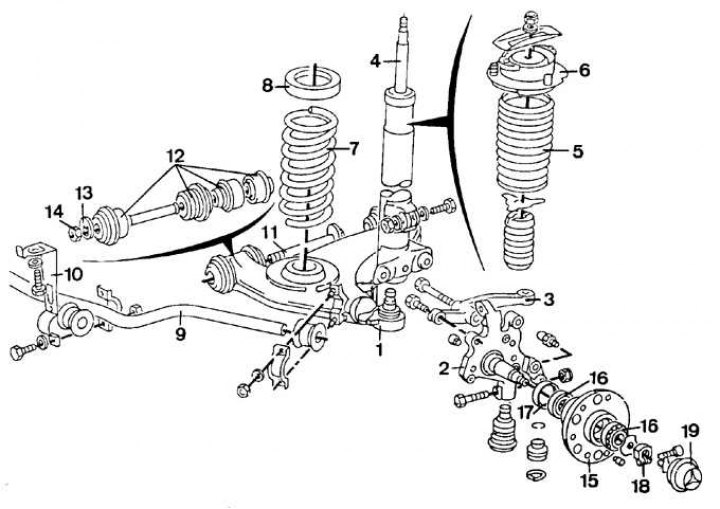
1 – lower arm; 2 – steering knuckle; 3 – steering lever; 4 – shock absorber; 5 – protective cover; 6 – upper shock absorber support; 7 – coiled, cylindrical spring; 8 – support cup; 9 – anti-roll bar; 10 – stabilizer mount; 11 – lower arm pivot bolt; 12 – rubber-metal bushings; 13 – eccentric washer; 14 – nut; 15 – hub; 16 – bearing; 17 – sealing ring; 18 – nut; 19 – protective cap
Rear suspension elements
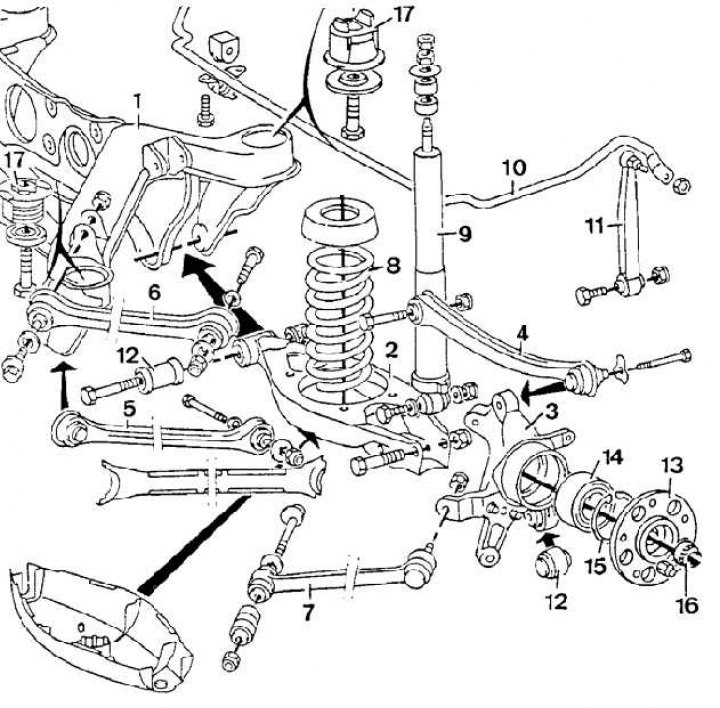
1 – rear beam; 2 – lower arm of the rear suspension; 3 – hub fastening element; 4 – upper arm; 5 – longitudinal reaction lever; 6 – Upper reaction lever; 7 – lower reaction arm; 8 – spring; 9 – shock absorber; 10 – anti-roll bar; 11 – stabilizer earring; 12 – metal-rubber bushing; 13 – hub; 14 – bearing; 15 – retaining ring; 16 – nut; 17 – metal-rubber support of the rear beam
Front suspension section
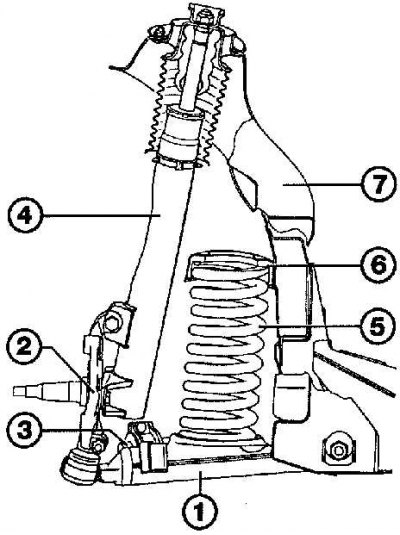
1 – lower arm; 2 – steering knuckle; 3 – anti-roll bar; 4 – shock absorber; 5 – coiled, cylindrical spring; 6 – spring support plate; 7 – body element
Later model rear suspension parts (early models are similar)
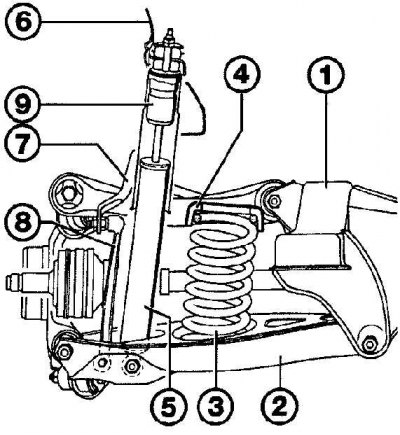
1 – lower frame; 2 – lower arm; 3 – coiled, cylindrical spring; 4 – spring support plate; 5 – shock absorber; 6 – body element; 7 – anti-roll bar; 8 – connecting earring; 9 – shock absorber stop
Front suspension
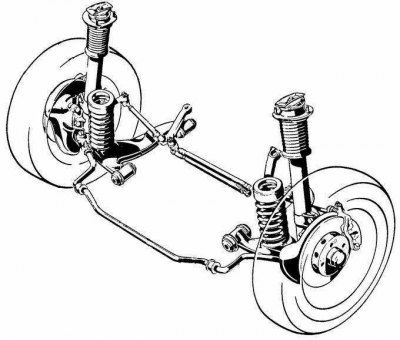
The front suspension is independent with coil springs and telescopic shock absorbers. The shock absorbers are attached to the lower arms of the front suspension via the steering knuckle, which in turn is attached on the inside via rubber bushings and on the outside via a ball joint. The steering knuckles, on which the hubs, brake discs and calipers are mounted, are bolted to the shock absorbers and connected to the lower arms of the front suspension via ball joints. Most models are equipped with a front anti-roll bar, which is connected to the lower arms via earrings.
The independent rear suspension also has coil springs and telescopic shock absorbers.
Text republished from the website: MercedesMan.ru
The hub mount is attached to the lower control arm and is connected to the rear lower frame via three links. Coil springs are installed between the body panels and the rear lower control arm. Most models have a rear anti-roll bar that is connected to the lower control arms via tie rods. The station wagon has a self-adjusting rear suspension.
The connection of the steering column to the steering gear is carried out by an intermediate shaft and a rubber coupling.
The steering gear is fixed to the engine compartment bulkhead and is connected directly to one of the steering knuckles via a transverse steering rod. The steering rod is connected to the second steering knuckle via the central and transverse steering rods. The transverse steering rods are screwed with steering rod ends with a ball joint, which provide for toe-in adjustment.
Power steering is installed on all vehicles. The power steering pump is driven from the crankshaft pulley by an auxiliary drive belt.