
Cars BMW Cars Volkswagen Cars Chevrolet Cars Land Rover Cars Lada Cars Honda Cars Peugeot
English Русский
Български
Беларускі
Український
Српски
Hrvatski
Română
Polski
Slovenský
Magyar
Bookmark News and articles Sitemap Feedback Site search
MercedesMan.ru


A-Class C-Class E-Class G-Class M-Class S-Class Others
W116 (1972-1980, petrol) W126 (1979-1991, petrol) W140 (1991-1998) W220 (1998-2005)
  • Main
  • S-Class
  • W140 (1991-1998)
  • User manual
  • Maintenance
  • Checking the condition of suspension and steering components

Checking the condition of suspension and steering components (Mercedes-Benz S-Class W140)

0
Contents: Checking the shock absorber strut ↡ Checking the condition of the…↡ Checking the steering play ↡ Checking tie rod ends, ball joints…↡
Note: Steering and suspension components should be inspected regularly. Worn or damaged steering and suspension components can cause excessive and dangerous tire wear, poor ride and handling characteristics, and increased fuel consumption. For more information on steering and suspension components, refer to Chapter Suspension and steering.


Checking the shock absorber strut


1. Jack up the vehicle and securely place it on supports.

2. Inspect the suspension shock absorbers for signs of developing leaks.

3. Check the reliability of the installation and the integrity of the struts. Check the upper supports of the struts for damage and signs of wear. If any are found, replace the struts.

Checking the condition of the steering and suspension system


1. Inspect the steering system components for damage and deformation. Look for signs of fluid leakage, damaged gaskets, boots and fittings.

2. Clean the lower end of the steering knuckle. Have an assistant grab the lower edge of the wheel and rock it while you watch the ball joints that connect the steering knuckle to the control arm move. Inspect the ball joint boots for tears. If you find play or torn or leaking boots, the ball joint(s) should be replaced.

3. Grasp each front wheel at the front and rear edges and try to turn it with the front edge in and the rear edge out to check for play in the steering gear. If play is found, check for loose steering gear mounts and tie rod joints. If loose, tighten them. If the tie rods are loose, the tie rod joints may be worn out (first check the tightness of the nuts). Additional information on the steering system and suspension can be found in Chapter Suspension and steering.


(Publication taken from an online resource: MercedesMan)

Checking the steering play


1. Set the steering wheel to the center position.

2. Move the steering wheel from side to side while watching the front wheels. The steering wheel can have a maximum play of 25 mm.

3. If there is more play in the steering wheel, check the steering rods, steering gear and play in the front suspension bearings.

4. Move the steering rods vigorously by hand. The ball joints should not have any play, otherwise replace the joints or steering rods.

Checking tie rod ends, ball joints and steering gear boots


1. Shine a light on the lower ball joint boots on the left and right and check for damage.
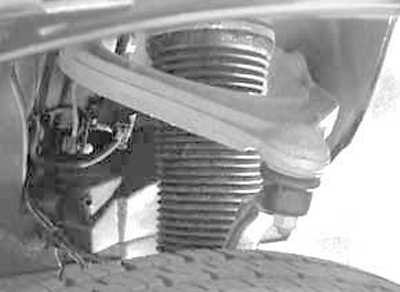
1. Shine a light on the lower ball joint boots on the left and right and check for damage.


2. Shine a light on the left and right tie rod end boot and check for damage.

2. Shine a light on the left and right tie rod end boot and check for damage.
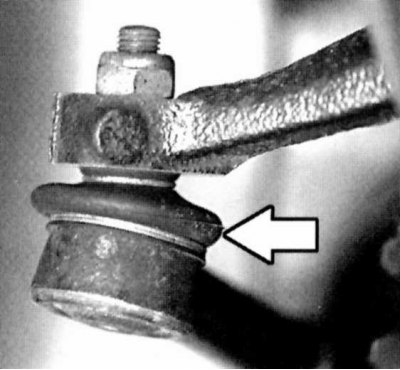

3. If there is damage to the dust boots, for safety reasons, the corresponding joint with the dust boot should be replaced. Contamination destroys the joint.


4. Move the steering rods vigorously in different directions by hand. The joint should not have any play. Otherwise, the steering rod end must be replaced.

5. Check the tightness of the locknuts of the steering rod ends and the nut of the hinge pin without turning it. The tightening torque is given in Specifications. 6. Check the protective covers on the steering gear, replace with new ones if necessary.
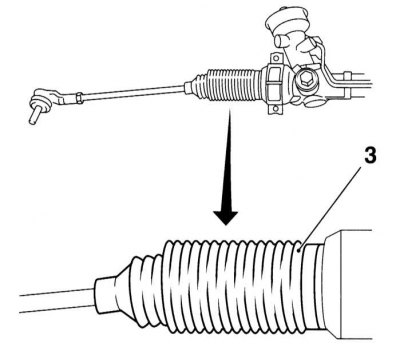
5. Check the tightness of the locknuts of the steering rod ends and the nut of the hinge pin…
This article is available at: russian, bulgarian, belarusian, ukrainian, serbian, croatian, romanian, polish, slovak, hungarian
The article has been verified: Polyakov Zakhar Grigorievich
Share with friends:
◀ Previous
S-Class W140 / Maintenance
Next ▶

Visual inspection of automatic transmission for leaks
Checking ATF level, replacing AT filter
Checking the condition of the exhaust system
Checking the functioning of the cooling system and frost resistance of the coolant, replacing the liquid
Checking the condition of the ribbed belts of the serpentine drive of auxiliary units
Checking the condition of the protective covers of the drive shafts
Checking the air conditioning system
Lubrication of door stops and lock cylinders
Visual inspection of the seat belt and airbag unit
Checking the functionality of headlights and horn
More similar articles for repairing other models

☛ V-belt — checking condition Mercedes W168 (1997-2004)
☛ Checking the condition of suspension and steering components Mercedes W203 (2000-2007)
☛ Technical characteristics of suspension and steering Mercedes W124 (1984-1995)
☛ Checking the condition of suspension and steering components Mercedes W463 (1999-2019)
☛ Checking the condition of suspension and steering components Mercedes W163 (1997-2005)
☛ Checking the Power Steering Fluid Level Mercedes Sprinter (1995-2000, diesel)
Link in different formats to this article
Comments and feedback from visitors
No comments yet


How much will 16 + 40 ?


W220 (1998-2005) 
  • General information
  • Introduction to guide
  • User manual
  • Maintenance
  • Power unit
  • Engine repair
  • Cooling and heating systems
  • Power and exhaust systems
  • Ignition and control system
  • Charge and launch systems
  • Transmission
  • Automatic gearbox
  • Drive shafts
  • Chassis
  • Brake system
  • Front suspension
  • Rear suspension
  • Steering
  • Body
  • Body elements
  • Electrical equipment
  • Equipment and devices
  • Electrical circuits
W140 (1991-1998) 
  • User manual
  • Controls and instruments
  • Driving and operation
  • Maintenance
  • Power unit
  • Petrol engine V6
  • Petrol engine V8
  • Petrol engine V12
  • Diesel engine OM603
  • Diesel engine OM606
  • Cooling system
  • Power supply and injection system
  • Control system HFM-SFI
  • Control system LH-SFI
  • Control systems ME-SFI
  • Diesel control system
  • Ignition system
  • Charge and launch system
  • Transmission
  • Mechanical gearbox 717.438
  • Mechanical gearbox 717.454
  • Automatic gearbox 722.5
  • Automatic gearbox 722.6
  • Clutch and drive shafts
  • Differential
  • Chassis
  • Brake system
  • Steering
  • Front suspension
  • Rear suspension
  • Body
  • Exterior (external elements)
  • Interior (internal elements)
  • Electrical equipment
  • Equipment and devices
  • Electrical circuits
W126 (1979-1991, petrol) 
  • Power unit
  • Engine repair
  • Ignition system
  • Lubrication system
  • Cooling system
  • Fuel system
  • Fuel injection system
  • Transmission
  • Clutch and cardan
  • Mechanical gearbox
  • Automatic gearbox
  • Chassis
  • Front suspension
  • Rear suspension
  • Steering
  • Brake system
  • Electrical equipment
  • Power devices
  • Electrical circuits
W116 (1972-1980, petrol) 
  • General information
  • Introduction to guide
  • Power unit
  • 8-cylinder V8 engine
  • 6-cylinder I6 engine
  • Cooling and lubrication system
  • Power system (carburetor)
  • Fuel injection system
  • Ignition system
  • Transmission
  • Clutch and cardan
  • Car gearbox
  • Chassis
  • Front suspension
  • Rear suspension
  • Steering
  • Brake system
  • Electrical equipment
  • Power devices
  • Electrical circuits
 
MercedesMan.ru © 2017–2026 · Mobile version · Read about Mercedes · Sitemap: EN BG BY UA RS HR RO PL SK HU · Feedback · Site search · Bookmark A-Class (W168) · C-Class (W201) · C-Class (W202) · C-Class (W203) · E-Class (W123) · E-Class (W124) · E-Class (W210) · G-Class (W463) · M-Class (W163) · S-Class (W116, petrol) · S-Class (W126, petrol) · S-Class (W140) · S-Class (W220) · Sprinter · Vito 1 · Vito 2 · Vario 814D ·
 
We only use cookies without which some of the site's features may not be available.