



Contents: Checking the shock absorber strut ↡ Checking the condition of the…↡ Checking the steering play ↡ Checking tie rod ends, ball joints…↡
Note: Steering and suspension components should be inspected regularly. Worn or damaged steering and suspension components can cause excessive and dangerous tire wear, poor ride and handling characteristics, and increased fuel consumption. For more information on steering and suspension components, refer to Chapter Brake system.
Checking the shock absorber strut
1. Jack up the car and securely place it on supports.
2. Inspect the shock absorbers for signs of damage and gas leaks.
3. Check the reliability of the installation and the integrity of the struts. Check the upper supports of the struts for damage and signs of wear. If any are found, replace the struts.
Checking the condition of the steering and suspension system
1. Inspect the steering system components for damage and deformation. Look for signs of fluid leakage, damaged gaskets, boots and fittings.
2. Clean the lower end of the steering knuckle. Have an assistant grab the lower edge of the wheel and rock it while you watch the ball joints that connect the steering knuckle to the control arm move. Inspect the ball joint boots for tears. If you find play or torn or leaking boots, the ball joint(s) should be replaced.
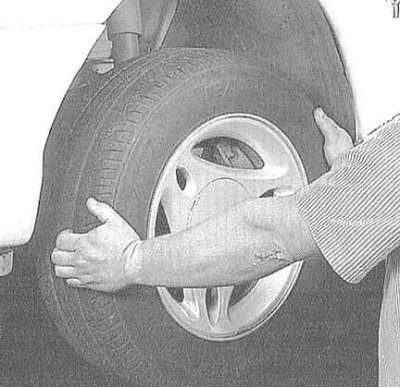
3. Grasp each front wheel at the front and rear edges and try to turn it with the front edge in and the rear edge out to check for play in the steering gear. If play is found, check for loose steering gear mounts and tie rod joints. If loose, tighten them. If the tie rods are loose, the tie rod joints may be worn out (first check the reliability of tightening the nuts). Additional information on the steering system and suspension can be found in Chapter Brake system.
Checking the steering play
1. Set the steering wheel to the center position.
2. Move the steering wheel from side to side while watching the front wheels. The steering wheel can have a maximum play of 15 mm.
3. If there is more play in the steering wheel, check the steering rods, steering gear and play in the front suspension bearings.
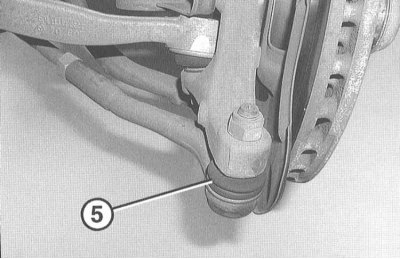
4. Move the steering rods (4) on the left and right by hand vigorously. The ball joint (5) should not have any play, otherwise replace the joints or steering rods.
[Article was borrowed from the website: MERCEDESMAN.ru]
5. Shine a light on the dust caps (5) and check for damage. Pay attention to traces of grease.
6. If there is damage to the cap, replace the corresponding joint together with the cap as a precaution. Penetrating dirt destroys the joint.
Checking tie rod ends, ball joints and steering gear boots
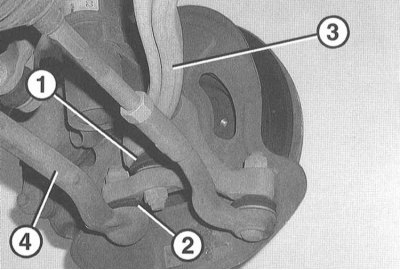
1. Shine a light on the left and right ball joint boots and check for damage.
2. Shine a light on the left and right tie rod end boot and check for damage.
3. If there is damage to the dust boots, for safety reasons, the corresponding joint with the dust boot should be replaced. Contamination destroys the joint.
4. Move the steering rods vigorously in different directions by hand. The joint should not have any play. Otherwise, the steering rod end must be replaced.
5. Check the reliability of tightening the locknuts of the steering rod ends and the nut of the hinge pin without turning it. The tightening torque is given in Specifications.
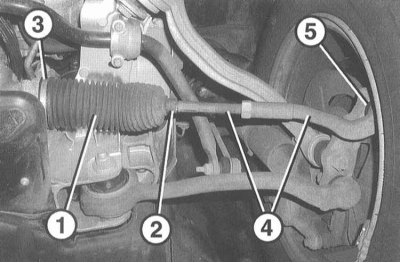
6. Check the protective covers on the steering gear and replace them with new ones if necessary.
7. Check the reliability of the fastening of the outer (2) and inner (3) clamping rings.