



Checking the serpentine belt of auxiliary units
Serpentine belt routing diagrams for auxiliary units
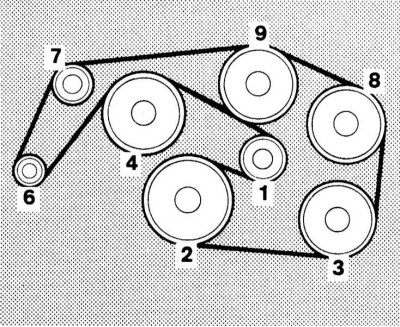
Serpentine Belt Routing Diagram for Auxiliary Drive on S280 and S320 Models
1 - Tension roller with tensioner; 2 - Crankshaft; 3 - Air conditioning compressor; 4 - Fan; 5 - Air pump; 6 - Generator; 7 - Guide roller; 8 - Power steering pump; 9 - Water pump; 10 - Air pump
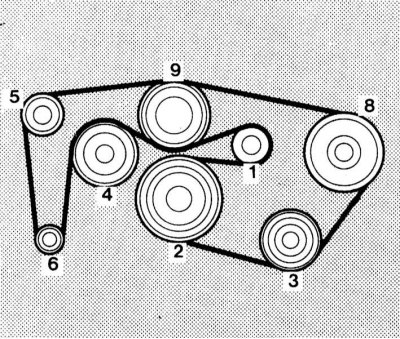
Serpentine belt routing diagram for auxiliary units on S420 and S500 models
1 - Tension roller with tensioner; 2 - Crankshaft; 3 - Air conditioning compressor; 4 - Fan; 5 - Air pump; 6 - Generator; 7 - Guide roller; 8 - Power steering pump; 9 - Water pump; 10 - Air pump
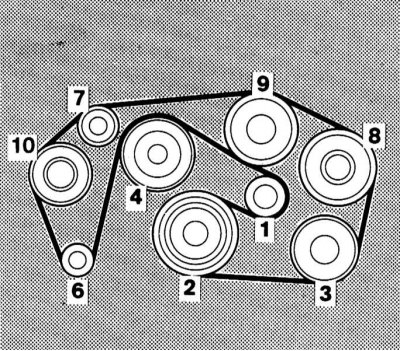
S600 Model Serpentine Belt Routing Diagram for Auxiliary Drive
1 - Tension roller with tensioner; 2 - Crankshaft; 3 - Air conditioning compressor; 4 - Fan; 5 - Air pump; 6 - Generator; 7 - Guide roller; 8 - Power steering pump; 9 - Water pump; 10 - Air pump
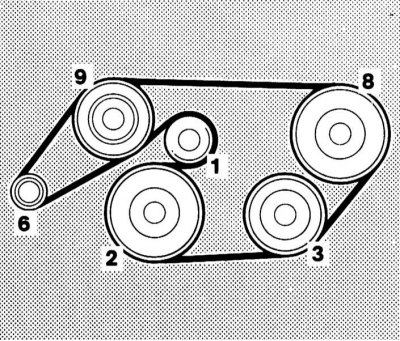
Serpentine Belt Routing Diagram for Accessory Drive on S300TDI Models
1 - Tension roller with tensioner; 2 - Crankshaft; 3 - Air conditioning compressor; 4 - Fan; 5 - Air pump; 6 - Generator; 7 - Guide roller; 8 - Power steering pump; 9 - Water pump; 10 - Air pump
With fingers (and using a flashlight if necessary) walk the entire length of the belt, feeling for cracks and delamination. Also check for abrasions and polished areas. The belt should be inspected from both sides, which means twisting it to check the condition of the reverse side. At the same time, check for rust, cracks and burrs on the pulleys. Shallow perpendicular cracks are allowed on the working surface of the belt. If these cracks do not extend beyond one rib and are not very deep, there is no need to replace the belt.
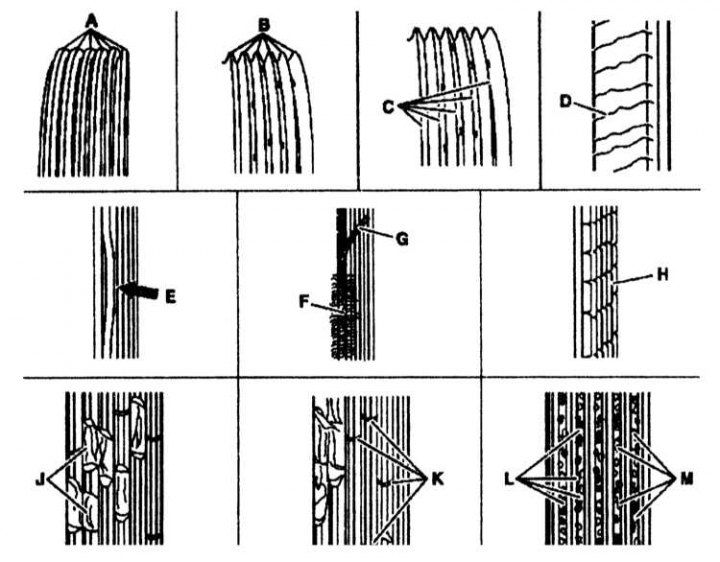
Checking the accessory drive belt
A - New belt; B - Wall wear - ribs are sharpened (on new belts they are trapezoidal); C - Cord exposure; D - Cracks on the back of the belt; E - Separation of rubber from the base; F - Outer cord wear; G - Side cord break; H - Cracks across the ribs; J - Rib injury; K - Cracks in individual ribs; L - Contamination or stones stuck between the ribs; M - Tearing rubber on the ribs
The ribbed belt tension is automatic. It is necessary to periodically check the condition of the belt, and if defects are found, replace the belt.
The belt tension is carried out by an automatic tensioner and does not require checking.
1. Turn off the engine, put the transmission in neutral. Raise and place the car on stands.
2. Mark the belt with chalk in a clearly visible place.
3. Using the head, turn the engine by the crankshaft pulley in the direction of rotation, i.e. to the right, so that the chalk marking is visible. In this case, inspect the belt section by section.
(Publication taken from an online resource: «www.mercedesman.ru»)
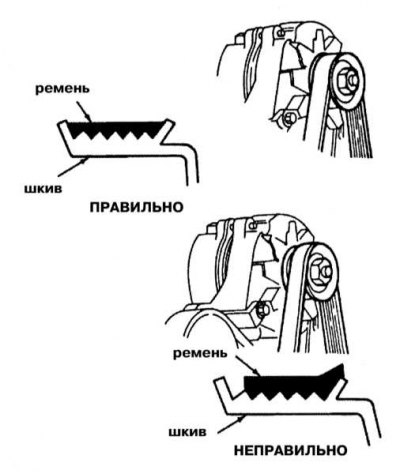
When installing the drive belt, place it correctly on the pulleys - it should be located strictly in the center of the pulley (even short-term operation of an incorrectly installed belt can lead to its damage)
Belt tension can be checked by pressing firmly with your thumb and determining the amount of deflection. Measure the amount of deflection with a ruler. If the distance between pulley centers is between 180 and 280 mm, the amount of deflection should be 6 mm. If the distance between pulley centers is between 300 and 400 mm, the deflection should be 13 mm.
If one or more of the above damages are present, the V-belt must be replaced with a new one.