



Warning: Gasoline is highly flammable, so special precautions must be taken when working with any fuel system components.
Do not smoke or approach the work area with an open flame or unprotected lampshade.
Do not perform such work in garages equipped with heating appliances that run on natural gas (such as water heaters, dryers, etc.). The work area must be well ventilated.
If gasoline comes into contact with your skin, wash it off immediately with soap and water.
When performing any work on the fuel system, wear safety glasses and keep a fire extinguisher handy. If gasoline spills, wipe up the puddle immediately, but do not keep gasoline-soaked rags in places where they can spontaneously ignite.
Examination
If you smell gasoline while driving or after the car has been standing in the sun, you must immediately check the condition of the entire fuel system.
1. Remove the fuel tank cap and check it for damage and corrosion. The sealing insert on the cap should be intact. If there is damage or corrosion, replace the cap.
2. Inspect the fuel system inlet and return lines for cracks. Make sure that the connections between the fuel system lines and the fuel injection system, and between the fuel system lines and the built-in fuel filter are not loose.
Caution: On vehicles equipped with a fuel injection system, the system pressure must be relieved before servicing the fuel hoses (see section Safety precautions and rules for maintaining cleanliness when working with the fuel system Chapters Power and exhaust systems).
3. Since some fuel system components - such as the fuel tank and some fuel system lines - are located underneath the vehicle, they are easier to inspect when the vehicle is jacked up. If this is not possible, jack up the vehicle and support it on jack stands.
4. With the vehicle raised, inspect the fuel tank and filler neck for holes, cracks, or other damage. Pay particular attention to the condition of the connection between the filler neck and the tank. Sometimes fuel leaks occur due to loose rubber neck clamps or damage to the neck material. Inspect all fuel tank mounting brackets and straps to ensure that the tank is securely fastened to the vehicle.
Warning! Never, under any circumstances, attempt to repair the fuel tank (excluding the replacement of its rubber components). A welding flame or any other open flame can easily cause gasoline vapors to explode inside the tank. 5. Carefully inspect all fuel hoses and metal lines leading from the tank for loose connections, twists, signs of wear on hose materials, and other damage. Repair or replace damaged sections as necessary.
Replacing the fuel filter
Petrol engines
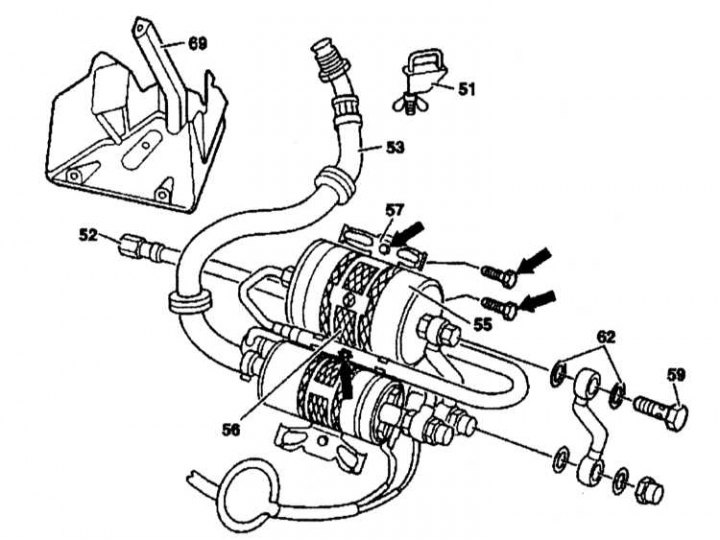
Replacing the fuel filter on gasoline engines
51 - Clamp; 52 - Delivery tube; 53 - Return pipe; 55 - Fuel filter; 56 - Foil tape; 57 - retainer; 58 - Bolt; 62 - Sealing rings; 69 - Lid
Original source of information: MercedesMan.ru
1. Open the fuel tank cap.
2. Disconnect the return (53) and pressure (52) tubes.
3. Disconnect the delivery pipe (52) from the fuel filter.
4. Install the new filter with foil tape (56).
5. Start the engine and check for fuel leaks.
Diesel engine OM 603
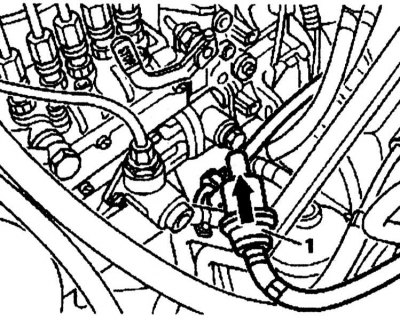
Remove the fuel pre-filter. Install it with the arrow pointing in the direction of fuel flow.
Diesel engine OM 606
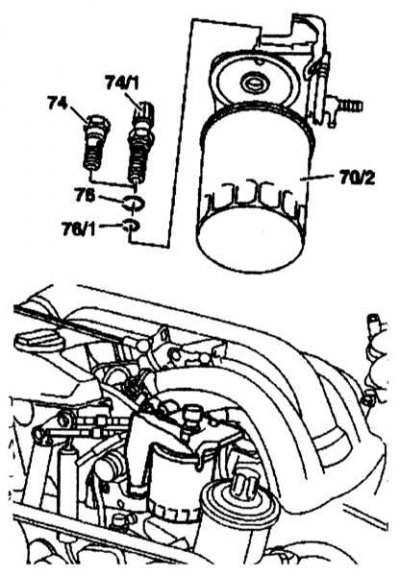
Replacing the fuel filter on a 606 diesel engine
70/2 — Fuel filter
74 — Full union bolt
74/1 - Shut-off valve
76, 76/1 — Sealing rings
On some models, a full-flow filter with a separator can be installed instead of a fuel filter, which is distinguished by the absence of a drain plug at the bottom of the filter.
Removal air from the fuel system of a diesel engine
If the engine has stopped due to the fuel tank being completely empty, then after refueling it is necessary to remove air from the fuel system. To do this, start the engine continuously for no more than 60 seconds until it starts to run steadily.