



Contents: System check ↡ Filter replacement ↡
Warning! Gasoline is highly flammable, so special precautions must be taken when working with any components of the fuel system! Do not smoke or approach the work area with an open flame or unprotected portable lamp. Do not carry out such work in garages equipped with heating devices that operate on natural gas (such as water heaters, dryers, etc.)! The work area must be well ventilated. If gasoline gets on your skin, wash it off immediately with soap and water. When doing any work on the fuel system, wear safety glasses and keep a fire extinguisher handy. If gasoline spills, wipe up the puddle immediately, but do not keep gasoline-soaked rags in places where there is a risk of ignition!
System check
1. If you smell gasoline while driving or after the car has been standing in the sun, you must immediately check the condition of the entire fuel system.
2. Remove the fuel tank cap and inspect it for damage and signs of corrosion. Assess the condition of the cap seal. Replace any defective components.
3. Inspect the fuel supply and return lines for cracks and deformations. Assess the reliability of tightening the union connections on the fuel distribution line and the built-in fuel filter.
Caution! Before servicing the fuel system components, remember to relieve the pressure in the fuel system (see Chapter Fuel and exhaust systems)!
4. In order to provide access to some components of the fuel system, such as the fuel tank and individual fuel lines located under the floor, the vehicle should first be raised above the ground (see the relevant Section in Introduction).
5. After raising the vehicle, inspect the fuel tank and its filler neck for holes, cracks and other damage. Pay special attention to the condition of the neck joint with the tank. Sometimes fuel leaks occur due to loosening of the neck fastening clamps, or due to aging of the rubber from which the neck is made. Carefully examine the condition of the fuel tank fastening elements, if necessary, make the appropriate corrections.
Warning! Do not attempt to repair the fuel tank yourself under any circumstances (excluding the replacement of its rubber components), - remember that contact of fuel vapors contained in the tank with the open flame of a gas burner will inevitably lead to ignition of the latter!
6. Carefully check the tightness of all fuel hose fittings and metal lines coming from the tank. Make sure there are no deformations or signs of aging of the flexible hose materials. Replace defective components.
Filter replacement
Petrol models
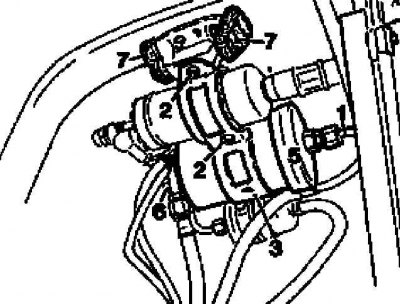
Fuel filter installation details for petrol models
1. Open the fuel tank cap to equalize the pressure in it with the atmospheric pressure.
2. Using a special clamp, clamp the fuel hoses.
3. Unscrew the hollow bolt of the union nut (6).
4. Loosen the mounting screws (2).
5. Remove the assembly from the rubber support cushions (7) and release the fuel filter (5) from the clamp (3).
6. Disconnect the fuel inlet line (1) from the old filter and, after replacing the sealing ring, connect it to the new filter.
7. When installing a new filter, ensure that the plastic sleeve protrudes from both sides of the clamp (3), otherwise the risk of galvanic corrosion increases.
Note: The arrow on the filter housing must point in the direction of fuel flow.
8. Further installation is carried out in the reverse order of dismantling the components.
9. Finally, start the engine and check the relevant fuel system components for signs of developing leaks, tightening the fasteners if necessary.
Diesel models - filter replacement, moisture and air removal
Full-flow fuel filter G270 CDI (M612)
Full-flow fuel filter installation details for diesel models equipped with the M612 engine (G270 CDI):
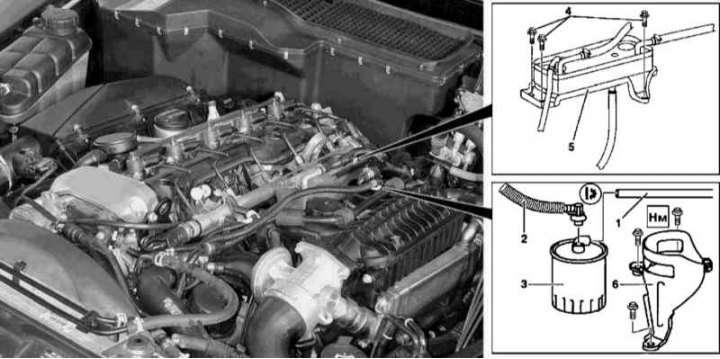
1. Remove the cylinder head trim panels.
2. Disconnect the inlet (1) and outlet (2) fuel lines from the fuel filter (3) - prepare replacement mounting clamps.
3. If the filter is to be removed together with the mounting clamp (6), loosen the bolts (4) and slightly lift the fuel cooler (5).
4. Loosen the clamping screw of the fastening clamp (6) and remove the fuel filter (70), or, if necessary, loosen the corresponding fastener and remove the filter assembly with the clamp.
5. Installation is carried out in the reverse order - before starting the engine, the filter must be filled with fuel and the low-pressure fuel line must be purged (see Section Removal air from the low pressure circuit of the fuel system).
6. Finally, start the engine and check the fuel system for signs of developing leaks. Make the appropriate corrections if necessary.
Full flow fuel filter G400 CDI (M628)
Full-flow fuel filter installation details for diesel models equipped with the M628 (G400 CDI) engine:
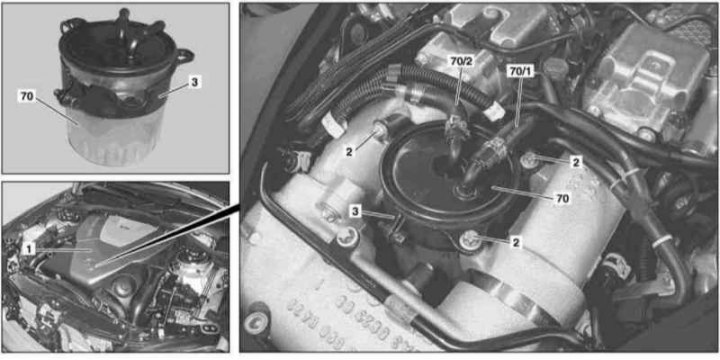
1. Open the hood and fix it in a vertical position.
2. Remove the air cleaner assembly (1) (see Chapter Fuel and exhaust systems).
3. Disconnect the inlet (70/1) and outlet (70/2) fuel lines from the fuel filter (70) - prepare replacement mounting clamps.
4. Loosen the clamping screw (3) and remove the fuel filter (70), or, if necessary, unscrew the bolts (2) and remove the filter assembly with the clamp.
5. Installation is carried out in reverse order.
6. Finally, start the engine and check the fuel system for signs of developing leaks. Make the appropriate corrections if necessary.
Pre-fuel filter with sump - removal of sediment and replacement of filter element
Attention! The replacement of the preliminary fuel filter must be carried out simultaneously with the replacement of the full-flow filter (see above)!
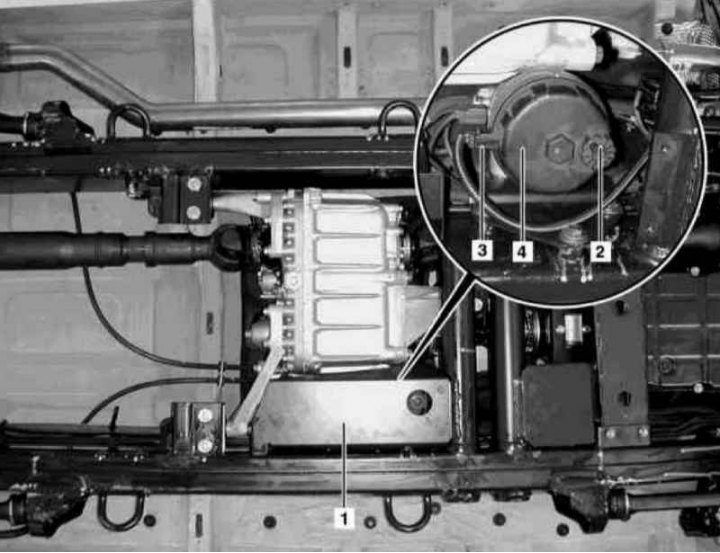
Pre-Fuel Filter Installation Details (diesel models)
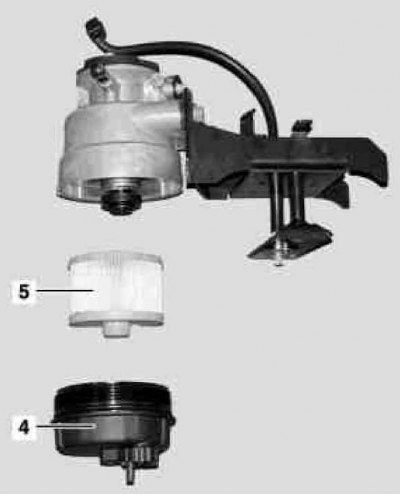
Fuel pre-filter design (diesel models)
1. Replace the full-flow fuel filter (see above).
2. Unscrew the mounting bolts and remove the protective screen (1).
3. Attach a hose with a diameter of approximately 8 mm to the drain valve (2).
4. Loosen the drain valve (2) and drain the water-fuel mixture into the prepared container.
5. Disconnect the connector (3).
6. Unscrew the cover (4) of the moisture separator - prepare a replacement sealing ring.
7. Remove the filter element (5) from the cover (4).
8. Installation is carried out in reverse order.
9. On models equipped with a 612 series engine, do not forget to purge the low-pressure fuel line at the end (see Chapter Fuel and exhaust systems).
Removal air
1. If the engine has stopped due to the fuel tank being completely empty, then after refueling it is necessary to remove air from the fuel system. To do this, start the engine continuously for no more than 60 seconds until it starts to run steadily.