



Contents: Checking the frost resistance of the…↡ Replacing the coolant ↡ Removal air locks ↡ Removal oil from the cooling and…↡
Note: Please also refer to the materials in the Section Checking the condition and replacing engine compartment hoses, localizing leaks.
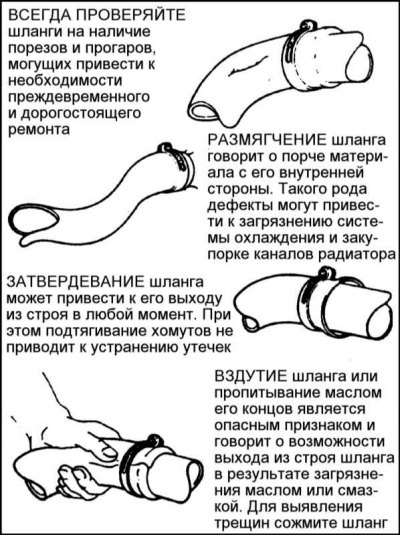
Hoses, as well as drive belts, have a tendency to fail at the most inopportune moment - to avoid troubles associated with a ruptured radiator or heater hose, carefully inspect them as shown in the illustration
1. Many serious engine malfunctions are related to cooling system failures. If the car is equipped with an automatic transmission, its operation and service life are also directly related to the operation of the cooling system.
2. The cooling system should be checked when the engine is cold, so it is best to do this before the first trip of the day or no earlier than three hours after turning off the engine.
3. Slowly, being careful in case the engine is still warm, remove the expansion tank cap. Rinse it thoroughly inside and out with clean water. Also rinse the filler neck of the tank. The presence of traces of corrosion in the filler neck means that the coolant should be replaced (see below). The coolant inside the expansion tank should be relatively clean and transparent. If it is brownish, drain the system and fill it with new coolant.
4. Carefully check the radiator hoses, as well as the heater hoses, which have a smaller diameter. Check the cooling system hoses along their entire length; if cracks, swellings, and signs of aging of the material are detected, replace them. Cracks are easier to detect by squeezing the hose. Pay special attention to the places where the fastening clamps are installed, which can cut or puncture the hoses, which will lead to the development of coolant leaks.
5. Make sure all hose connections are securely fastened. Coolant leaks usually show up as white or rusty deposits in the area of the leak. If your vehicle uses wire-type clamps, it makes sense to replace them with screw-type clamps.
6. Using compressed air or a soft brush, clean the front of the radiator (and also the air conditioner condenser, where available). Remove any insects, leaves or other foreign objects that may have fallen onto the radiator fins - be very careful not to damage the fins or cut your fingers on them.
7. If the coolant level is constantly dropping and you have not found any leaks, you should have the cooling system pressure tested at a Mercedes-Benz service station.
Checking the frost resistance of the coolant
Warning! Do not allow antifreeze to come into contact with your skin or painted surfaces of your vehicle. If it does come into contact with your skin, rinse immediately with plenty of water. Antifreeze is extremely toxic and can be fatal if ingested. Do not leave antifreeze in an open container or spilled on the floor; its sweet smell can easily attract children or pets. Check your local regulations for disposal of used antifreeze. Many areas have special collection centers.
1. Before the start of the winter season, it is necessary to check the concentration of antifreeze in the coolant, especially if clean water was poured into the system during operation - use a hydrometer with a calibration for frost resistance.
2. Warm up the engine slightly so that the upper radiator hose is warm. When measuring the concentration of antifreeze, the liquid temperature should be about +20°C.
3. Carefully unscrew the expansion tank cap.
Caution! When the engine is hot, open the expansion tank cap carefully. There is a risk of burns! Place a rag on the cap. Open the cap only when the liquid temperature is no more than +90°C.
4. Draw up the liquid using the hydrometer bulb.
5. In our latitudes, the concentration of antifreeze is sufficient to provide protection for the system down to a temperature of -25°C, and in particularly cold climates down to -35°C.
Replacing the coolant
1. Prepare a drain container of suitable volume.
2. Remove the expansion tank cap.
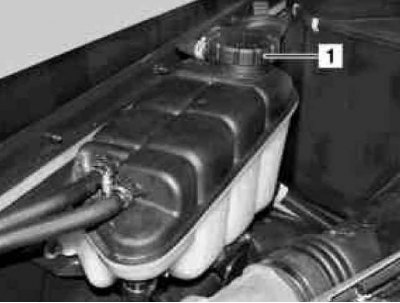
3. Open the heater control valve.
4. Remove the crankcase guard.
5. Drain the coolant one by one, first from the radiator (see accompanying illustrations a and b), then from the engine crankcase (see accompanying illustration).
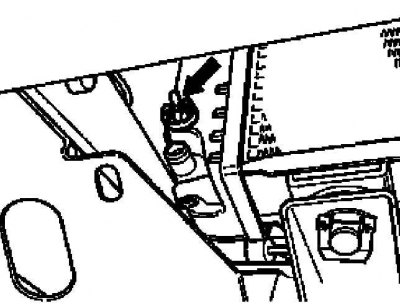
a - Location of the radiator drain valve, - pull a hose with an internal diameter of 12 mm onto the valve (petrol models)
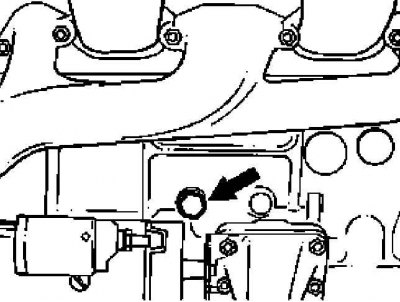
b — Location of the radiator drain valve, - pull a hose with an internal diameter of 12 mm onto the valve (diesel models)
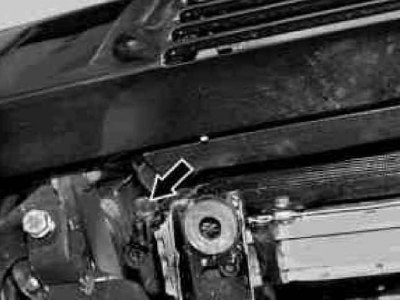
c — Location of the drain plug of the engine crankcase water jacket, - if necessary, use a hose with an internal diameter of 14 mm
6. Check the patency of open sections of the cooling tract channels; clean them if necessary.
7. Assess the condition of the drain plug sealing washers; replace any defective washers.
8. Pour the required amount of fresh coolant into the system through the neck of the expansion tank. When operating the car in conditions with temperatures down to -25°C, the concentration of antifreeze in the coolant should be about 40%. When the thermometer drops to -35°C, the concentration should be increased to 50% (see Specifications).
Note: If a higher degree of freeze protection is required, the antifreeze concentration can be increased to 60% (this concentration will provide freeze protection at temperatures down to -40°C). Further increases in the antifreeze content in the coolant lead to a decrease in its effectiveness both in heat dissipation and in protecting the engine from corrosion.
9. Start the engine and release air pockets from the cooling system (see below).
10. Attach a label to the expansion tank cap indicating the concentration, brand of antifreeze and the date of its replacement. Any subsequent replenishment of the system (before the scheduled replacement) should be carried out only with a liquid of the same composition, or with distilled water
Removal air locks
1. If the engine overheats after replacing the fluid, the cause is most likely the presence of air locks in the system. Locks usually appear as a result of haste when filling the system and do not disrupt the proper circulation of the coolant.
2. The presence of air locks in the rubber hoses of the cooling system is usually quite easy to detect by touch. After replacing the coolant, the air locks usually disappear when the engine is first started.
3. With the engine running and warmed up to normal operating temperature, turn on the heater and its fan - warm air should enter the passenger compartment in sufficient quantity. One of the reasons for insufficient air heating may be the presence of air locks in the cooling system tract.
4. The appearance of air locks in the cooling tract can sometimes lead to the most serious consequences, and not just to a decrease in the efficiency of the heater. A fairly large lock can prevent the circulation of liquid inside the engine's water jacket. To make sure there are no locks inside the engine, feel the upper radiator hose: it should be hot when the engine is running. Insufficient heating of the hose may indicate the presence of air locks in the jacket, as well as a possible malfunction of the thermostat.
Petrol models
1. If there are air pockets in the system after the first engine start after the coolant change procedure, turn off the engine and wait until it cools down completely, then remove the expansion tank cap and squeeze the coolant hoses. In the worst case, the cooling system will have to be completely drained and filled with fresh coolant (see above).
Diesel models
G270 CDI (M612)
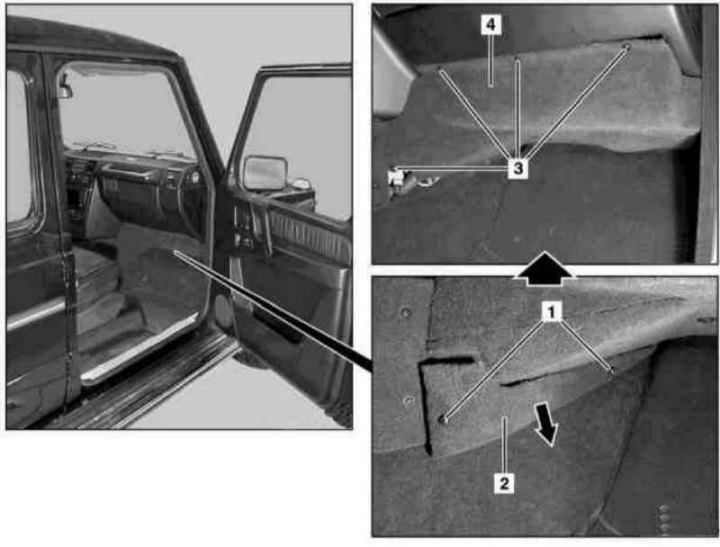
Preparing to remove air locks from the cooling system of a turbocharged engine (1 of 4)
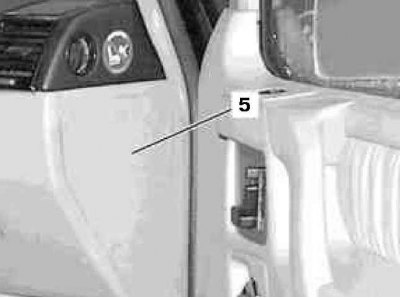
Preparing to remove air locks from the cooling system of a turbocharged engine (2 of 4)
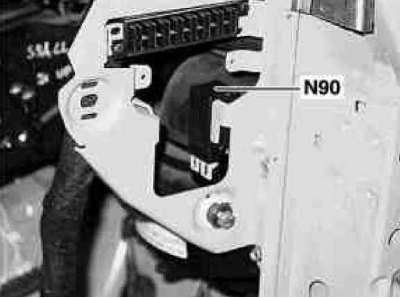
Preparing to remove air locks from the cooling system of a turbocharged engine (3 of 4)
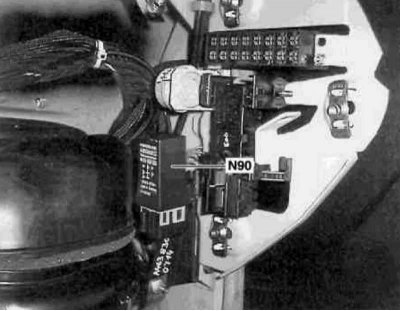
Preparing to remove air locks from the cooling system of a turbocharged engine (4 of 4)
N90 — Charge Air Cooler Control Module
1. Shift the AT selector lever to position "P" and turn off the ignition.
2. Unscrew the mounting bolts (1), pull down the cover (2) on the right under the instrument panel, unscrew the bolts (3) and remove the cover (4).
Note: On models equipped with the TELE AID emergency call system (code ET2), disconnect the electrical wiring from the corresponding speaker in the right front door.
3. Open the right front door and release the side cover (5) on the right side of the instrument panel from its clips to facilitate access to the charge air cooler control module (N90).
4. Remove module N90 and short-circuit terminals No.2 and No.5 of the contact block to close the power supply circuit of the circulation pump (M44).
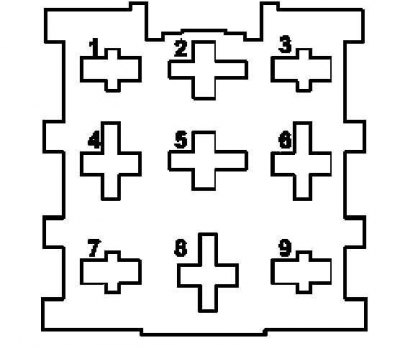
Attention! Be careful: the terminal numbers on the block and on the module connector do not match!
5. Open the expansion tank cap and turn on the ignition - activation of the circulation pump will remove the plugs from the cooling system tract.
6. After making sure that the air has been completely removed, turn off the ignition and reinstall the removed components.
G400 CDI (M628)
Attention! During the procedure, constantly monitor the fluid level in the expansion tank, if necessary, make the appropriate adjustments! When the coolant temperature reaches 60-70°C, the expansion tank cap should be closed.
1. On models equipped with a 628 series engine, air is removed from the cooling tract by activating the electric motor of the circulation pump (M44).
2. Connect and activate the STAR DIAGNOSIS reader (follow the instructions provided in the device manufacturers instructions).
3. Select the car model, indicating the engine type and steering drive.
4. Enter the main control module group and select the required driver.
5. Specify the type of power supply system (CDI-V1).
6. Select the activation mode, specifying the circulation pump electric motor (M44) as the target point.
7. To activate the pump, press the function key "F3" - the pump will function only when the key is pressed.
Attention! The key must be pressed physically, not virtually with the mouse!
Removal oil from the cooling and heating systems of diesel engines
Caution! Do not open the expansion tank cap until the coolant has warmed up to 90°C. Be careful when opening the cap - do not scald yourself!
Removal oil from the cooling/heating system of a diesel engine
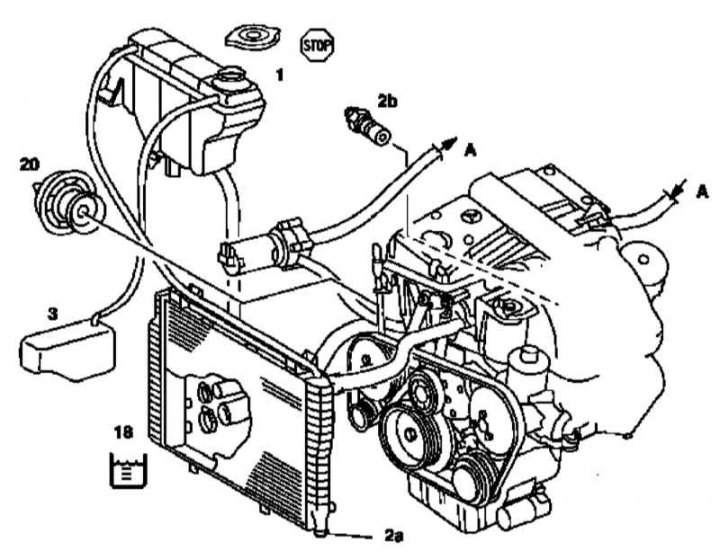
1 - Expansion tank; 2a - Radiator drain valve; 2b - Engine crankcase drain plug; 3 - Overflow tank (not used on the models under consideration); 1 - 8 Radiator; 20 - Thermostat; A - Heater supply and return flows
1. Remove the crankcase guard. Drain the cooling system (see above).
2. Remove the cooling system thermostat (see Chapter Cooling, heating, ventilation and air conditioning systems).
3. Using pliers, remove the locking plate (6), then pull it down and turn it at the same time to remove the working element (5) from the thermostat housing (4). The housing can then be used as a tool for removing oil from the cooling system.
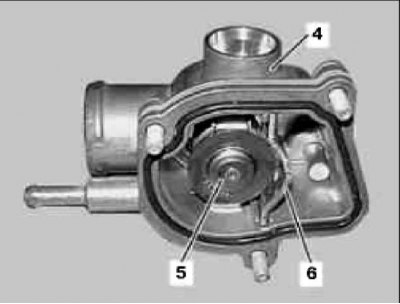
4. Turn on the heater to maximum output (see Section Comfort devices), if equipped accordingly, also activate the additional heater (see ibid).
5. Fill the cooling system with a special flushing solution (5% concentrate to 95% water).
6. Start the engine and warm it up at moderate speed to a temperature of about 80°C (it will take about 5 minutes).
7. Stop the engine and allow it to cool to approximately 50°C.
8. Drain the solution from the cooling system (see above).
9. Fill the cooling system with clean water, run the engine for 5 minutes, then turn it off again and drain the water.
(Information copied from the website: «www.mercedesman.ru»)
10. Fill the cooling system with fresh coolant, remove air from the cooling system (see above) and inspect the system components for signs of developing leaks.