



Contents: Disc designations ↡ Tyre designation ↡ Date of tire manufacture ↡ Tread depth ↡ Checking the air pressure in the…↡ Checking the condition of tire…↡ Examples of typical tire tread wear ↡ Wheel rotation ↡ Lightweight spare wheel ↡ Wheel replacement ↡ Wheel mounting bolts ↡
Depending on the model and equipment, different sizes of tires and wheels may be installed. Wheel bolts for steel and alloy wheels are the same size.
Note: When installing non-Mercedes-Benz alloy wheels, different bolt sizes may be required.
Note: If there is any discrepancy between the tire inflation pressure values specified in Specifications and on the nameplate attached to the inside of the fuel tank filler cap, the latter should be considered decisive.
For sporty driving, it is recommended to increase the pressure in the front and rear tyres by approximately 0.2 kgf/cm², based on the basic values for different load conditions.
Winter tires usually have an inflation pressure 0.2 kgf/cm² higher than summer tires - pay attention to the recommendations of winter tire manufacturers.
Remember that the use of winter tires usually imposes restrictions on speed limits.
Disc designations
Example 7S J x 16 H2 ET63
- 7Ѕ — Wheel width in inches
- J — Letter designation of the height and contour of the side flange of the disk rim
- x — Designation of a solid deep disc
- 16 — Disc diameter in inches
Permissible lateral runout on the side edge of the disc: 0.8 mm;
Permissible radial runout on the disk seat: 0.5 mm.
Tyre designation
Example: 205/70 R 16 112 H
- 195 — Tire width in mm
- /70 — Height to width ratio (the height of the tire cross-section is 70% of the width)
If separate information about the width to height ratio is missing (for example, 205 R 16), which means we are talking about a "normal" ratio, which is 82%.
- R — Radial design
- 16 — Disc size in inches
- 112 — Load capacity parameter
- N — Designation of the permissible maximum speed
The speed symbols apply to both summer and winter tires. The letter designations of the speed are given in Specifications.
Note: The additional designation M+S indicates that the tyre tread is winter grade.
Date of tire manufacture
The production date is indicated on the tire in the manufacturer's code
Example: DOT CUL2 UM8 019 TUBELESS
- DOT — Department of Transportation (US Department of Transportation)
- CU — abbreviation of the manufacturer's name
- L2 — tire size
- UM8 — tire design
- 4600 — date of manufacture - 46th working week of 2000
- TUBELESS — tubeless (TUBETYPE - tire with a tube)
Regularly checking your tires can help you avoid the hassle of being stopped on the road due to a flat tire. They can also provide valuable information about potential steering and suspension problems long before more serious symptoms occur.
Tread depth
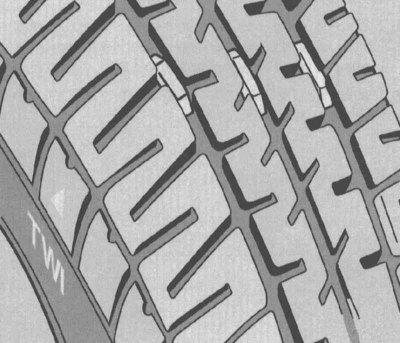
The tread wear indicators of the tyre up to a depth of 1.6 mm are located in places marked on the sidewall with the letters TWI
The tires are equipped with built-in tread wear indicator strips that are exposed when the tread depth decreases to 1.6 mm, after which the tires are considered worn. This value represents the minimum permissible tread depth; in most cases, it is recommended to replace tires with a tread depth of 2 mm or less. Tread depth can also be determined using a simple and inexpensive device known as a tread depth gauge.
Pay attention to any unusual tread wear. Tread defects such as cavities, bulges, flat spots and more severe wear on one side indicate a violation of the front wheel alignment angles and/or wheel balancing. If any of these defects are detected, contact a tire repair shop for correction.
Check the tire carefully for cuts, punctures, and stuck nails or tacks. Sometimes, after a tire has been punctured by a nail, it will hold its pressure for a while or deflate very slowly. If you suspect a "slow puncture," first check the valve nipple for leaks. Then inspect the tread for any foreign objects stuck in it or previously repaired punctures that have begun to leak air again. If you suspect a puncture, you can confirm its presence by wetting the suspected area with soapy water. If there is a leak, the solution will begin to bubble. If the puncture is not too large, the tire can usually be repaired at any tire shop.
Carefully inspect the inside sidewalls of the tires for signs of brake fluid leakage - if any, immediately check the condition of the corresponding brake mechanisms.
Checking the air pressure in the tires
Attention! Checking the air pressure should only be done on cold tires!
Note. The tire pressure values given for a light vehicle load are the minimum values that ensure comfortable driving. Increasing the tire inflation pressure as recommended with increasing load also has a positive effect on vehicle controllability and is also permitted for use with normal load, although it is associated with some disturbance of ride smoothness.
1. Maintaining the correct tire pressure increases their service life, helps save fuel and improves overall driving comfort. A special pressure gauge is required to check the pressure.
Note: Always keep an accurate pressure gauge in your glove compartment - pressure gauges built into air hose nozzles at petrol stations should not be trusted.
2. Always check the pressure when the tires are cold (i.e. before traveling by car). If you check the pressure on warm or heated tires, this will lead to overestimation of the pressure gauge readings due to thermal expansion of the tires. In this case, you should never lower the pressure, because after the tire cools down, it will be lower than normal.
3. Unscrew the protective cap from the inflation valve protruding from the wheel disk or from the hub cap, then press the pressure gauge nozzle firmly onto the valve. Read the readings of the device and compare them with the recommended values Specifications /on the plate attached to the back of the fuel filler flap. Remember to replace the protective cap to prevent dirt and moisture from entering the valve mechanism. Check the pressure in all four tires and inflate them to the recommended pressure if necessary.
4. Remember to maintain the required pressure in the spare tire.
5. Unscrew the valve cap.
6. Tire pressure is checked once a month and also during maintenance (including spare tire). When checking, use a special pressure gauge or a pressure gauge built into the compressor.
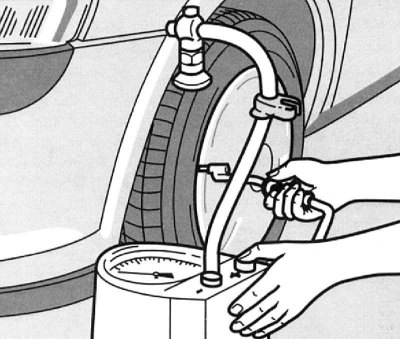
Note: Do not rely on the pressure gauges built into the compressor nozzles used to inflate tires at petrol stations.
7. In addition, air pressure should be checked before each long trip, since in this case the temperature load on the tires increases.
8. The required air pressure in the tires is indicated on the sticker located on the inside of the fuel tank cap.
Note: When using winter tires, the air pressure should be increased by 0.2 kgf/cm² relative to the set value.
9. The air pressure of the narrow spare tires is indicated on the sidewall of the rim. The air pressure in the tires changes depending on the change in the ambient air temperature by 10°C by approximately 0.1 kgf/cm². This should be taken into account when checking the air pressure in the tires indoors, especially in the cold season.
Example:
- Temperature in the garage: about + 20°C
- Outside air temperature: about 0°C
- Set tire pressure = prescribed value + 0.2 kgf/cm²
Checking the condition of tire inflation valves
Note: The valve extensions used must be checked for damage and contamination that could lead to leaks. If necessary, the extensions must be replaced.
Tire inflation valve
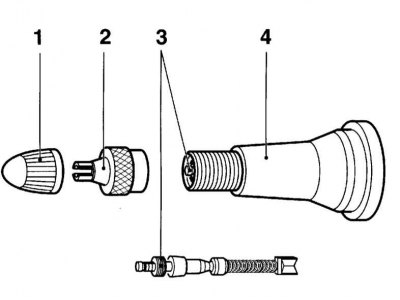
1 and 2 - Rubber/plastic and metal protective caps
3 — nipple
4 - valve body
1. Unscrew the protective cap and extension.
2. Apply a small amount of soapy water or saliva to the valve. If an air bubble forms, tighten the nipple using the lug on the metal protective cap.
3. Check the valve again. If bubbles appear and the valve cannot be tightened, it should be replaced - take the car to a tire shop.
4. Don't forget to screw the protective cap back into place.
Examples of typical tire tread wear
Lateral wear
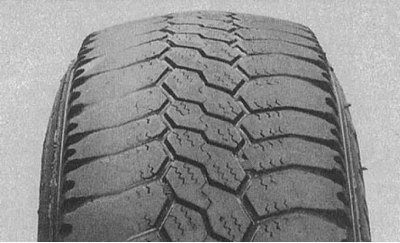
Underinflation causes the tire to overheat while driving due to excessive deflection, which means the tread is not pressed down sufficiently onto the road surface. This results in loss of traction and excessive tread wear, not to mention the risk of tire failure due to overheating.
- Check and adjust pressure;
- Incorrect wheel alignment (wear on one side) - repair or replace suspension parts;
- Too sharp turns - reduce speed!
Central wear
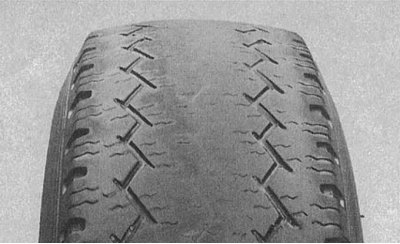
Overinflation of a tire results in accelerated wear of the center tread, reduced traction, harsher ride, and an increased risk of fatal tire damage.
- Check and adjust pressure.
- If you had to inflate your tires to the pressure specified for this purpose in order to transport heavy loads, Specifications pressure values, do not forget to release it after this when switching to normal operating mode.
Uneven wear
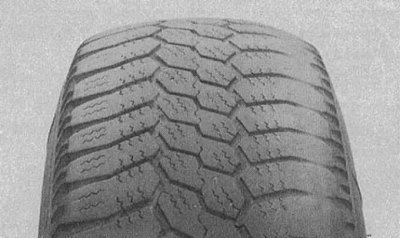
The tires of the front wheels may wear out unevenly as a result of incorrect adjustment of the wheel alignment angles. You can check and adjust the installation angles for a reasonable fee in most tire repair shops.
Incorrect camber or runout
Repair or replace suspension parts.
Suspension defect
Repair or replace suspension parts.
The wheels are out of balance
Balance the wheels.
Front wheel alignment is incorrectly set
Adjust the front wheel alignment angles.
Note: Frayed edges of the tread pattern, which is a sign of wear, are best detected by touch.
Wheel rotation
Note: Wheel rotation is only permitted when the front and rear wheel assemblies are the same size.
1. Rotate the wheels every 5-10 thousand kilometers depending on the degree of wear of the tires. Make sure to maintain the direction of rotation of the wheels (for directional tires).
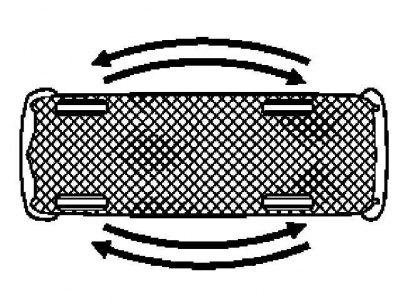
2. Rotation must be performed before the characteristic signs of tire wear appear: wear of the shoulder area (front wheels)/middle part of the tread (rear wheels).
3. Clean the inside of the wheel assemblies thoroughly at each rotation.
4. After completing the procedure, do not forget to check the tire inflation pressure (see above).
Caution: To avoid loosening of the wheels, tighten the wheel bolts strictly in accordance with the requirements Specifications, use only genuine wheel bolts with the Mercedes-Benz logo!
Lightweight spare wheel
On AMG models, if a tyre is damaged, a lightweight spare wheel is installed in place of the failed wheel assembly, which should be replaced with the standard one at the earliest opportunity - the compact spare wheel is designed for a maximum mileage of 20,000 km. The driving speed with the compact spare wheel installed should not exceed 80 km/h.
The use of more than one lightweight spare wheel at the same time is not permitted.
Wheel replacement
See Section Jacking/lifting a car and transporting it in case of an accident.
Wheel mounting bolts
1. Wheel bolts damaged mechanically or as a result of corrosion must be replaced.
2. Before screwing in, wheel bolts should not be lubricated with any compounds.
3. If the thread in the wheel hub is damaged, the vehicle should be immediately taken to a Mercedes-Benz service station to have the necessary repairs carried out.
4. Before installing the wheels, check the cleanliness of the mating surfaces of the discs and hubs.
5. To avoid loosening of the wheels, tighten the wheel bolts strictly in accordance with the requirements Specifications, use only genuine wheel bolts with the Mercedes-Benz logo!