



It is advisable to check the tire pressure before long trips, as this is when the maximum temperature load on the tires occurs. When driving long distances at high speed with low tire pressure, more energy is spent on deformation of the tire, as a result of which it overheats and separation of the profile layer or even a tire rupture may occur. Also, with low tire pressure, fuel consumption increases.
Regularly checking the condition of your tires will allow you to promptly detect intense wear and eliminate its cause, which will help avoid more serious consequences.
If there is uneven wear on the tires, it is necessary to find the cause and eliminate it.
Check the tires for cuts, punctures, and foreign objects in the tires. Air leaks from the tire can be identified using soapy foam.
Carefully inspect the inside sidewall of each tire for traces of brake fluid.
The required tire pressure prolongs its service life and therefore it is necessary to check it regularly. Check the tire pressure only when the tires are cold.
When replacing wheels, it is not advisable to change the direction of rotation of the tire, as their repeated running-in will cause increased tire wear.
Checking the level of wear on tire treads
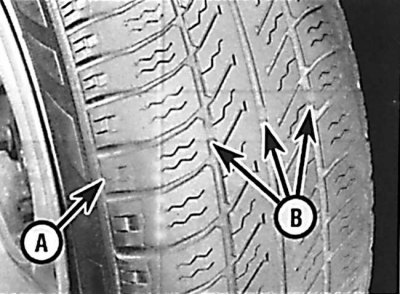
Wheel tyres must be replaced immediately if the special indicators (B) located at the bottom of the tread become level with the surface of the tyre tread due to wear. The position of the indicators is indicated by a triangular mark on the sidewall of the tyre (A).
Measuring the tread depth of a tire
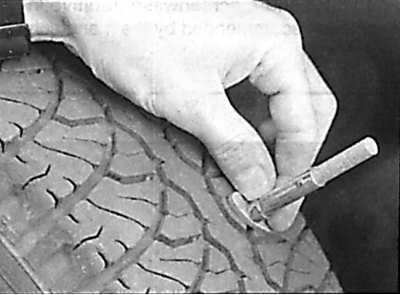
The tread depth of the tires can be monitored with a special device and when the tire wear limit is reached, it must be replaced.
Checking tire pressure
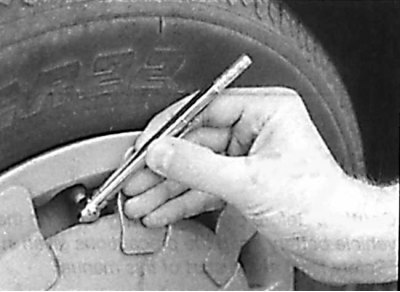
Checking tire pressure is only done on cold tires. Optimal tire pressure increases tire life and vehicle performance.