



Contents: Upper control arm that determines…↡ Upper reaction arm ↡ Lower axial pressure compensation arm ↡ Lower guide arm ↡ Installation ↡ Upper control arm that determines…↡ Upper reaction arm ↡ Lower axial pressure compensation arm ↡ Lower guide arm ↡
1. If you need to remove several rear suspension arms at the same time, use a jack to support the lower rear suspension arm using a wooden block.
2. Raise the rear of the vehicle and secure it on stands. Remove the corresponding rear wheel.
Upper control arm that determines camber
Upper camber control arm mount
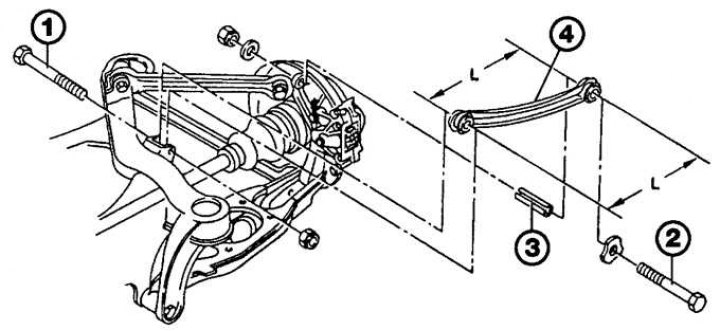
1 – internal hinge bolt; 2 – outer hinge bolt; 3 – mounting sleeve; 4 – lever; L = 314±0.5 mm
1. Unscrew the nut and remove the pivot bolt securing the arm to the hub mounting element (see fig. Fastening of the upper control arm determining the camber).
2. Remove the nut and pivot bolt that secures the rear camber control arm to the lower frame and remove the arm from underneath the vehicle.
3. If necessary, press the mounting sleeve out of the lever from the fastener side.
4. Check the condition of the lever for mechanical damage. Pay special attention to the rubber bushings of the lever and check them for cracks and aging and, if necessary, replace them.
Upper reaction arm
Upper Reactive Arm Fastening Elements
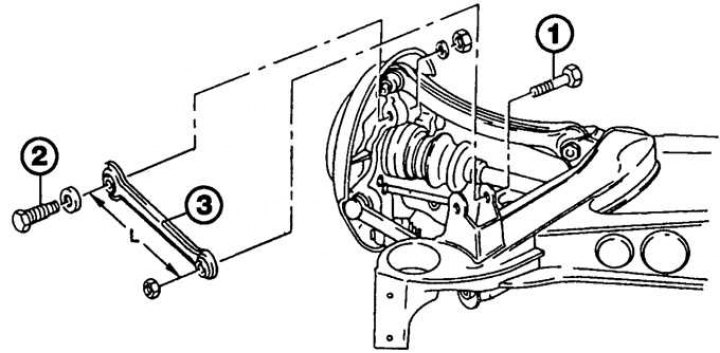
1 – internal hinge bolt; 2 – outer hinge bolt; 3 – lever; L = 247±0.5 mm
1. Unscrew the nut and remove the pivot bolt securing the arm to the hub mounting element (see fig. Upper reaction arm fastening elements).
2. Remove the nut and pivot bolt that secures the rear camber control arm to the lower frame and remove the arm from underneath the vehicle.
3. Check the condition of the lever for mechanical damage. Pay special attention to the rubber bushings of the lever and check them for cracks and aging and, if necessary, replace them.
Lower axial pressure compensation arm
Lower axial pressure compensation arm mounting elements
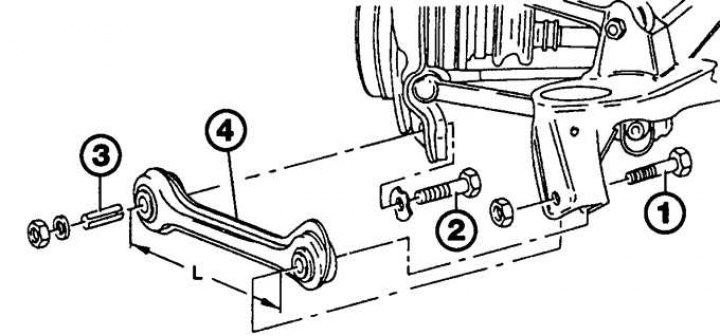
1 – internal hinge bolt; 2 – outer hinge bolt; 3 – mounting sleeve; 4 – lever; L = 314±0.5 mm
1. Unscrew the nut and remove the pivot bolt securing the arm to the hub mounting element (see fig. Lower axial pressure compensation arm fastening elements).
2. Unscrew the nut and remove the pivot bolt securing the rear camber control arm to the lower frame and remove the arm from underneath the vehicle. If necessary, press the mounting sleeve out of the arm on the fastener side.
3. Check the condition of the lever for mechanical damage. Pay special attention to the rubber bushings of the lever and check them for cracks and aging and, if necessary, replace them.
Lower guide arm
Lower Guide Arm Fastening Elements
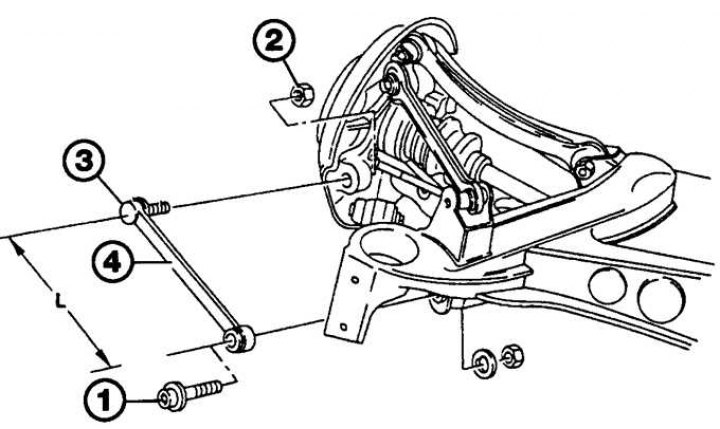
1 – internal hinge bolt; 2 – nut; 3 – outer hinge bolt; 4 – lever; L = 245±0.5 mm
1. Before removing the arm, make alignment marks on the inner pivot bolt, eccentric washers and lower frame (see fig. Lower guide arm fastening elements). These marks must be used when installing the lever to maintain rear wheel alignment.
2. Unscrew the nut, remove the eccentric washer and remove the pivot bolt securing the arm to the lower frame.
3. Unscrew the nut from the ball joint journal, then remove the ball joint from the hub fastener and remove the control arm. When removing the ball joint journal and hub fastener, you must use a puller.
4. Check the bushing for wear and damage, check the ball joint for freedom of movement and the condition of its protective boot. Replace the lever if necessary.
Installation
Upper control arm that determines camber
1. If necessary, press the mounting sleeve into the hub mounting element.
2. Place the lever back in place, insert the pivot bolts and screw new nuts onto them without tightening them completely.
3. Install the rear wheel, then lower the vehicle to the ground and tighten the wheel bolts to the specified torque.
4. Rock the vehicle to seat the control arm mountings, then tighten both pivot bolt nuts to the specified torque.
Upper reaction arm
1. Place the lever back in place, insert the pivot bolts and screw new nuts onto them without tightening them completely.
2. Install the rear wheel, then lower the vehicle to the ground and tighten the wheel bolts to the specified torque.
3. Rock the vehicle to seat the control arm mountings, then tighten both pivot bolt nuts to the specified torque.
Lower axial pressure compensation arm
1. If necessary, press the mounting sleeve into the hub mounting element.
2. Place the lever back in place, insert the pivot bolts and screw new nuts onto them without tightening them completely.
3. Install the rear wheel, then lower the vehicle to the ground and tighten the wheel bolts to the specified torque.
(Article obtained from this portal MercedesMan.ru)
4. Rock the vehicle to seat the control arm mountings, then tighten both pivot bolt nuts to the specified torque.
Lower guide arm
1. Reinstall the arm, then insert the inner pivot bolt and eccentric washer and thread a new nut onto the bolt, but do not tighten it completely.
2. Install the ball joint pin onto the hub mounting element and secure with a new nut, tightening it to the required torque.
3. Install the rear wheel, then lower the vehicle to the ground and tighten the mounting bolts to the specified torque.
4. Rock the vehicle to properly install the arm, check that the marks on the lower frame, pivot bolt and eccentric washer are aligned, then tighten the pivot bolt nut to the specified torque.
Attention! Check the rear wheel alignment as soon as possible.