



Contents: Relieving pressure ↡ Filling the hydraulic system with…↡ Filling the system on a vehicle…↡ Rear shock absorber ↡ Pressure accumulator ↡ Control unit ↡ Control unit connecting rod ↡ Hydraulic pump on models with…↡ Hydraulic pump on models with…↡
Relieving pressure
1. Before disconnecting any hoses, the pressure in the self-leveling rear suspension hydraulic system must be relieved.
2. Raise the rear of the vehicle and support it on stands.
3. While working underneath the vehicle, clean the bleeder screw at the top of the rear self-leveling suspension control unit.
4. Place a clean transparent hose on the bleed nipple and place the other end in a container.
5. Loosen the bleed nipple on the control unit, drain 500 mm of fluid into a container and tighten the bleed nipple to the required torque.
Filling the hydraulic system with the rear of the vehicle raised
Attention! When installing, it is necessary to use a new nut for fastening the connecting rod of the control unit.
1. Raise the fluid level in the pressure accumulator of the self-leveling rear suspension control system to the maximum mark.
2. Unscrew the nut securing the connecting rod to the control unit lever. Remove the rod from the lever and move the lever up to the stop.
3. Start the engine, then increase the engine speed to 2,000 - 3,000 rpm and let it run at this speed for 30 seconds, then turn off the engine.
4. Connect the connecting rod to the control unit lever by installing it into the outer hole of the lever, then screw on the new fastening nut and tighten it to the required torque.
5. Check the fluid level in the pressure accumulator of the self-leveling rear suspension system.
Filling the system on a vehicle mounted on wheels
1. Raise the fluid level on the rear self-leveling suspension system pressure accumulator to the maximum mark.
2. Place a load of 120 kg in the trunk. This will set the control unit to a position where the hydraulic system can be filled and bled.
3. Start the engine, increase its speed to 2000-3000 rpm and let it run at this speed for 1 minute, then turn it off.
4. Remove the load from the trunk and check the fluid level in the pressure accumulator of the self-leveling rear suspension system.
Rear shock absorber
Caution: When installing the rear shock absorber, it is necessary to use a new upper shock absorber mounting bolt and a new lower shock absorber mounting nut, as well as a new pressure hose sealing ring.
Removal
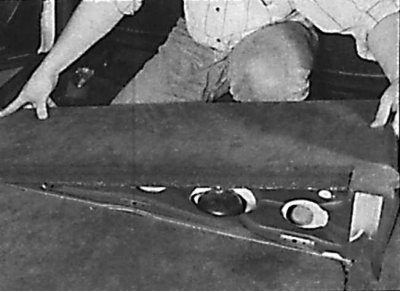
Removal the front section of the luggage compartment floor covering
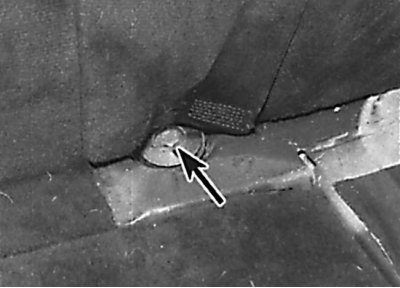
Location of the upper shock absorber mounting bolt
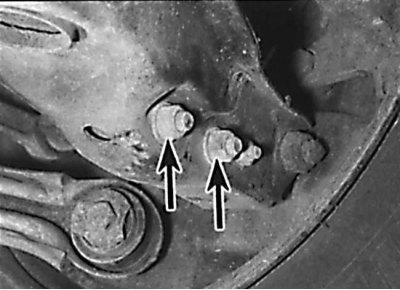
Location of the lower shock absorber mounting bolts
1. Raise the rear of the vehicle and secure it on stands. Remove the corresponding rear wheel.
2. Unscrew the screws and remove the protective cover from the base of the lower rear suspension arm. Support the lower rear suspension arm with a jack through a wooden block.
3. Relieve pressure in the hydraulic system.
4. Wipe the area around the pressure accumulator connections and place a rag underneath to catch any spilled fluid. Unscrew the connecting bolt securing the shock absorber pressure hose to the top of the pressure accumulator, remove the hose and sealing rings. Plug the end of the hose and the hole in the pressure accumulator with plugs.
5. To gain access to the upper mounting bolt, remove the rear seatbacks, then unscrew the screws and remove the front section of the cargo floor trim. To gain access to the rear mounting screws, lift the trim panel off the cargo floor. Remove the side trim panel from the cargo floor (see Fig. Removing the front section of the luggage compartment floor covering, Location of the upper shock absorber mounting bolt).
6. Unscrew the upper shock absorber mounting bolt and remove the washer and rubber cushion.
7. Unscrew the nuts from the lower shock absorber mounting bolts and remove the bolts (see Fig. Location of the lower shock absorber mounting bolts). Remove the shock absorber from under the wheel arch and remove the rubber cushion from it.
8. Check the condition of the shock absorber for fluid leaks and mechanical damage and replace if necessary.
Installation
1. Install the rubber cushion onto the shock absorber rod and install the shock absorber in place.
2. Align the lower part of the shock absorber with the rear suspension arm, install the mounting bolts, screw new nuts onto them without tightening them completely.
3. Position the shock absorber rod correctly on the body and install the rubber cushion and washer. Screw in the new shock absorber upper mounting bolt and tighten it to the required torque.
4. Install the luggage compartment floor panel and secure it with screws.
5. Connect the shock absorber pressure hose to the pressure accumulator by installing gaskets on both sides of the hose coupling, and secure the hose with the connecting bolt, tightening it to the required torque.
6. Tighten the lower shock absorber mounting bolt nuts to the specified torque. Install the protective cover on the base of the lower rear suspension arm.
7. Install the wheel, then lower the vehicle to the ground and tighten the wheel bolts to the specified torque.
8. Fill the hydraulic system with fluid.
Pressure accumulator
Removal
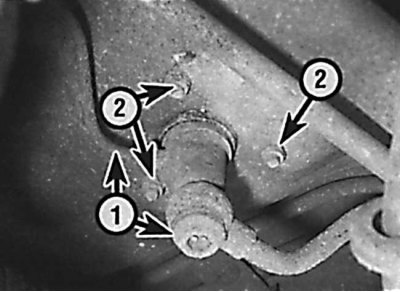
Connection points of the tube and pressure hose (1) to the pressure accumulator and the location of the mounting bolts (2) of the pressure accumulator
1. Relieve pressure in the hydraulic system.
2. Wipe the area around the pressure accumulator connection and lay a rag to catch any spilled fluid. Unscrew the connecting bolt securing the shock absorber pressure hose to the top of the pressure accumulator and remove the gasket. Unscrew the union nut and remove the tube from the pressure accumulator connecting the pressure accumulator to the control unit (see picture).
3. Unscrew the nuts securing the pressure accumulator to the bottom of the car.
4. To access the upper mounting bolt, remove the rear seat backs, then unscrew the screws and remove the front section of the luggage compartment floor covering. To access the rear mounting screws, remove the panel from the luggage compartment floor. The pressure accumulator can now be removed from the vehicle.
Installation
1. Install the pressure accumulator in place, then screw on the new mounting nuts and tighten them to the specified torque.
2. Connect the hose and tube to the pressure accumulator. At the same time, install gaskets on both sides of the hose coupling and secure them with a nut and bolt, tightening them to the required torque.
3. Place the panel on the luggage compartment floor and secure with screws.
4. Fill the hydraulic system with fluid.
Control unit
Caution! When installing the control unit, it is necessary to use a new nut that secures the connecting rod to the control unit lever.
Removal
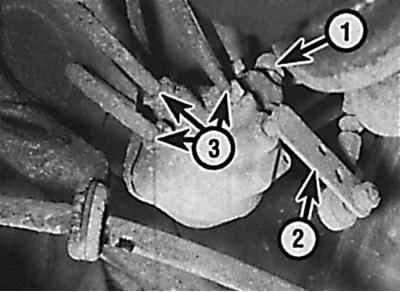
Location of the bleed nipple (1), connecting rod lever (2) and pipeline connections (3) on the control unit
1. Relieve pressure in the hydraulic system.
2. Clean the area around where the tubes connect to the control unit. Mark the tubes so that they are not mixed up during installation (see picture).
3. Unscrew the union nuts and remove the hydraulic tubes from the control unit. Close the holes in the control unit and the ends of the tubes with plugs.
4. Unscrew the nut and remove the connecting rod from the control unit lever.
5. Unscrew the mounting bolts, remove the control unit and take it out from under the car.
Installation
1. Install the control unit in place and secure it with bolts, tightening them to the required torque.
2. Connect the tubes to the control unit and secure them with the union nuts, tightening them to the required torque.
3. Raise the fluid level in the pressure accumulator of the self-leveling rear suspension control system to the maximum mark.
4. Unscrew the nut securing the connecting rod to the control unit lever. Remove the rod from the lever and move the lever up to the stop.
5. Start the engine, then increase the engine speed to 2000-3000 rpm and let it run at this speed for 30 seconds, then turn off the engine.
6. Connect the connecting rod to the control unit lever by installing it into the outer hole of the lever, then screw on the new fastening nut and tighten it to the required torque.
7. Check the fluid level in the pressure accumulator of the self-leveling rear suspension system.
Control unit connecting rod
Attention! When installing, it is necessary to use new nuts and bolt for fastening the connecting rod.
Removal
1. Raise the rear of the vehicle and support it on stands.
2. Unscrew the nut and bolt and remove the connecting rod from under the car. Check the condition of the connecting rod for wear or mechanical damage and replace it if necessary. Check the reliability of the connecting rod bracket fastening to the anti-roll bar.
Installation
1. Install the tie rod in place so that the ball joint of the tie rod fits into the outer hole of the control unit arm. Install a new bolt and nut securing the tie rod to the stabilizer bar bracket. Tighten the nuts to the specified torque and lower the vehicle.
Hydraulic pump on models with 4-cylinder petrol engines and diesel engines without turbocharging
Removal
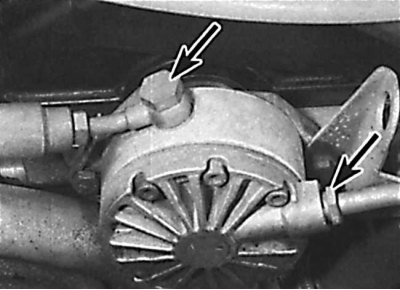
Hydraulic pump connection points for tube and hose
1. Relieve pressure in the hydraulic system.
2. Wipe the area around the hydraulic pump connections, then unscrew the connecting bolt and nut and disconnect the tube and hose from the hydraulic pump (see Fig. Connection points for the tube and hose to the hydraulic pump). Remove the sealing gaskets and plug the ends of the hose and tube and the holes in the hydraulic pump.
3. Remove the four bolts securing the hydraulic pump to the cylinder head and remove the pump with the sealing ring.
Caution: Do not unscrew the two bolts that secure the pump cover to the pump body.
Repair
Hydraulic pump components
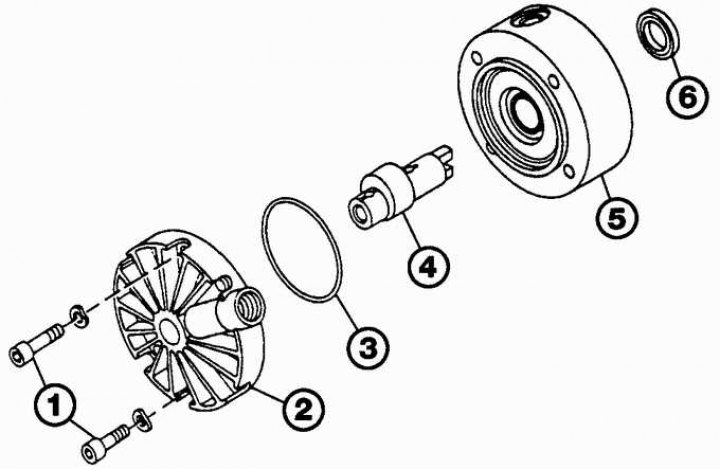
1 – bolts; 2 – lid; 3 – sealing ring; 4 – rotor; 5 – body; 6 – gasket
1. Using paint, mark the relative positions of the cover and the hydraulic pump housing (see fig. Hydraulic pump elements).
2. Unscrew the bolts securing the hydraulic pump cover, then remove the cover and sealing ring and take out the pump rotor.
3. Check the condition of the hydraulic pump components and replace them if necessary. Regardless of the condition, replace the cover sealing ring and rotor gasket.
4. Carefully remove the old rotor gasket from the rear of the pump housing using a flat-head screwdriver. Install the new rotor gasket into place in the pump housing.
5. Lubricate the rotor gasket and rotor with clean hydraulic fluid and install the rotor into the housing.
6. Install a new sealing ring on the pump cover, then install the cover with the sealing ring on the pump body. Install the cover so that the marks made before removal are aligned. Secure the pump cover with bolts, tightening them to the required torque.
Installation
1. Install a new O-ring onto the rear of the hydraulic pump and install the pump onto the cylinder head, aligning the lug on the pump rotor with the groove in the camshaft.
2. Screw in the pump mounting bolts and tighten them to the required torque.
3. Connect the hose and tube to the pump. At the same time, install gaskets on both sides of the hose coupling. Secure the hose and tube with a connecting nut and bolt, tightening them to the required torque.
4. Fill the hydraulic system with fluid.
Hydraulic pump on models with 6-cylinder petrol engines and turbocharged diesel engines
Models with 6-cylinder petrol engines and turbocharged diesel engines are equipped with a combined hydraulic pump that simultaneously operates the power steering system and the self-levelling rear suspension system.