
Cars BMW Cars Volkswagen Cars Chevrolet Cars Land Rover Cars Lada Cars Honda Cars Peugeot
English Русский
Български
Беларускі
Український
Српски
Hrvatski
Română
Polski
Slovenský
Magyar
Bookmark News and articles Sitemap Feedback Site search
MercedesMan.ru


A-Class C-Class E-Class G-Class M-Class S-Class Others
W163 (1997-2005)
  • Main
  • M-Class
  • W163 (1997-2005)
  • Chassis
  • Brake system
  • Removal and installation the master brake cylinder

Removal and installation the master brake cylinder (Mercedes-Benz M-Class W163)

0
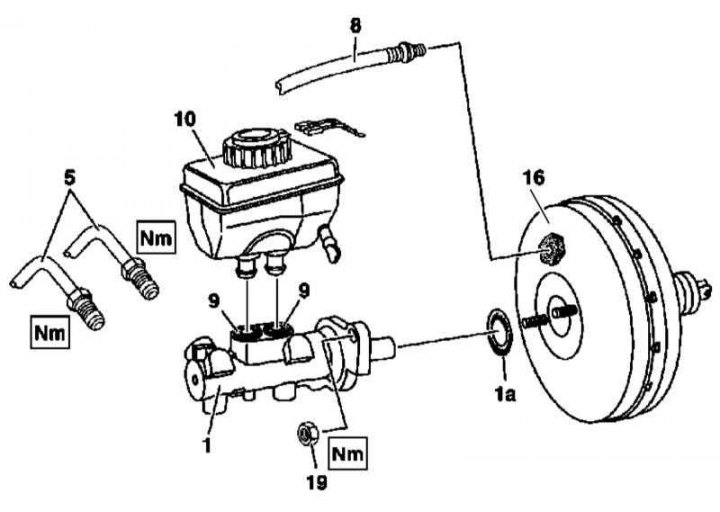
Details of the installation of the GTZ (on the example of models with AT, version 1)
Details of the installation of the GTZ (on the example of models with AT, version 1)


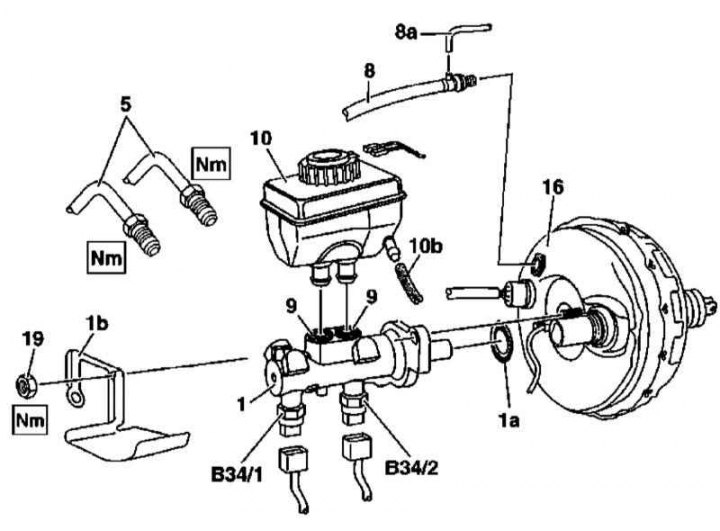
Details of the installation of the GTZ (on the example of models with AT, version 2)
Details of the installation of the GTZ (on the example of models with AT, version 2)


Removal/installing the brake booster
Removal/installing the brake booster


Removal/installing the brake booster

Removal/installing the brake booster
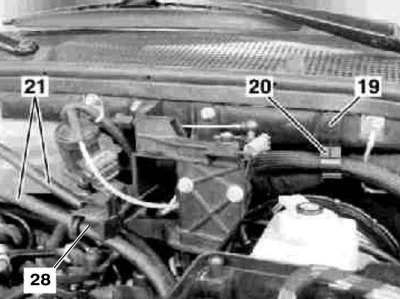
21 — Hoses
28 — Bracket


1. Illustrative material on the procedure for removing/installing the brake booster is presented in the illustrations, to which all references in the text refer, unless otherwise specified.

2. Open the hood and fix it in a vertical position.

3. Remove the powertrain trim panels and fuse/relay box covers.

4. Disconnect the electrical wiring from the brake master cylinder reservoir (10).

5. Disconnect the vacuum line (8) from the brake booster (16).

6. On diesel models, release the vacuum line (8a) and the auxiliary line from the retainers on the bulkhead.

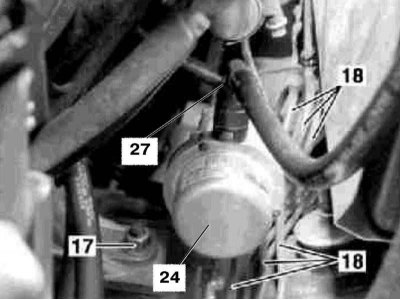
7. Disconnect the hose (27) from the vacuum pump (24).

8. Release the hoses (21) from the bracket (28).

9. Disconnect the hoses from the fuse/relay box and route them toward the engine.

10. After marking, disconnect the brake lines (5) from the brake master cylinder - immediately seal the open ends of the nipple connectors.

11. If equipped, disconnect the wiring from ESP brake pressure sensors 1 and 2 (B4/1 and B34/2), - release the latches on the bottom sides of the connectors.

12. Remove the self-locking nuts (19) securing the master cylinder (1) - the nuts must be replaced without fail.

13. If equipped, remove the heat shield (1b).

14. If equipped, remove the anti-theft alarm siren from the engine compartment bulkhead.

15. Pulling strictly horizontally, remove the master cylinder from the brake booster unit and transfer it to the workbench.

16. Check the cylinder for signs of developing leaks from the rear of the primary piston, replace the assembly if necessary.


17. On models with manual transmission, disconnect the clutch operator hose (10b) from the master cylinder reservoir - immediately plug the open end of the nipple connector.

18. Pump out the brake fluid from the reservoir (10), then, pulling it vertically, remove it from the brake master cylinder assembly (1).

19. Check the condition of the sealing bushings (9), replace if necessary.

20. Installation is carried out in the reverse order - do not forget to replace the sealing ring (1a) and the self-locking nuts of the cylinder mounting.

21. Finally, bleed the brake system (see Section Bleeding the brake system).
This article is available at: russian, bulgarian, belarusian, ukrainian, serbian, croatian, romanian, polish, slovak, hungarian
The article has been verified: Panova Maya Vladimirovna
Share with friends:
◀ Previous
M-Class W163 / Brake system
Next ▶

Checking the non-return valve
Checking the proper functioning of the brake booster
Checking the brake system for leaks
General information and safety precautions
Brake and auxiliary systems specifications
Removal and installation the brake booster and the BAS diaphragm stroke sensor
Removal and installation of the ETS/ESP hydraulic modulator
Removal and installation of hydraulic lines laid between the master cylinder and the ETS/ESP hydraulic modulator
Assessing the degree of wear and replacing brake pads
Replacing brake hoses
More similar articles for repairing other models

☛ Brake fluid — checking the level Mercedes W168 (1997-2004)
☛ Dual master cylinder Mercedes W203 (2000-2007)
☛ Removal, disassembly and installation of the master brake cylinder Mercedes W123 (1976-1985)
☛ Removal and installation the brake fluid reservoir and the brake… Mercedes W463 (1999-2019)
☛ Master brake cylinder Mercedes W116 (1972-1980, petrol)
☛ Master Brake Cylinder — General Information Mercedes Sprinter (1995-2000, diesel)
Link in different formats to this article
Comments and feedback from visitors
No comments yet


How much will 10 + 48 ?


W163 (1997-2005) 
  • General information
  • Introduction to the guide
  • Controls and instruments
  • Driving and operation
  • Maintenance
  • Power unit
  • Gasoline engines
  • Diesel engines
  • Cooling system
  • Heating and ventilation
  • Power system (gasoline)
  • Fuel system (diesel)
  • Exhaust system
  • Ignition and control system
  • Charging and starting system
  • Transmission
  • Mechanical gearbox
  • Automatic gearbox
  • Clutch
  • Drive shafts and cardan
  • Transfer case
  • Chassis
  • Brake system
  • Front suspension
  • Rear suspension
  • Steering
  • Suspension geometry
  • Body
  • Exterior (external elements)
  • Interior (internal elements)
  • Doors and locks
  • Electrical equipment
  • Equipment and devices
  • Drive motors
  • Lighting and signaling
  • Audio system
  • Electrical circuits
 
MercedesMan.ru © 2017–2026 · Mobile version · Read about Mercedes · Sitemap: EN BG BY UA RS HR RO PL SK HU · Feedback · Site search · Bookmark A-Class (W168) · C-Class (W201) · C-Class (W202) · C-Class (W203) · E-Class (W123) · E-Class (W124) · E-Class (W210) · G-Class (W463) · M-Class (W163) · S-Class (W116, petrol) · S-Class (W126, petrol) · S-Class (W140) · S-Class (W220) · Sprinter · Vito 1 · Vito 2 · Vario 814D ·
 
We only use cookies without which some of the site's features may not be available.