



Contents: Operating principles of auxiliary…↡ Pressure and return pump (A7/3m1) ↡ Solenoid valves for holding (inlet)…↡ Low pressure accumulator (11) ↡ Multi-way control solenoid valves…↡ Pre-fill solenoid valves (A7/3y26…↡ Operating principle of the ESP…↡ Procedure to follow when the ABS…↡ Security measures ↡
The brake system consists of a master cylinder, a vacuum booster and disc brakes on the front and rear wheels and is divided diagonally into two independent hydraulic circuits. If any of the circuits fails, (for example, as a result of a breach in the seal) the second continues to function in normal mode, providing adequate braking of the vehicle. Additionally, a pressure regulator valve is built into the circuits of both rear brake mechanisms, providing dynamic adjustment of the braking force of the rear wheels in accordance with the change in load on the rear axle of the car. The fluid pressure in both circuits is created by a tandem-design master brake cylinder (MBC). The MBC is activated when the foot brake pedal is depressed.
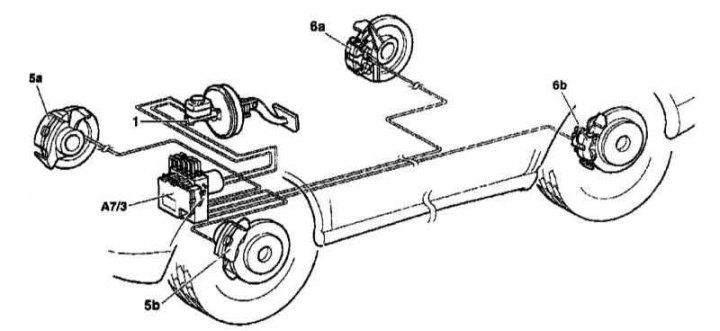
Hydraulic drive organization diagram for brake mechanisms
1 - GTZ; 5a - Right front brake caliper; 5b - Left front brake caliper; 6a - Right rear brake caliper; 6b - Left rear brake caliper; A7/3 - Auxiliary systems hydraulic modulator
A brief description of the operating principles of the auxiliary electronic systems anti-lock brakes (ABS), emergency brake assist (BAS), electronic brake force distribution (EBV), traction control (ASR/4-ETS) and anti-skid (ESP) is given in Chapter Controls and safe operating techniques.
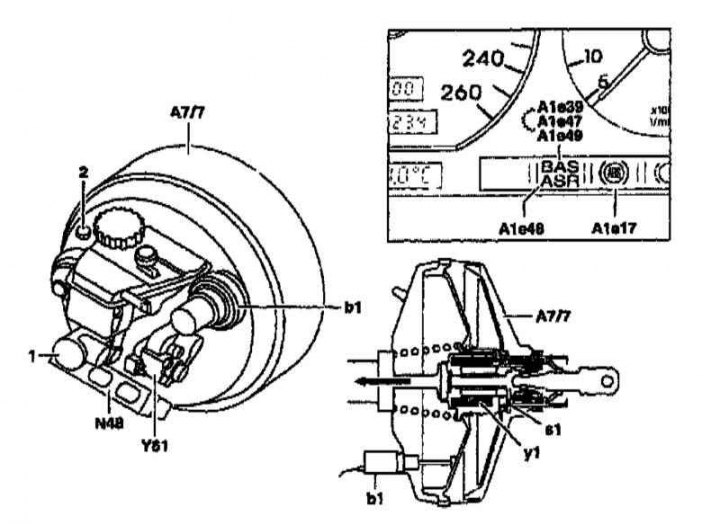
Layout of Brake Assist System (BAS) components
1 - GTZ; 2 - Vacuum connector; A1e17 - ABS warning light; A1e48 - BAS/ASR indicator lamp; A7/7 - Brake booster; A7/7b1 - BAS diaphragm stroke sensor; A7/7s1 - BAS release switch sensor; A7/7y1 - Solenoid valve BAS; N48 - BAS control module integrated into ESP control module (N47-5); Y61 - Master cylinder switch valve (if provided)
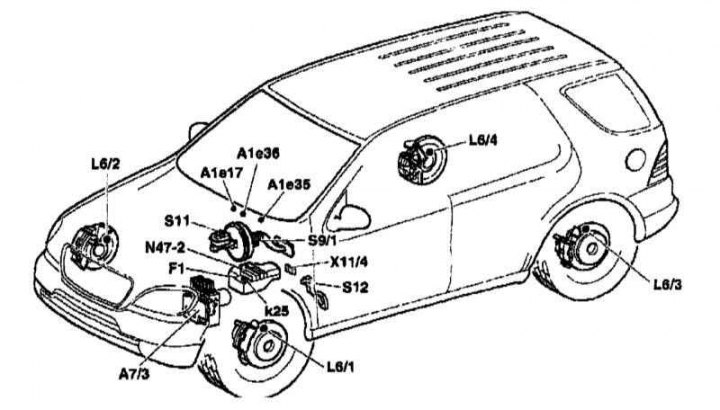
Layout diagram of the components of the auxiliary electronic systems ASR/ETS/ESP
A1e17 - ABS warning light; A1e35 - ETS control lamp; A1e36 - 4-ETS indicator light; A7/3 - Hydromodulator; F1 - Fuse and relay mounting block; k25 - Pressure-return pump relay; L6/1 - Left front wheel sensor; L6/2 - Right front wheel sensor; L6/3 - Left rear wheel sensor; L6/4 - Right rear wheel sensor; N47-5 - BAS/ESP Control Module; S9/1 - 4-pin brake light switch sensor; S12 - Parking brake arming switch; S11 - Brake fluid level switch; X11/4 - Diagnostic connector DLC of the on-board diagnostic system
The brake fluid reservoir is located under the master cylinder and supplies fluid to the entire hydraulic braking system.
The brake booster accumulates part of the vacuum created in the engine's intake manifold. Since a diesel engine lacks the necessary vacuum at the intake manifold, diesel-powered vehicles have a special vacuum pump. Using the appropriate valve, the force on the brake pedal is increased as needed due to the vacuum effect.
The pedal-operated parking brake acts via cables on the rear wheel brake mechanisms. Additionally, the rear brake mechanisms are equipped with drum units of the pedal-cable parking brake.
Operating principles of auxiliary systems ABS/4-ETS/ESP/EBV
The electrohydraulic diagram of the functioning of the auxiliary systems is presented in the illustration, to which all references in the text refer.
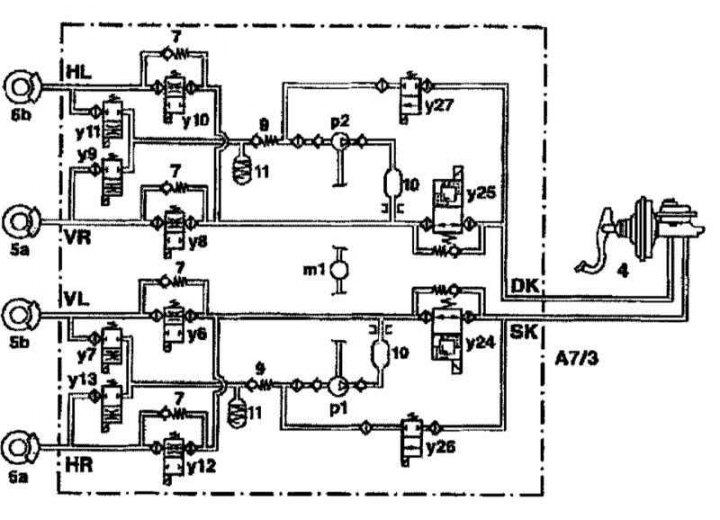
Hydraulic circuit diagram of auxiliary electronic systems ABS/4-ETS/ESP/EBV
4 - Brake path control unit; 5a - Right front brake caliper; 5b - Left front brake caliper; 6a - Right rear brake caliper; 6b - Left rear brake caliper; 7 - Check valve; 9 - One-way check valve of the return pump; 10 - Damper with control plate; 11 - Low pressure accumulator; A7/3 - Hydraulic modulator of auxiliary brake systems; m1 - Pressure and return pump; p1 - Self-priming pump of the first (DK) diagonal circuit; p2 - Self-priming pump of the second (SK) diagonal circuit; y6 - Left front solenoid pressure holding valve (inlet); y7 - Left front solenoid pressure relief valve (outlet); y8 - Right front pressure holding solenoid valve (inlet); y9 - Right front solenoid pressure relief valve (outlet); y10 - Left rear pressure holding solenoid valve (inlet); y11 - Left rear solenoid pressure relief valve (outlet); y12 - Right rear pressure holding solenoid valve (inlet); y13 - Right rear pressure relief valve (outlet); y24 - Control multi-way solenoid valve of the first (DK) diagonal circuit; y25 - Second (SK) diagonal circuit multi-way solenoid control valve; y26 - Solenoid valve for pre-filling the first (DK) diagonal circuit; y27 - Solenoid valve for pre-filling the second (SK) diagonal circuit; DK - First diagonal contour; SK - Second diagonal contour; VL - Left front wheel; VR - Right Front Wheel; HL - Left rear wheel; HR - Right rear wheel
The hydraulic modulator of auxiliary brake systems (A7/3) includes components of the closed-loop dynamic control systems ABS, 4-ETS/ASR and ESP.
Pressure and return pump (A7/3m1)
The self-priming pressure and return pumps (p1, p2) are integrated into the hydraulic modulator assembly (A7/3) and are switched by pulse signals during the pressure build-up and pressure release phases of the ETS and ESP active control systems, as well as during return flow adjustment when ABS is activated.
Self-priming pressure and return pumps (p1, p2) are started when necessary in order to minimize noise levels.
Each brake circuit is equipped with a separate damper (10), which reduces the level of noise produced by the pump.
Solenoid valves for holding (inlet) and relieving (outlet) pressure (A7/3y6 - A7/3y13)
One 2/2-way valve is used to control the pressure in the circuits of each wheel in the build-up/hold and hold/release phases of the ABS, ETS and ESP control modes.
Low pressure accumulator (11)
The low-pressure accumulator (11) is filled with brake fluid during the pressure release phase of ABS, ETS or ESP and ensures its transfer to the pressure-return pump (p1/p2).
Multi-way control solenoid valves (A7/3y24 and A7/3y25)
Electromagnetic multi-way switching valves (y24 and y25) ensure the cut-off of active pressure diagonal circuits from the brake master cylinder during the operation of ETS and ESP. The valves also ensure pressure relief when it rises above 150 atm. The brake fluid passed through the switching valves is directed back to the brake master cylinder.
Pre-fill solenoid valves (A7/3y26 and A7/3y27)
Valves (y26, y27) open during the pressure build-up phases of the ETS/ESP.
Operating principle of the ESP torque/lateral overload sensor assembly
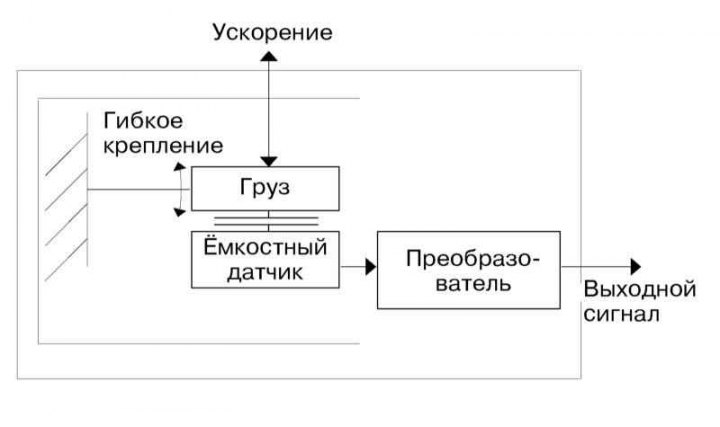
The sensors for the deflection moment and lateral overloads are combined into a single assembly (B24/2) to save space. The micromechanical sensor assembly converts the lateral and vertical projections of the angular accelerations into electrical signals. The working elements, which differ in mass, are affected by the forces that arise during the non-inertial movement of the vehicle (making turns and accelerations) overloads provide varying degrees of deformation. A special electronic converter converts the received signals and transmits them via the CAN bus to the control module of the anti-slip and anti-skid systems (N47).
The sensing element of the torque sensor is formed from a micromechanical ring (a) equipped with eight spring bridges (b) that ensure its movement and electromagnetic action. When rotating in the assembly, additional Coriolis forces arise, proportional to the rotation speed, recorded electromagnetically and, after conversion in the ACIS module into the form of analog signals, sent to the control unit of the instrument cluster.
Design of the capacitive torque sensor of the ESP system
a - Silicon ring
b — Spring jumper
c — Electronic sensor
The transverse overload measurement principle is based on the use of a spring-mass element with a capacitive detector. The operating voltage is supplied from the ESP control module (N47-2).
The transverse overloads that occur during cornering ensure the displacement of the spring-mass element from the equilibrium position by an amount proportional to the value of the reaction force that occurs. Any change in the element's position results in a change in the detector's capacity. Then, the recorded deviation value is converted into a signal voltage that allows the ESP control module (N47-2) to perform a quantitative assessment of the recorded transverse overload values.
The electronic control module ensures that the system, in the event of mechanical damage to the circuit (for example, a cable break), or if the voltage drops excessively, it is automatically switched off. The situation is displayed on the instrument panel by activating the ABS indicator lamp. At the same time, the ESP and BAS systems are switched off, which is confirmed by the activation of the corresponding indicator (see Chapter Controls and safe operating techniques). The main braking system continues to function properly - during braking, the car behaves as if the ABS system is absent.
Activation of the ESP indicator lamp while driving indicates that a fault has been detected in the brake assist system (BAS) or the anti-skid system (ESP) - the corresponding systems are also switched off, while the main braking system remains functional.
If the red brake system warning light is activated while driving, you must stop immediately and try to determine the cause of the malfunction, which may in particular be a drop in the brake fluid level or the parking brake lever not being fully released.
Procedure to follow when the ABS warning light comes on while driving
Stop the car, turn off the engine and start it again.
Check the battery voltage level - if the measurement result is less than 10.5 V, recharge the battery.
Note: If the ABS warning light comes on when you start driving and then goes out after a while, this indicates low battery voltage, which increases after the generator starts working.
Make sure that the wire ends are securely fastened to the battery terminals; tighten the fasteners if necessary.
Jack up the car and place it on supports, remove the wheels and check the condition of the wheel sensor wiring.
More detailed diagnostics should be performed at a service station using special equipment for reading fault codes (DTC) recorded in the control module memory.
Security measures
- Brake fluid is a highly toxic and chemically aggressive compound and when in contact with body panels it destroys the paintwork!
- Brake dust generated during the wear of brake pads may contain asbestos, which is harmful to human health - do not inhale it under any circumstances when cleaning brake mechanisms!
- Working with the brake system requires special cleanliness and strict adherence to instructions. If you do not have the necessary experience, it is advisable to contact a service station.
Note: When driving on wet roads, it is necessary to periodically press the brake pedal to remove moisture from the brake discs
- During the rotation of the wheel, moisture is thrown off the brake discs under the action of centrifugal force, but a film of silicone, rubber abrasion products, grease and other contaminants remain, reducing braking efficiency!
- After installing new brake pads, the latter must be worked in - try to avoid sudden braking for the first 200 km after replacement!
- Corroded disc brakes create a shaking effect when braking that does not disappear over time - replace the discs!
- The burning of dirt onto the surface of the brake pads leads to the formation of grooves on the surface of the brake discs, which leads to a decrease in braking efficiency!