
Cars BMW Cars Volkswagen Cars Chevrolet Cars Land Rover Cars Lada Cars Honda Cars Peugeot
English Русский
Български
Беларускі
Український
Српски
Hrvatski
Română
Polski
Slovenský
Magyar
Bookmark News and articles Sitemap Feedback Site search
MercedesMan.ru


A-Class C-Class E-Class G-Class M-Class S-Class Others
Sprinter (1995-2000, diesel) Vito 1 (1996-2003) Vito 2 (2003-2014, diesel) Vario 814D (1996-2003, diesel)
  • Main
  • Mercedes-Benz
  • Sprinter (1995-2000)
  • Chassis
  • Brake system
  • Design of the brake system

Design of the brake system (Mercedes-Benz Sprinter 903)

0
The front and rear wheels are equipped with disc brakes, which, with a few exceptions, are identical, i.e. they operate on the same principle. All wheels are equipped with disc brakes with a floating caliper. Models 901 and 902 are equipped with solid discs, while models 903 and 904 are equipped with ventilated discs.

The braking system is equipped as standard with a booster, which operates thanks to an independent vacuum pump. In addition, the Sprinter model can be equipped with various additional systems that increase safety and improve the vehicle's performance. For example, ABS and automatic differential lock systems can be installed. They are described in more detail below.
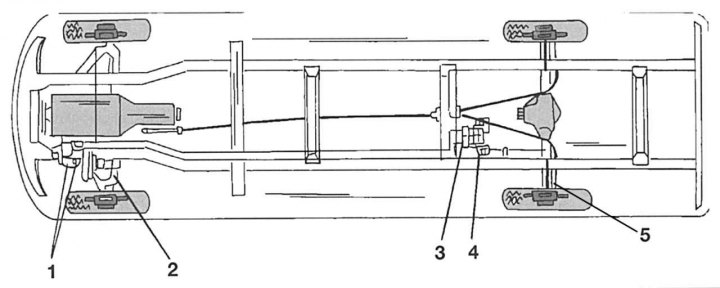
Figure 266. Diagram of the brake system with a pressure equalization valve: 1 - pressure…

Figure 266. Diagram of the brake system with a pressure equalization valve: 1 - pressure equalization valve; 2 - front brake caliper; 3 - double pressure regulator; 4 - adjustable pressure equalization valve; 5 - rear brake caliper
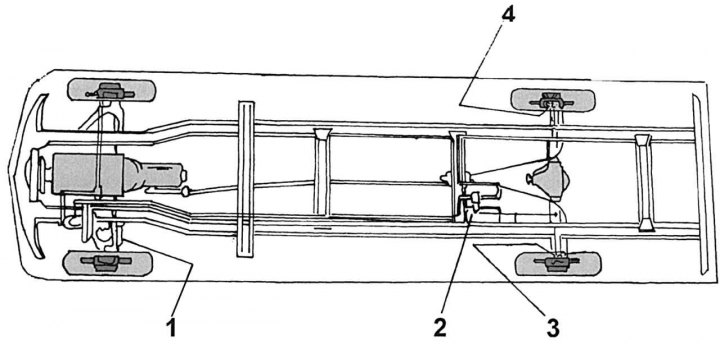

Figure 267. Diagram of the brake system without a pressure equalization valve: 1 - front brake…

Figure 267. Diagram of the brake system without a pressure equalization valve: 1 - front brake caliper; 2 - pressure regulator; 3 - rear left brake caliper; 4 - rear right brake caliper


Depending on the modification, the car is equipped with either a conventional pressure regulator in the rear brake circuit, or a dual pressure regulator with the ability to adjust and a non-adjustable pressure equalization valve in the master brake cylinder. Figures 266 and 267 schematically show the braking systems of both modifications.

When the brakes are applied, the brake discs located on the front and rear wheels cause the rotation to slow down and reduce the speed of the vehicle. When the brake pedal is pressed, the pressure rod connected to it presses on two pistons located one behind the other in the master brake cylinder, which is mounted in the engine compartment on a vacuum booster. The pistons transmit the pressure force to the brake fluid located in the master cylinder. Hydraulic pressure is generated, which is then transmitted through pipes and hoses to the wheel brake cylinders. Under the pressure of their pistons, the brake pads are pressed against the discs. When examined in more detail, the mechanism of action is as follows: since the brake caliper bracket has only one piston, the pressure created in the system is transmitted to the latter, which in turn presses the brake pad on one side. When this happens, the entire floating caliper bracket moves along the guide pins due to the pressure created, and the pad on the other side is pressed against the brake disc. This way braking is fully achieved.

The parking brake acts on the shoes through a system of levers and cables. Thanks to the special design of the rear brake discs, there is still room for drum brakes at the rear. When you press the parking brake pedal, the front brake cable, which is attached to the equalizer, is driven. A separate cable runs from the equalizer to the brake mechanism of each rear wheel. The force is transmitted to the drive lever, which expands the pads.


Material taken from a web resource (mercedesman.ru)

The front and rear brakes are adjusted separately.
This article is available at: russian, bulgarian, belarusian, ukrainian, serbian, croatian, romanian, polish, slovak, hungarian
The article has been verified: Levin Kirill Glebovich
Share with friends:
◀ Previous
Mercedes Sprinter / Brake system
Next ▶

Brake system — general information
Brake System Maintenance — General Information
General description of the various components of the braking system
Checking the brake fluid level
Replacing brake fluid
Checking the brakes
More similar articles for repairing other models

☛ Brake system specifications Mercedes W168 (1997-2004)
☛ Design and description of the brake system Mercedes W203 (2000-2007)
☛ Design and technical characteristics of the brake system Mercedes W123 (1976-1985)
☛ Anti-lock brake system (ABS) Mercedes W463 (1999-2019)
☛ Anti-lock brake system (ABS) Mercedes W163 (1997-2005)
☛ Anti-lock brake system (ABS) Mercedes W140 (1991-1998)
Link in different formats to this article
Comments and feedback from visitors
No comments yet


How much will 10 + 28 ?


Vario 814D (1996-2003, diesel) 
  • General information
  • Maintenance
  • Power unit
  • Engines 602.984/985
  • Engines 904.908/914/923/936
  • Transmission
  • Clutch
  • Manual gearbox 711.613
  • Manual gearbox 710.64/66
  • Manual gearbox 715.051
  • Automatic gearbox 723.345
  • Power take-off box
  • Chassis
  • Front suspension
  • Rear suspension
  • Steering
  • Brake system
  • Body and electrical equipment
  • Interior (internal elements)
  • Exterior (external elements)
  • Heater and air conditioner
  • Electrical diagrams
Vito 2 (2003-2014, diesel) 
  • General information
  • User manual
  • Maintenance
  • Diesel engine OM646
  • Engine repair
  • Cooling and lubrication system
  • Power and exhaust system
  • Transmission
  • Clutch
  • Car gearbox
  • Chassis
  • Front suspension
  • Rear suspension
  • Steering
  • Brake system
  • Body
  • Body elements
  • Electrical equipment
  • Equipment and devices
  • Security systems
  • Electrical circuits
Vito 1 (1996-2003) 
  • General information
  • User manual
  • Maintenance
  • Petrol engines 2.0 l
  • Engine repair
  • Lubrication system
  • Cooling system
  • Power and control system
  • Petrol engines 2.8 l
  • Engine repair
  • Lubrication system
  • Cooling system
  • Power and control system
  • Diesel engines 2.3 l
  • Engine repair
  • Cooling system
  • Lubrication system
  • Turbocharging and recycling
  • Power and control system
  • Diesel engines 2.2 l
  • Engine repair
  • Cooling system
  • Lubrication system
  • Turbocharging and recycling
  • Power and control system
  • Transmission
  • Clutch
  • Mechanical gearbox
  • Automatic gearbox
  • Chassis
  • Front suspension and wheels
  • Rear suspension
  • Steering
  • Brake system
  • Body
  • Exterior (external elements)
  • Interior (internal elements)
  • Electrical equipment
  • Equipment and devices
  • Heater and air conditioner
  • Electrical circuits
Sprinter (1995-2000, diesel) 
  • General information
  • Introduction to the guide
  • Maintenance
  • Power unit
  • Engine repair
  • Lubrication system
  • Cooling system
  • Power and exhaust system
  • Transmission
  • Clutch
  • Mechanical gearbox
  • Automatic gearbox
  • Front axle
  • Rear axle and cardan
  • Chassis
  • Car suspension
  • Steering
  • Brake system
  • Tires and wheels
  • Electrical equipment
  • Equipment and devices
  • Headlights and lighting
  • Power devices
  • Electrical circuits
 
MercedesMan.ru © 2017–2026 · Mobile version · Read about Mercedes · Sitemap: EN BG BY UA RS HR RO PL SK HU · Feedback · Site search · Bookmark A-Class (W168) · C-Class (W201) · C-Class (W202) · C-Class (W203) · E-Class (W123) · E-Class (W124) · E-Class (W210) · G-Class (W463) · M-Class (W163) · S-Class (W116, petrol) · S-Class (W126, petrol) · S-Class (W140) · S-Class (W220) · Sprinter · Vito 1 · Vito 2 · Vario 814D ·
 
We only use cookies without which some of the site's features may not be available.