



In this case, it is necessary to remove this air from the brake system. The presence of air in the pipelines can also be judged by the fact that when pressing the brake pedal, no strong resistance is felt.
In this case, it is necessary to eliminate the leak and remove air from the system.
In workshops, air is removed from the system using a combined device for filling brake fluid and bleeding the brake system.
Attention! When using the mentioned device, the pressure in the system should not exceed 1 bar.
You can do without any devices. In this case, air is removed from the brake system by pumping it using the brake pedal. An assistant is needed for this operation.
If you need to bleed the entire system, you need to remove air from each wheel cylinder.
If the caliper of only one brake mechanism was replaced or repaired, then, as a rule, it is sufficient to simply remove air from the corresponding wheel cylinder.
Cars with ABS
Attention! If one of the chambers of the brake fluid expansion tank has been completely emptied, for example due to a leak or carelessness when bleeding the brake system, then air also gets into the ABS hydraulic booster pump. In this case, bleeding the brake system should be done in a workshop using a special device.
Air removal sequence:
- a) rear right wheel brake mechanism;
- b) rear left wheel brake mechanism;
- c) front right wheel brake mechanism;
- d) front left wheel brake mechanism.
Attention! Loosen the bleed nipples carefully so as not to strip the threads. It is recommended to apply a rust converter to the nipple threads two hours before bleeding the system or support. If the nipple does not open despite the measures taken, it is recommended to contact a workshop and perform bleeding there.
Attention! During bleeding, check the brake fluid level in the expansion tank from time to time. Do not allow the brake fluid level in the tank to drop to the limit or even allow the tank to be "empty". In this case, air will be pumped into the system. Replenish the amount of brake fluid in the expansion tank by adding only fresh fluid!
In vehicles with a brake force regulator, when bleeding the rear wheel brake system, move the regulator lever.
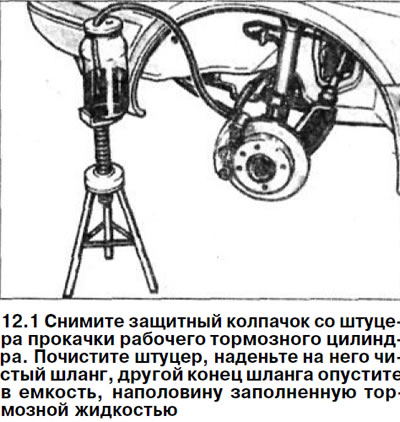
1. Remove the protective cap from the bleed nipple of the working brake cylinder. Clean the nipple, put a clean hose on it, lower the other end of the hose into a container half filled with brake fluid (see illustration). To unscrew the fittings, use a key designed for unscrewing bleeder fittings, for example, HAZET 1968-N.
Caution! Keep collected liquid out of reach of children.
2. Ask an assistant to press the brake pedal all the way ("pump") until the pressure in the brake system rises. This is felt by the increase in resistance when pressing the pedal.
Once sufficient = pressure has been achieved, the pedal should be pressed all the way down and held in this position.
3. Use a wrench to loosen the bleed nipple by about half a turn. Collect the leaking brake fluid in a container. Make sure that the end of the hose in the container for collecting the leaking brake fluid is always below the fluid level.
4. Close the bleed screw as soon as the brake fluid pressure in the fluid system decreases.
5. Repeat the pressure build-up in the brake system using the brake pedal. Then press the brake pedal down as far as it will go and hold it with your foot. Open the bleed nipple and, as soon as the brake fluid flows out and the pressure in the system drops, close the nipple.
6. Repeat bleeding the system on one wheel cylinder until air bubbles no longer appear in the fluid flowing into the container.
7. Tighten the bleed nipple with a washer to a torque of KG Nm, the nipple without a washer to a torque of 7 Nm.
8. After removing the air, remove the hose from the bleed nipple and close the nipple with a dust cap.
Remove air from the remaining wheel cylinders in the same manner, while observing the bleeding sequence.
9. Fill the expansion tank with brake fluid to the maximum mark and screw the cap onto the filler neck.
Attention! Make sure that:
- a) the brake hoses are securely connected;
- b) the brake hose is secured in the holder;
- c) the brake drive bleed nipples are screwed in;
- d) there is a sufficient volume of brake fluid in the expansion tank.
[Original article is on the portal: MERCEDESMAN]
10. Check the brake system for leaks with the engine running. To do this, press the brake pedal with a force of 200-300 N (20-30 kg) for about 10 seconds. The pressure in the system and, accordingly, the resistance of the brake pedal, should not decrease. Check all connections for leaks.
11. Perform several braking tests on a road with light traffic. At least one braking test should be performed so that the ABS is activated, which is felt by the pulsation of the brake pedal.
Caution! When checking the brake system in the manner described, take into account the situation on the road and watch the traffic behind you.
Attention! Brake fluid must be disposed of at special collection points.