
Cars BMW Cars Volkswagen Cars Chevrolet Cars Land Rover Cars Lada Cars Honda Cars Peugeot
English Русский
Български
Беларускі
Український
Српски
Hrvatski
Română
Polski
Slovenský
Magyar
Bookmark News and articles Sitemap Feedback Site search
MercedesMan.ru


A-Class C-Class E-Class G-Class M-Class S-Class Others
190 (W201) (1982-1993) W202 (1993-2000) W203 (2000-2007)
  • Main
  • C-Class
  • W202 (1993-2000)
  • Chassis
  • Brake system
  • Bleeding the brake system

Bleeding the brake system (Mercedes-Benz C-Class W202)

0

Cars without ASR traction control system


Attention! To bleed the brake system of a vehicle with ASR, you need a Mercedes electronic control device. The device is connected to the diagnostic plug on the right in the engine compartment. Pressing the button automatically bleeds the ASR system.


After each brake repair, during which the brake system was opened, air may penetrate into the pressure pipes, which must be removed from there. A sign of the presence of air in the pipes of the system is the lowering of the brake pedal when pressing it with the foot without noticeable resistance. In this case, it is necessary to eliminate the leak and remove air from the system.

Air is released by pressing the brake pedal, and an assistant is also needed. If it is necessary to bleed air from the entire brake system, it must be removed from each brake cylinder separately. When regularly changing the brake fluid as part of maintenance, air must be removed from all four brake cylinders so that it does not penetrate into the brake system.

Air removal sequence:
  • 1. Right rear caliper.
  • 2. Left rear caliper.
  • 3. Front right caliper.
  • 4. Front left caliper.

If the caliper has been replaced or repaired, it is usually sufficient to bleed the relevant cylinder. If the repair was performed with an empty brake fluid reservoir, it is necessary to bleed the entire brake system.

Before bleeding, unscrew the brake fluid reservoir cap and fill with brake fluid up to the "max" mark.

Caution! When bleeding the brake fluid, watch the brake fluid reservoir. The brake fluid level should not drop too low, otherwise air will be sucked in through the reservoir. Always top up with fresh brake fluid!


1. Remove the dust cap from the caliper breather valve. Clean the valve, attach a clean hose, and place the other end of the hose in a container half filled with brake fluid.
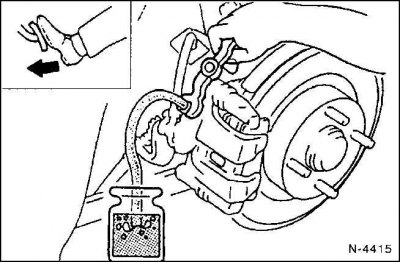
1. Remove the dust cap from the caliper breather valve. Clean the valve, attach a clean hose, and…


2. Have an assistant pump the brake pedal until pressure builds up in the brake system, which is felt as an increase in resistance when the pedal is pressed.

3. Once sufficient pressure has been built up, fully depress the brake pedal and hold it there.

4. Open the breather valve on the caliper by turning the wrench about half a turn. Collect the spilled liquid in a container, making sure that the end of the hose is always below the liquid level in the container.

5. As soon as the fluid pressure decreases, immediately close the breather valve.

6. Repeat the inflation process until the pressure increases. Press the brake pedal down as far as it will go, keep your foot on the pedal, open the breather valve screw until the pressure drops, and tighten the valve screw.

7. Repeat this operation on one brake cylinder until no more air bubbles appear in the brake fluid flowing into the container. Approximately 80 ml of brake fluid should flow out of one brake cylinder.


8. After bleeding is complete, remove the hose from the breather air valve, put on the dust cap. Lightly tighten the valve screw to 7 Nm.

9. Also bleed air from the other brake cylinders.

Caution! When bleeding, keep an eye on the equalizing tank. The brake fluid level should not drop too low, otherwise air will be sucked in through the tank. Top up with fresh brake fluid only.


10. After finishing bleeding, add brake fluid to the reservoir up to the "max" mark. Screw on the cap.

Attention! Conduct a safety check:
  • are the bleed screws tightened?;
  • is the brake fluid level ok;
  • with the engine running, check for leaks. To do this, press the brake pedal with a force of 200 to 300 N (20–30 kg) for about 10 seconds. The pedal should not move. Check the tightness of all connections.


11. Finally, make a few braking attempts on a quiet street.
This article is available at: russian, bulgarian, belarusian, ukrainian, serbian, croatian, romanian, polish, slovak, hungarian
The article has been verified: Khromov Roman Mikhailovich
Share with friends:
◀ Previous
C-Class W202 / Brake system
Next ▶

Brake fluid
Rear brake disc — removal and installation
Front brake disc — removal and installation
Support — removal and installation
Checking the thickness of brake discs and their lateral runout
Brake lines / hoses
Replacing brake lines
Parking brake pads — removal and installation
Adjusting the parking brake
Brake light switch — removal and installation
More similar articles for repairing other models

☛ Brake system — bleeding Mercedes W168 (1997-2004)
☛ Bleeding the brake system Mercedes W123 (1976-1985)
☛ Bleeding the brake system Mercedes W463 (1999-2019)
☛ Bleeding the brake system Mercedes W163 (1997-2005)
☛ Bleeding the brake hydraulic system Mercedes W116 (1972-1980, petrol)
☛ Brake System Maintenance — General Information Mercedes Sprinter (1995-2000, diesel)
Link in different formats to this article
Comments and feedback from visitors
No comments yet


How much will 35 + 31 ?


W203 (2000-2007) 
  • General information
  • Introduction to guide
  • User manual
  • Maintenance
  • Power unit
  • Gasoline engines
  • Diesel engines
  • Cooling system
  • Ventilation and heating
  • Supply system
  • Injection system (gasoline)
  • Injection system (diesel)
  • Exhaust system
  • Ignition and control system
  • Charge and launch systems
  • Transmission
  • Mechanical gearbox
  • Automatic gearbox
  • Clutch and drive shafts
  • Differential
  • Chassis
  • Brake system
  • Car suspension
  • Steering
  • Body
  • Exterior (external elements)
  • Interior (internal elements)
  • Electrical equipment
  • Equipment and devices
  • Lighting system
  • Electrical diagrams (2000)
  • Electrical diagrams (since 2001)
W202 (1993-2000) 
  • General information
  • User manual
  • Driving a car
  • Car care
  • Maintenance
  • Power unit
  • Gasoline engines
  • Diesel engines
  • Lubrication system
  • Cooling system
  • Heating and ventilation
  • Ignition system
  • Fuel system
  • Injection system (gasoline)
  • Injection system (diesel)
  • Exhaust system
  • Transmission
  • Clutch
  • Car gearbox
  • Chassis
  • Suspension, wheels and tires
  • Steering
  • Brake system
  • Body
  • Exterior (external elements)
  • Interior (internal elements)
  • Doors and windows
  • Electrical equipment
  • Equipment and devices
  • Power devices
  • Lighting system
  • Electrical circuits
190 (W201) (1982-1993) 
  • General information
  • Introduction to the guide
  • Operation and care
  • Maintenance (gasoline)
  • Maintenance (diesel)
  • Troubleshooting
  • Power unit
  • Petrol engine I4
  • Petrol engine V6
  • Diesel engines
  • Engine overhaul
  • Cooling and heating
  • Power system (carburetor)
  • Injection system (gasoline)
  • Injection system (diesel)
  • Exhaust system
  • Charge and start system
  • Ignition system (I4)
  • Ignition system (V6)
  • Diesel heating system
  • Transmission
  • Clutch
  • Mechanical gearbox
  • Automatic gearbox
  • Cardan shaft and axle shafts
  • Chassis
  • Brake system
  • Car suspension
  • Steering
  • Body
  • Exterior (external elements)
  • Interior (internal elements)
  • Doors, locks and windows
  • Electrical equipment
  • Equipment and devices
  • Electrical circuits
 
MercedesMan.ru © 2017–2026 · Mobile version · Read about Mercedes · Sitemap: EN BG BY UA RS HR RO PL SK HU · Feedback · Site search · Bookmark A-Class (W168) · C-Class (W201) · C-Class (W202) · C-Class (W203) · E-Class (W123) · E-Class (W124) · E-Class (W210) · G-Class (W463) · M-Class (W163) · S-Class (W116, petrol) · S-Class (W126, petrol) · S-Class (W140) · S-Class (W220) · Sprinter · Vito 1 · Vito 2 · Vario 814D ·
 
We only use cookies without which some of the site's features may not be available.