



Contents: Removal ↡ Installation ↡
Removal
1. Mark the position of the rear wheels relative to the hub with paint. This will allow the balanced wheel to be put back in place after removal so that the balance is not disturbed. Loosen the wheel bolts without raising the car, then raise the car from behind and remove the rear wheels.
Attention! Swapping the inner and outer linings, as well as the linings of the left wheel for the linings of the right wheel, is not allowed. It can lead to uneven action of the brakes. All linings of one axle are changed simultaneously.
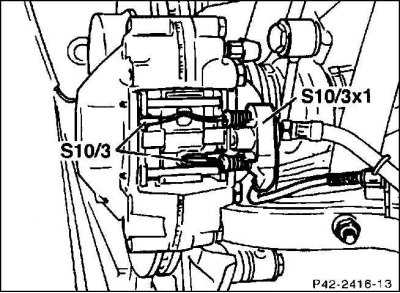
2. Only vehicles with ASR system (traction control system): Remove the wear sensor wire (S10) from the plug connection (S10/3x1). Do not pull on the wire when doing this.
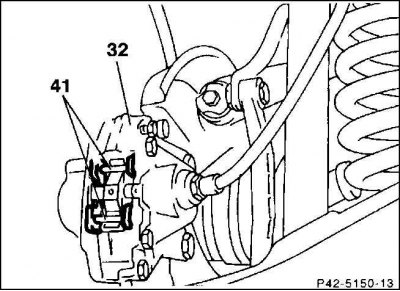
3. Knock out the retaining pins (41) from the caliper (32) using a suitable punch.
4. Remove the cross springs.
5. Remove the pads using a release lever, pliers or a screwdriver. If the pads are rusted, you will need a special puller, such as those from HAZET.
Installation
Attention! When the pads are removed, do not press the brake pedal, otherwise the brake pistons will jump out of the housing. If this happens due to oversight, remove the caliper and assemble it in a specialized workshop.
1. Clean the guide surfaces, respectively, the place where the pads are seated in the housing shaft with a suitable soft metal brush and a vacuum cleaner, or wipe with a cloth with alcohol. Do not use products containing mineral oil or tools with sharp edges for this.
2. Before installing the pads, feel the brake disc with your fingers for any unevenness and measure the thickness of the disc.
3. Check the dust boot (45) for cracks. Replace a damaged dust boot immediately, as dirt that has penetrated quickly disables the caliper. The fixed-brake mechanism must be removed and disassembled in a specialized workshop.
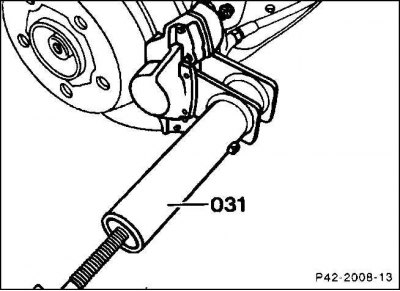
4. Press both brake pistons with a special tool (031). A piece of wood will also do (hammer handle), however, be especially careful not to distort the pistons or damage the piston surface and dust boots.
Attention! When the pistons are retracted, the brake fluid is squeezed out of the brake cylinders into the expansion tank. Monitor the fluid level in the tank, it is advisable to suck out the brake fluid with a siphon.
5. To suck out the fluid, use a plastic bottle that only contained brake fluid. Do not use drinking bottles. Brake fluid is poisonous and should not be sucked out by mouth. Use a suction siphon. After changing the pads, the brake fluid level should not exceed the maximum mark, since the fluid may splash out of the reservoir due to thermal expansion. The leaked fluid, dripping from the master cylinder, corrodes the paintwork, which leads to corrosion.
Attention! If the linings are heavily worn, check the ease of movement of the pistons. To do this, insert a suitable wooden block into the caliper and ask an assistant to slowly press the brake pedal. The brake pistons should easily come out and settle back. To check, there should be a second lining in the assembled opposite caliper.
6. Check the 20-degree position of the piston. In specialized workshops, a template is used for this. As a rule, when removing the linings, do not turn the pistons! Then adjustment is not necessary.
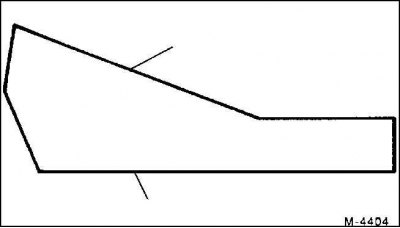
7. Make a template out of cardboard or tin according to the drawing.
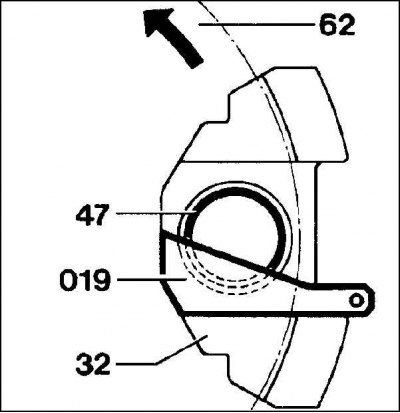
8. The long side of the template should be adjacent to the rear wheel caliper. The brake piston has a step. This step should be adjacent to the oblique side of the template, otherwise turn the piston.
9. Place the template on the lower guide plane in the caliper. The piston position is correct if the mating side (20° position) matches the piston projections. If necessary, carefully turn the piston with a screwdriver. To prevent disc brake squealing, lubricate the back of the brake pad and the sides of its base with a thin layer of grease.
10. Clean the caliper pad guides with a suitable wire brush, being careful not to damage the piston dust boot.
11. Insert the pads into the caliper.
12. Only for vehicles with ASR: Install wear sensors on both pads. Twist the sensor wire into a spiral and connect it to the plug on the caliper. Only transparent, heat-resistant sensors are allowed.
13. Place the cross springs and drive in the retaining pins.
Attention! Pins and springs are subject to replacement.
14. Position the wheels so that the markings applied before removing them match. Screw the wheels on. Remove the car from the stands and tighten the wheel bolts in a cross pattern to a torque of 110 N·m.
Caution: Press the brake pedal vigorously and repeatedly until you feel strong resistance.
15. Check the brake fluid level in the reservoir and top up to the maximum mark if necessary.
16. Carefully break in the new brake pads. To do this, repeatedly accelerate the car to 80 km/h, then brake it to 40 km/h with light pressure on the pedal. Let the brakes cool down a little between braking.
Warning! Avoid emergency braking until the distance is 200 km.
17. Brake shoe linings are a special waste material and in each case, before throwing them away, you should find out whether this is permitted.