



Contents: Removal ↡ Installation ↡
Note: The models in question may be equipped with BENDIX, GIRLING and TEVES brake calipers. They differ slightly in the brake pad mounting system.
Removal
Loosen the wheel bolts.
Jack up the car and support it.
Remove the front or rear wheels.
Caution: Outer and inner pads or right and left pads are not interchangeable. If the pads are mixed up during installation, this may cause brake failure. Always replace all brake pads on one axle at the same time.
Pull out the plug (3) of the brake lining wear indicator (if installed) from the corresponding connector (4). The figure shows the brake caliper of the BENDIX/GIRLING system.
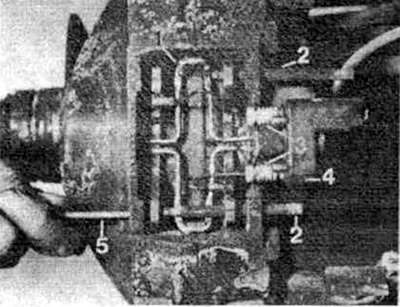
Pull the retainer out of the finger (2) and push the fingers out using the punch (5).
Remove the springs (1) securing the brake pads.
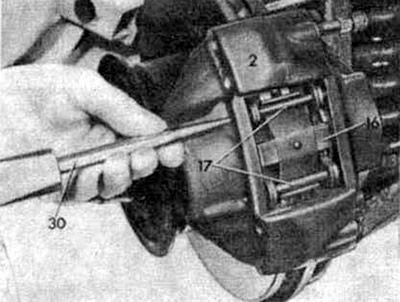
Drive the pins (17) out of the caliper using a punch (30). The figure shows a TEVES brake caliper.
Remove the cross spring (16).
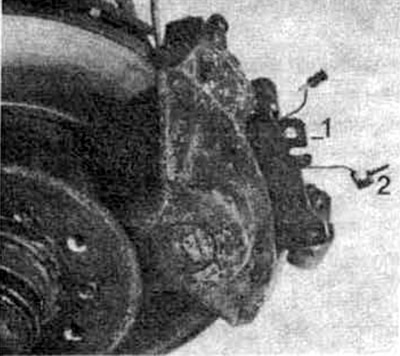
Remove the wear sensor (2) from the brake pad (if installed).
Caution: If the insulation of the contact pin is worn through or the insulation of the sensor or the wire leading to it is damaged, the sensor must be replaced.
Pull out the brake pad (1) using pliers or a screwdriver. If the pad is rusted to the shoe, you will have to use a special puller.
Press the brake shoe so that the pistons enter their cylinders and pull it out. Repeat the above operations for the second shoe.
Installation
Caution: Do not press the brake pedal with the brake pads removed, as this will cause the pistons to be pushed out of their cylinders.
Clean the contact surfaces of the pads with the caliper with a soft metal brush and vacuum cleaner or wipe them with alcohol. Do not use mineral oil-based solvents or sharp tools.
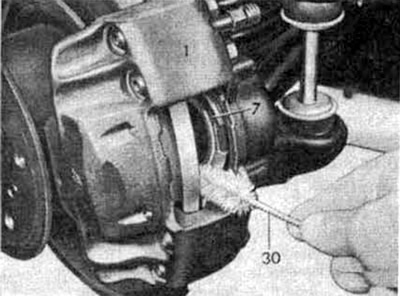
Before installing the pads, run your hand over the brake disc and check that there are no "ridges" on it. A defective disc must be replaced. Before installing new brake pads, it is necessary to clean discs that have gray or blue spots.
Measure the thickness of the brake discs.
Check the dust boots for cracks. Defective dust boots must be replaced, as dirt penetrating the caliper causes brake fluid leaks. In case of leaks, the caliper must be removed and disassembled for repair (is performed in a specialized workshop).
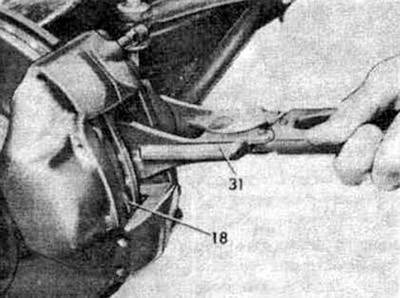
Press both pistons into place using special pliers (31). This operation can be done using a hard wooden tool (for example, hammer handles), however, care must be taken not to damage the pistons or dust boots.
Note: When pushing one piston into place, hold the other one with the brake shoe (18). Otherwise, it will be pushed out. If necessary, you can use an old brake shoe.
Note: When pushing the pistons into the cylinders, the brake fluid flows back into the reservoir. Monitor the fluid level in the reservoir, sucking out excess fluid with a bulb if necessary.
It should be remembered that brake fluid is poisonous and should never be sucked out by mouth through a tube. It is necessary to use only a specially designated bulb or syringe for this purpose. After installing the pads, check that the fluid in the reservoir does not exceed the maximum mark, as it tends to expand when heated. Brake fluid spilled from the reservoir flows down the main brake cylinder and can cause damage and corrosion.
Note: If the brake pads are excessively worn, check the pistons for freedom of movement. If the pistons are sticking, the brake caliper needs to be repaired (produced in the workshop).
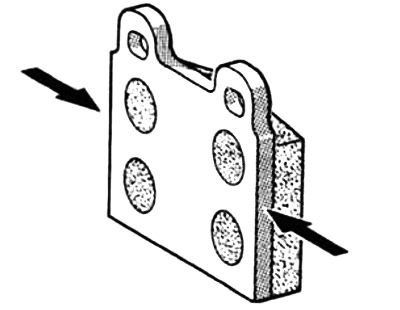
To prevent brake squealing, apply to the rear surfaces of the brake pads and the side surfaces of the support brake discs (see arrows) special lubricant (for example, Plastitube, Tunap VC 582/S, Chevron SRJ/ 2, Liqui Moly LM-36 or LM-508-ASC). Under no circumstances should the lubricant come into contact with the working surfaces of the pads. If it accidentally comes into contact with the working surfaces of the pads, it should be immediately removed with alcohol.
Install the brake pads into the caliper.
Install the springs that secure the pads, being careful not to damage the dust boots. Be careful not to pinch the spring between the dust boot and the caliper.
Drive the pins into place from the inside out, positioning them so that they can be pushed through the brake shoes. When driving the pins into place, make sure that they do not turn.
Push the fingers into the caliper cylinders and check the reliability of the spring fastening.
Install the cross spring and finger retainers.
Caution: When replacing the brake pads, always replace the brake pad tension spring as well.
Install the brake pad wear indicator sensor in place (if any) and connect it to the connector on the support.
Replace the wheel, lower the vehicle and tighten the wheel bolts in a diagonal pattern.
Caution: After finishing the work, press the brake pedal several times with the engine off until you feel a clear resistance in the pedal.
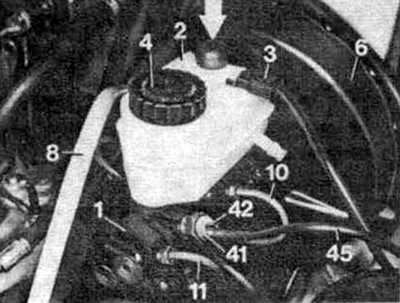
1. Brake master cylinder, 3. Low brake fluid level indicator plug, 4. Cover, 6. Brake servo cylinder, 8. Vacuum tube, 10, 11. Brake tubes, 45. SPD switch wire. The arrow shows the low brake fluid level indicator switch.
Check the fluid level in the tank (2) and, if necessary, top it up to the maximum mark.
Note: On models equipped with a differential pressure indicator (DPA), the indicator light may light up after changing the pads. In this case, it is necessary to press in the pin (42) at the switch (41).
Break in new pads by slowly braking from 80 to 40 km/h several times. Allow the brakes to cool between braking operations.
Caution: After changing the pads, avoid sudden braking for the first 200 km.