



Contents: Removal ↡ Installation ↡
Removal
Loosen the wheel bolts.
Jack up and support the front end.
Remove the front wheel.
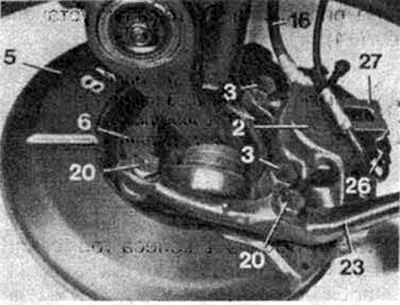
5. Cover. 16. Brake hose. 20. Self-locking bolts. 23. Steering linkage arm. 26. Plug connector. 27. Wire support.
Loosen the fixing screws (3) and remove the caliper (2) from the pivot pin (6).
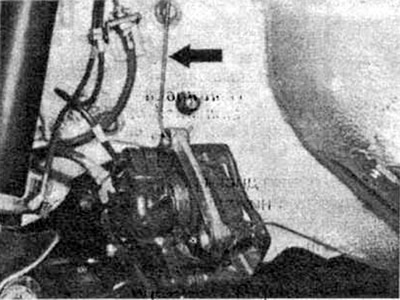
Hang the caliper on a wire hook (shown by arrow) in such a way as not to twist or kink the brake hose and the brake pad wear indicator wire.
Caution: Do not disconnect the brake hose, otherwise you will have to bleed the brake system.
Remove the hub.
Unscrew three hexagon head bolts M12x1.5 in the front part of the hub (on the side where the wheel is installed).
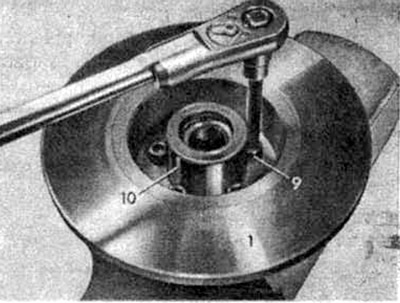
Place the front of the hub (10) in a vice so that the vice jaws rest on the bolts. Remove the retaining bolts (9) from the hub (10) using a socket wrench and remove the brake disc (1).
Installation
In order for both wheels to brake equally, both discs must have the same degree of surface treatment. Therefore, discs should always be replaced in pairs (on both wheels).
Remove rust from the disc flange and from the front of the hub.
Material created based on the website MERCEDESMAN
Wipe new discs with solvent to remove the protective coating.
Secure the new disc to the hub using new self-locking hex head bolts.
Install the hub with the disc on the steering knuckle, install the outer hub bearing in place and tighten the nut.
Adjust the axial clearance of the wheel bearings.
Secure the caliper to the steering knuckle with new self-locking bolts.
Caution: Care must be taken not to twist or kink the brake hose.
Replace the wheel, lower the vehicle and tighten the wheel bolts in a diagonal pattern.
Caution: After finishing work, press the brake pedal several times to allow the new disc to rub against the brake pads.
Check the fluid level in the brake reservoir.