



Attention! If the brake pads are to be used again, they must be marked when removed. It is not allowed to switch the brake pads from the outer side to the inner side and vice versa or from the right wheel to the left. Be sure to replace all the brake pads on one axle at the same time, even if only one of them has reached the wear limit.
Removal
1. Mark the position of the front wheels relative to the hubs with paint. This will allow you to install the balanced wheel in its original position during assembly. Loosen the wheel mounting bolts before jacking up the car. Raise the front of the car, place it on stands and remove the front wheels.
Attention! The operation of lifting and installing the car on stands is associated with danger! Therefore, before carrying out the operation, read the Section Jacking and towing Introduction to the manual.
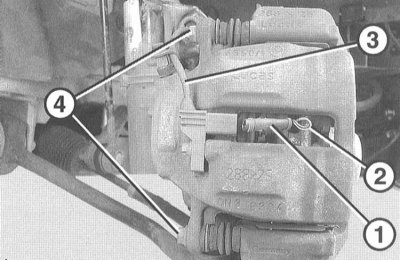
2. Right brake: Remove the plug (1) of the wear sensor from the socket. Do not pull the cable (2). Disconnect the wire (3) of the wear sensor from the holders.
3. Unscrew the mounting bolts (4) at the top and bottom.
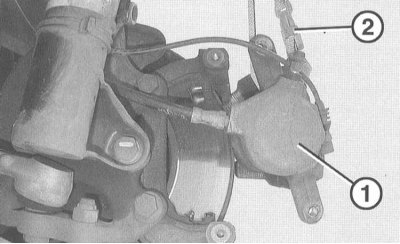
4. Remove the caliper (1) from the brake shoe guide.
5. Secure the caliper to the shock absorber strut with tape (2) or wire. Do not disconnect the brake hose. Otherwise, you will have to bleed the brake system after installation. Make sure that the hose is not stretched.
Caution! Do not press the brake pedal with the caliper removed. Otherwise, the brake cylinder piston will be pushed out of the housing. If the piston is accidentally pushed out, remove the caliper and take it to a service station for assembly.
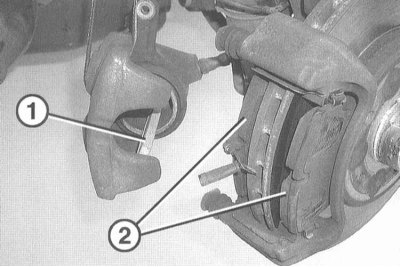
6. Protect the brake cylinder piston from being squeezed out with a block of wood (1).
7. Remove the brake pads (2) from the guide.
8. If you are using the removed brake pads, mark them (inner, outer). This way, you can install them in their original place.
Examination
1. Clean the sliding surfaces and the brake pad seat on the guide with a light metal wire brush and wipe the brake disc with a cloth soaked in alcohol. Do not use mineral solvents or sharp-edged tools for this purpose.
Caution: Use only alcohol to clean the brake.
2. Before installing the brake pads, check the brake disc with your fingers for grooves. If there are grooves, the disc can be turned (work of the service station), if the disc is still thick enough. Otherwise, replace the disc.
3. Measure the brake disc thickness as described in Section Checking the brake disc.
4. Check the locking brackets and replace them with new ones if necessary.
5. Check the piston mudguard for damage. Replace the damaged mudguard immediately, as dirt penetration may cause the caliper to become unsealed. To do this, the caliper must be disassembled (work of the service station).
6. Check if brake fluid is leaking from under the piston. If necessary, have the caliper repaired at a service station or replace it with a new one.
7. Also check the protective cover of the caliper guide pins and replace it if damaged.
Caution! If the brake pads are heavily worn, check the ease of piston movement. To do this, insert a wooden block into the caliper and ask an assistant to slowly press the brake pedal. The piston should be easily pressed in and out. To check, another brake pad and the opposite caliper must be inserted. If the piston moves heavily, replace the caliper.
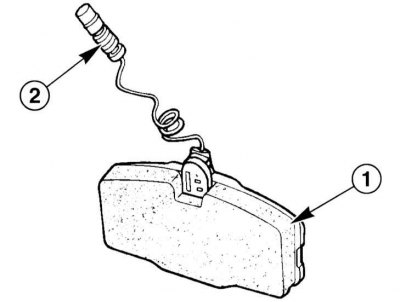
8. Right brake: Remove the wear sensor (1) from the connector on the brake shoe. Replace the damaged wear sensor with a new one. (2) – wear sensor plug.
Installation
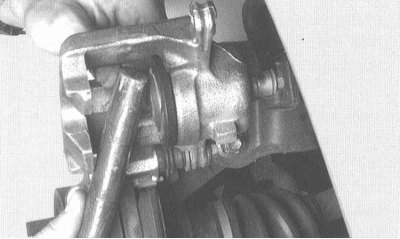
1. Press the brake piston in using a tool. This can also be done using a block of hard wood (hammer handles). In this case, pay special attention to ensure that the piston does not warp and that the protective cover is not damaged.
Attention! When you press the piston, brake fluid is forced out of the brake cylinder into the reservoir. Monitor the fluid level in the reservoir, and suck out the fluid from the reservoir if necessary.
To suck out the fluid, use a special bottle or a plastic bottle that is intended only for storing brake fluid. Do not use a bottle intended for drinking water for this purpose! Brake fluid is poisonous and should never be sucked out by mouth. Use a special suction device for this. After replacing the brake pads, the brake fluid level in the reservoir should not exceed the MAX mark, since the fluid expands when heated. The leaking fluid gets on the master brake cylinder, destroys its paintwork and leads to corrosion.
2. Insert the brake pads from the side at an angle into the retaining clips on the pad guide. If you are installing previously used pads, make sure that they are installed in their original positions.
Caution! There must be no grease or oil on the friction surfaces of the brake disc and brake pads.
3. Insert the caliper into its place in the brake pad guide.
4. Screw in new self-locking bolts at the top and bottom of the caliper and tighten them to a torque of 25 Nm.
5. Right brake: Insert the wear sensor plug into the connector. Insert the wear sensor wire into the holders.
6. Reinstall the front wheels so that the marks made during removal match. Pre-lubricate the centering belt of the wheel disk on the hub with a thin layer of bearing grease. Do not lubricate the wheel mounting bolts. Replace rusty bolts. Tighten the bolts. Lower the car onto the wheels and tighten the bolts crosswise to 110 Nm.
Attention! Press the brake pedal hard several times until you feel a noticeable resistance. This way the brake pads are pressed against the disc and take their working position.
7. Check the brake fluid level in the reservoir, if necessary, add fluid to the MAX mark.
8. Carefully break in the new brake pads. To do this, brake the car several times from 80 km/h to 9. km/h, pressing the brake pedal lightly. Let the brake cool between braking. Do not brake the car hard unless necessary for the first 200 km of driving.
Note: In some areas, brake pads must be disposed of in a special manner. Local authorities provide information on special waste disposal options.
Conduct a reliability check:
- Are the brake hoses secured?
- Is the brake hose secured in the holder?
- Are the air bleed nipples tightened?
- Is there enough brake fluid?
- With the engine running, check for leaks. To do this, press the brake pedal with a force of 200-300 N (20 - 30 kg) within 10 sec. The pedal should not weaken. Check all connections for leaks.
Fixed caliper brakes
Some models have 4-piston fixed caliper brakes at the front. This section only describes the differences in installation and removal of this design. The safety precautions and inspection notes are the same as those previously described.
Note: Illustrations are for informational purposes only and may not fully correspond to the model in question.
Removal
1. Mark the position of the front wheels relative to the hubs with paint. This will allow you to install the balanced wheels in their original position during assembly. Loosen the wheel mounting bolts before jacking up the car. Raise the front of the car, place it on stands and remove the front wheels.
Attention! The operation of lifting and installing the car on stands is associated with danger! Therefore, before carrying out the operation, read the Section Jacking and towing Introduction to the manual.
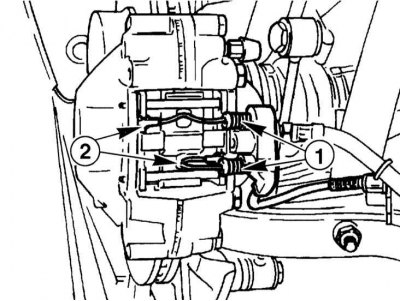
2. Disconnect the connector (1) of the wear sensor (2). Do not pull on the cable.
Note: When assembling, the wire must be routed as shown in the illustration.
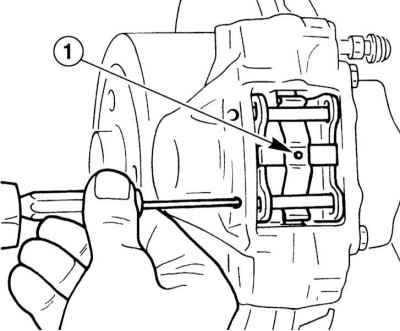
3. Using a suitable punch (∅ 3 mm), knock out the two pins from the outside inwards from the caliper. Remove the shaped spring (1).
4. Remove the brake pads with pliers or a screwdriver. If they are rusted, a special tool is required (e.g. HAZET No.1966-2).
5. If the old brake pads are used, mark them ("inner", "outer") so that they can be installed in their original places.
Caution! Do not press the brake pedal with the caliper removed. Otherwise, the brake cylinder piston will be pushed out of the housing. If the piston is accidentally pushed out, remove the caliper and take it to a service station for assembly.
Installation
1. Using the tool, push out both pistons. This can also be done using the handle of a hammer.
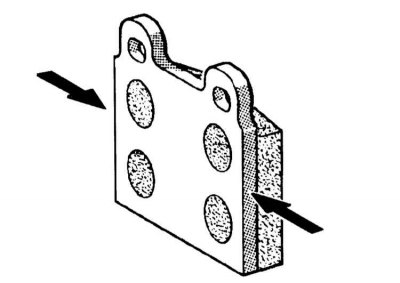
2. To eliminate the grinding of disc brakes, the reverse sides of the brake pads, as well as the sides of the back plate (arrows in the illustration) can be lubricated with a thin layer of brake paste (for example, high temperature copper paste, Plastilube, Liqui Moly LM-36 or LM-508-ASC). Under no circumstances should the paste get on the brake pads or brake disc. If necessary, the paste should be removed immediately and the areas washed with alcohol.
3. Remove the wear sensor from the old brake pads and insert it into the new pads. If the sensor is damaged, it should be replaced.
4. Insert the brake pads into the caliper. If you are installing used pads, make sure they are in their original positions.
5. Insert the wear sensor cable into the connector on the caliper. Route the cable according to its route.
6. Install the new shaped spring and install the new pins using a drift. Drive the drift in until it stops.
Attention! Be sure to replace the shaped spring and pins with new ones.
7. Reinstall the front wheels so that the marks made during removal match. Pre-lubricate the centering belt of the wheel disk on the hub with a thin layer of bearing grease. Do not lubricate the wheel mounting bolts. Replace rusty bolts. Tighten the bolts. Lower the car onto the wheels and tighten the bolts crosswise to 110 Nm.
Conduct a reliability check:
- Are the brake hoses secured?
- Is the brake hose secured in the holder?
- Are the air bleed nipples tightened?
- Is there enough brake fluid?
- With the engine running, check for leaks. To do this, press the brake pedal with a force of 200-300 N (20 - 30 kg) within 10 sec. The pedal should not weaken. Check all connections for leaks.