



Contents: Rules for handling brake fluid ↡ Bleeding the brake system ↡ Note on safety precautions ↡ Security measures ↡
Rules for handling brake fluid
Brake fluid is poisonous. Never suck it up by mouth or through a hose. Store brake fluid only in bottles that cannot be accidentally accessed.
When handling brake fluid, the following rules must be observed:
Brake fluid is aggressive and for this reason should not come into contact with the car's paintwork. If this happens, wipe the contact area immediately and rinse with water.
Brake fluid is hygroscopic, i.e. it absorbs moisture from the air. Store brake fluid only in closed containers.
Caution: Take measures to prevent children from accidentally drinking brake fluid.
Brake fluid that has already been used in the vehicle's brake system should not be used. When bleeding the brake system, also use only new fluid.
Brake fluid specification: DOT4.
Attention! The brake fluid level in the reservoir must be between the MAX and MIN marks.
Brake fluid should not come into contact with mineral oil. Even minor traces of mineral oil make the brake fluid unsuitable for use or lead to failures in the brake system. The cuffs and gaskets of the brake system are damaged when in contact with mineral oils. Do not use rags with traces of mineral oils for cleaning.
Use only new brake fluid to flush and clean brake cylinders, hoses and lines.
Replace brake fluid every 2 years, if possible after cold weather.
Warning! Brake fluid is a hazardous liquid that should never be poured out or thrown away with household waste. Local authorities should provide information on the nearest places to dispose of brake fluid.
Bleeding the brake system
After repairing the brake system, during which it was opened, air may enter the system. In this case, air must be removed from the system. A sign of the presence of air in the system pipes is the pliability of the brake pedal when pressing it. In this case, it is necessary to eliminate the leak and remove air from the system.
At the service station, the brake system is usually filled with liquid, and air is removed from it using a special device. Note: When using the specified device, the filling pressure of the system should not exceed 1 atm. This operation can also be carried out without the specified device. In this case, air is removed from the brake system by rocking movements of the brake pedal, which requires the help of an assistant.
If air has entered any individual brake cylinder, it is necessary to bleed the entire brake system and thus each wheel cylinder. If only one caliper is being replaced or repaired, it is usually sufficient to bleed the relevant brake cylinder.
Note on safety precautions
If one of the chambers of the brake fluid reservoir is completely empty (for example, if there is a leak in the brake system or if you forgot to add fluid to the reservoir when removing air), air is sucked into the system, which enters the ABS pump. In this case, air from the brake system must be removed at a service station using a special device.
The bleeding sequence is: rear right brake, rear left brake, front right and front left brake and clutch slave cylinder.
Caution! Carefully open the air bleed valves so as not to tear them off. It is recommended to spray the valve threads with rust solvent about 2 hours before bleeding. If the valve does not unscrew, it is recommended to carry out this operation at a service station.
While bleeding air, periodically monitor the fluid reservoir. The fluid level should not drop too low, otherwise air may enter the system through the reservoir. Be sure to fill the system with new brake fluid only.
[Material based on data from the portal: MercedesMan.ru]
Unscrew the brake fluid reservoir cap and set it aside. Fill the system with fluid up to the MAX mark.
Mark the position of the wheels relative to the hubs with paint. This will allow you to install the balanced wheels in their original position during assembly. Loosen the wheel mounting bolts before jacking up the car. Raise the car, put it on stands and remove the wheels.
Security measures
The operation of lifting and installing the car on stands is associated with danger! Therefore, before carrying out the operation, read the Section Jacking and towing Introduction to the manual.
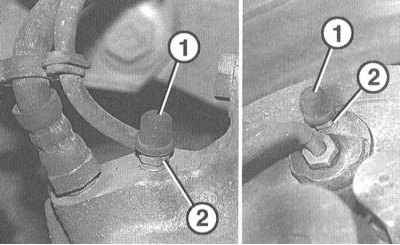
1. Remove the dust cap (1) from the air bleed valve (2) on the wheel cylinder.
2. Clean the valve, put a clean hose on it. Put the other end of the hose in a bottle half filled with brake fluid. Use a special key to unscrew the valve (HAZET 1968-N).
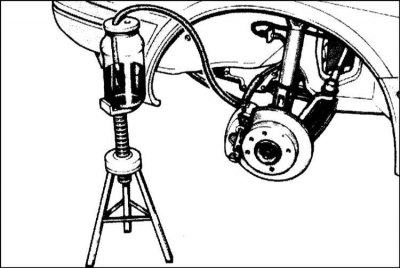
3. Place or hold the fluid bottle at least 30 cm above the bleed nipple. This will prevent air from entering the brake system through the bleed nipple thread.
4. Ask an assistant to pump the brake pedal until the pressure in the system increases. This will be felt by the resistance of the brake pedal.
5. Once the required pressure has been reached, fully press the pedal and hold it with your foot.
6. Using a spanner, loosen the valve on the wheel cylinder by about half a turn.
7. When the liquid starts to flow into the bottle, make sure that the end of the hose in the bottle is always below the liquid level.
8. Once the liquid pressure drops, close the valve.
9. Repeat the process of pumping the pedal until pressure is created. Press the pedal, leave your foot on the pedal, open the air bleed valve so that the pressure is released, and then close the valve.
10. Repeat the process of removing air from the wheel cylinder until there are no air bubbles in the liquid entering the bottle.
11. Carefully tighten the air bleed valve to 7Nm.
12. After completing the operation, remove the hose from the air bleed nipple and put the protective cap on the valve.
13. Similarly, following the above sequence, bleed the air from the other brakes.
14. Install the wheels so that the marks made during removal match. Pre-lubricate the centering belt of the wheel disk on the hub with a thin layer of bearing grease. Do not lubricate the wheel mounting bolts. Replace rusty bolts. Tighten the bolts. Lower the car onto the wheels and tighten the bolts crosswise to 110 Nm.
15. After completing the bleeding process, fill the reservoir with brake fluid to the MAX mark and screw on the cap.
Conduct a reliability check:
- Are the brake hoses secured?
- Is the brake hose secured in the holder?
- Are the air bleed nipples tightened?
- Is there enough brake fluid?
- With the engine running, check for leaks. To do this, press the brake pedal with a force of 200-300 N (20-30 kg) for 10 s. The pedal should not weaken. Check all connections for leaks.
16. Check the operation of the brake system on a road with light traffic. To do this, it is necessary to perform at least one strong braking using the ABS action (can be felt by the pulsation of the brake pedal).
Attention! Watch closely for the transport following you.
Warning! Brake fluid is a hazardous liquid that should never be poured out or thrown away with household waste. Local authorities should provide information on the nearest places to dispose of brake fluid.