
Cars BMW Cars Volkswagen Cars Chevrolet Cars Land Rover Cars Lada Cars Honda Cars Peugeot
English Русский
Български
Беларускі
Український
Српски
Hrvatski
Română
Polski
Slovenský
Magyar
Bookmark News and articles Sitemap Feedback Site search
MercedesMan.ru


A-Class C-Class E-Class G-Class M-Class S-Class Others
190 (W201) (1982-1993) W202 (1993-2000) W203 (2000-2007)
  • Main
  • C-Class
  • W203 (2000-2007)
  • Chassis
  • Brake system
  • Removal and installation the front caliper

Removal and installation the front caliper (Mercedes-Benz C-Class W203)

0
Contents: Removal ↡ Installation ↡

Removal


1. Mark the position of the front wheels relative to the hubs with paint. This will allow you to install the balanced wheels in their original position during assembly. Loosen the wheel mounting bolts before jacking up the car. Raise the front of the car, place it on stands and remove the front wheels.

Attention! The operation of lifting and installing the car on stands is associated with danger! Therefore, before carrying out the operation, read the Section Jacking and towing Introduction to the manual.


Note: If the caliper is removed only to remove the brake pads or brake rotor, there is no need to unscrew the brake line from the caliper. In this case, secure the caliper to the suspension with wire so that the hose is not twisted or stretched.


2. Unscrew the brake hose from the caliper as described in Section Removal and installation the brake hose.

Note: When opening the brake circuit, brake fluid will leak out. Drain it into a bottle that should be used exclusively for this purpose. You can first suck the fluid out of the reservoir using a special device. Observe safety precautions regarding brake fluid, refer to Section Bleeding the brake system.
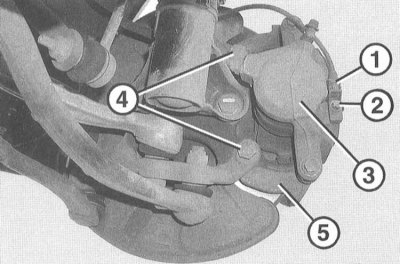

3. Right brake: Remove the wear sensor plug from the connector (1). Do not pull on the cable.…


3. Right brake: Remove the wear sensor plug from the connector (1). Do not pull on the cable. Loosen the screw (2) and remove the connector (1) from the caliper.


4. Remove the brake pads, refer to the relevant section.

Note: If the caliper is to be reinstalled, care must be taken to ensure that the piston does not come out of the cylinder.


5. Remove the bolts (4) at the top and bottom and remove the shoe guide (5) from the steering knuckle.

Caution! High loosening torque! Make sure the car is securely supported on stands and the wrench is horizontal. The indicated bolts can be loosened when the car is still on its wheels.


Installation


1. Install the shoe guide and secure with two new self-locking bolts to a torque of 115 Nm.

Warning! High tightening torque! Make sure the car is securely supported on stands and the torque wrench is horizontal. The bolts can be tightened finally when the car is standing on its wheels.


2. Install the brake pads, refer to the relevant section.

Caution! Do not allow grease or oil to come into contact with the friction surfaces of the brake disc and pads.


3. Right brake: Connect the wear sensor connector to the caliper. Insert the sensor plug into the connector.

4. Install the brake hose, refer to the relevant section.

Caution! The brake hose must not be twisted.


5. Bleed the brake system, refer to the relevant section.

6. Install the front wheel so that the marks made during removal match. Pre-lubricate the centering belt of the wheel disk on the hub with a thin layer of bearing grease. Do not lubricate the wheel mounting bolts. Replace rusty bolts. Tighten the bolts.

Caution: Make sure that the brake hose does not touch the wheel when the steering wheel is turned to its maximum angle.


7. Lower the vehicle onto its wheels and tighten the bolts crosswise to 110 Nm.

Attention! Press the brake pedal hard several times until you feel a noticeable resistance. This way the brake pads fit the disc and take their working position.


8. Check the fluid level in the reservoir, if necessary, add fluid to the MAX mark.

Conduct a reliability check:
  • Are the brake hoses secured?
  • Is the brake hose secured in the holder?
  • Are the air bleed nipples tightened?
  • Is there enough brake fluid?
  • With the engine running, check for leaks. To do this, press the brake pedal with a force of 200–300 N (20–30 kg) for 10 s. The pedal should not weaken. Check all connections for leaks.
This article is available at: russian, bulgarian, belarusian, ukrainian, serbian, croatian, romanian, polish, slovak, hungarian
The article has been verified: Rodionov Artyom Semyonovich
Share with friends:
◀ Previous
C-Class W203 / Brake system
Next ▶

Replacing the front disc brake pads
Brake system specifications
Design and description of the brake system
Replacing rear brake pads
Removal and installation the rear caliper
Removal and installation the brake disc
Checking the brake disc
Dual master cylinder
More similar articles for repairing other models

☛ Front catalytic converter — removal and installation Mercedes W168 (1997-2004)
☛ Front brake caliper Mercedes W124 (1984-1995)
☛ Removal and installation the front cover Mercedes W463 (1999-2019)
☛ Access to the right front seat storage compartment Mercedes W163 (1997-2005)
☛ Removal and installation the front caliper Mercedes W116 (1972-1980, petrol)
☛ Front disc brakes with floating caliper — general information Mercedes Sprinter (1995-2000, diesel)
Link in different formats to this article
Comments and feedback from visitors
No comments yet


How much will 28 + 26 ?


W203 (2000-2007) 
  • General information
  • Introduction to guide
  • User manual
  • Maintenance
  • Power unit
  • Gasoline engines
  • Diesel engines
  • Cooling system
  • Ventilation and heating
  • Supply system
  • Injection system (gasoline)
  • Injection system (diesel)
  • Exhaust system
  • Ignition and control system
  • Charge and launch systems
  • Transmission
  • Mechanical gearbox
  • Automatic gearbox
  • Clutch and drive shafts
  • Differential
  • Chassis
  • Brake system
  • Car suspension
  • Steering
  • Body
  • Exterior (external elements)
  • Interior (internal elements)
  • Electrical equipment
  • Equipment and devices
  • Lighting system
  • Electrical diagrams (2000)
  • Electrical diagrams (since 2001)
W202 (1993-2000) 
  • General information
  • User manual
  • Driving a car
  • Car care
  • Maintenance
  • Power unit
  • Gasoline engines
  • Diesel engines
  • Lubrication system
  • Cooling system
  • Heating and ventilation
  • Ignition system
  • Fuel system
  • Injection system (gasoline)
  • Injection system (diesel)
  • Exhaust system
  • Transmission
  • Clutch
  • Car gearbox
  • Chassis
  • Suspension, wheels and tires
  • Steering
  • Brake system
  • Body
  • Exterior (external elements)
  • Interior (internal elements)
  • Doors and windows
  • Electrical equipment
  • Equipment and devices
  • Power devices
  • Lighting system
  • Electrical circuits
190 (W201) (1982-1993) 
  • General information
  • Introduction to the guide
  • Operation and care
  • Maintenance (gasoline)
  • Maintenance (diesel)
  • Troubleshooting
  • Power unit
  • Petrol engine I4
  • Petrol engine V6
  • Diesel engines
  • Engine overhaul
  • Cooling and heating
  • Power system (carburetor)
  • Injection system (gasoline)
  • Injection system (diesel)
  • Exhaust system
  • Charge and start system
  • Ignition system (I4)
  • Ignition system (V6)
  • Diesel heating system
  • Transmission
  • Clutch
  • Mechanical gearbox
  • Automatic gearbox
  • Cardan shaft and axle shafts
  • Chassis
  • Brake system
  • Car suspension
  • Steering
  • Body
  • Exterior (external elements)
  • Interior (internal elements)
  • Doors, locks and windows
  • Electrical equipment
  • Equipment and devices
  • Electrical circuits
 
MercedesMan.ru © 2017–2026 · Mobile version · Read about Mercedes · Sitemap: EN BG BY UA RS HR RO PL SK HU · Feedback · Site search · Bookmark A-Class (W168) · C-Class (W201) · C-Class (W202) · C-Class (W203) · E-Class (W123) · E-Class (W124) · E-Class (W210) · G-Class (W463) · M-Class (W163) · S-Class (W116, petrol) · S-Class (W126, petrol) · S-Class (W140) · S-Class (W220) · Sprinter · Vito 1 · Vito 2 · Vario 814D ·
 
We only use cookies without which some of the site's features may not be available.