
Cars BMW Cars Volkswagen Cars Chevrolet Cars Land Rover Cars Lada Cars Honda Cars Peugeot
English Русский
Български
Беларускі
Український
Српски
Hrvatski
Română
Polski
Slovenský
Magyar
Bookmark News and articles Sitemap Feedback Site search
MercedesMan.ru


A-Class C-Class E-Class G-Class M-Class S-Class Others
190 (W201) (1982-1993) W202 (1993-2000) W203 (2000-2007)
  • Main
  • C-Class
  • W203 (2000-2007)
  • Chassis
  • Brake system
  • Checking the brake booster

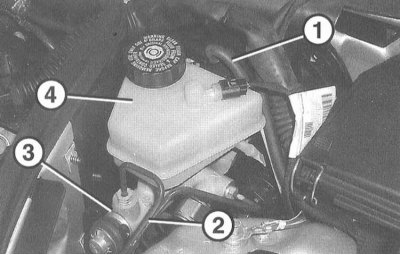
Checking the brake booster (Mercedes-Benz C-Class W203)

0
1 - Vacuum hose

1 - Vacuum hose
2 - Brake pipe
3 — Master brake cylinder
4 — Brake fluid reservoir


The driver's foot pressure on the brake pedal is amplified by the brake booster, using the vacuum created in the engine's intake manifold. In a diesel engine, the vacuum required for this purpose is created by a vacuum pump mounted on the engine flange. The operation of the brake booster should be checked if excessive force is required on the brake pedal to stop the vehicle.

1. Press the brake pedal at least five times with the vehicle not running. Then, with the pedal pressed, start the engine. The pedal should give noticeably under the driver's foot.

2. Otherwise, open the hood and remove the cover on the driver's side above the brake booster. The brake booster is located in the engine compartment directly on the bulkhead.

3. Disconnect the vacuum hose (1) at the brake booster. Start the engine. Place your finger on the end of the vacuum hose to check if there is vacuum.

Diesel Engine: Disconnect the vacuum hose from the vacuum pump and check the vacuum at the hose connection point.

Article borrowed from the web portal www.mercedesman.ru


4. If there is no vacuum, check the hose for leaks and damage, replace the hose if necessary.

5. If there is a vacuum, measure its value, replace the booster if necessary (work of the service station).
This article is available at: russian, bulgarian, belarusian, ukrainian, serbian, croatian, romanian, polish, slovak, hungarian
The article has been verified: Rodionov Artyom Semyonovich
Share with friends:
◀ Previous
C-Class W203 / Brake system
Next ▶

Removal and installation the brake hose
Bleeding the brake system
Removal and installation the brake light switch
Removal and installation the parking brake cable
Replacing the parking brake pads
 
More similar articles for repairing other models

☛ Brake fluid — checking the level Mercedes W168 (1997-2004)
☛ Checking the brake booster Mercedes W210 (1996-2002)
☛ Checking the proper functioning of the brake booster Mercedes W463 (1999-2019)
☛ Checking the proper functioning of the brake booster Mercedes W163 (1997-2005)
☛ Removal, installation and checking of the functioning of the brake… Mercedes W140 (1991-1998)
☛ Checking the brake fluid level Mercedes Sprinter (1995-2000, diesel)
Link in different formats to this article
Comments and feedback from visitors
No comments yet


How much will 50 + 14 ?


W203 (2000-2007) 
  • General information
  • Introduction to guide
  • User manual
  • Maintenance
  • Power unit
  • Gasoline engines
  • Diesel engines
  • Cooling system
  • Ventilation and heating
  • Supply system
  • Injection system (gasoline)
  • Injection system (diesel)
  • Exhaust system
  • Ignition and control system
  • Charge and launch systems
  • Transmission
  • Mechanical gearbox
  • Automatic gearbox
  • Clutch and drive shafts
  • Differential
  • Chassis
  • Brake system
  • Car suspension
  • Steering
  • Body
  • Exterior (external elements)
  • Interior (internal elements)
  • Electrical equipment
  • Equipment and devices
  • Lighting system
  • Electrical diagrams (2000)
  • Electrical diagrams (since 2001)
W202 (1993-2000) 
  • General information
  • User manual
  • Driving a car
  • Car care
  • Maintenance
  • Power unit
  • Gasoline engines
  • Diesel engines
  • Lubrication system
  • Cooling system
  • Heating and ventilation
  • Ignition system
  • Fuel system
  • Injection system (gasoline)
  • Injection system (diesel)
  • Exhaust system
  • Transmission
  • Clutch
  • Car gearbox
  • Chassis
  • Suspension, wheels and tires
  • Steering
  • Brake system
  • Body
  • Exterior (external elements)
  • Interior (internal elements)
  • Doors and windows
  • Electrical equipment
  • Equipment and devices
  • Power devices
  • Lighting system
  • Electrical circuits
190 (W201) (1982-1993) 
  • General information
  • Introduction to the guide
  • Operation and care
  • Maintenance (gasoline)
  • Maintenance (diesel)
  • Troubleshooting
  • Power unit
  • Petrol engine I4
  • Petrol engine V6
  • Diesel engines
  • Engine overhaul
  • Cooling and heating
  • Power system (carburetor)
  • Injection system (gasoline)
  • Injection system (diesel)
  • Exhaust system
  • Charge and start system
  • Ignition system (I4)
  • Ignition system (V6)
  • Diesel heating system
  • Transmission
  • Clutch
  • Mechanical gearbox
  • Automatic gearbox
  • Cardan shaft and axle shafts
  • Chassis
  • Brake system
  • Car suspension
  • Steering
  • Body
  • Exterior (external elements)
  • Interior (internal elements)
  • Doors, locks and windows
  • Electrical equipment
  • Equipment and devices
  • Electrical circuits
 
MercedesMan.ru © 2017–2026 · Mobile version · Read about Mercedes · Sitemap: EN BG BY UA RS HR RO PL SK HU · Feedback · Site search · Bookmark A-Class (W168) · C-Class (W201) · C-Class (W202) · C-Class (W203) · E-Class (W123) · E-Class (W124) · E-Class (W210) · G-Class (W463) · M-Class (W163) · S-Class (W116, petrol) · S-Class (W126, petrol) · S-Class (W140) · S-Class (W220) · Sprinter · Vito 1 · Vito 2 · Vario 814D ·
 
We only use cookies without which some of the site's features may not be available.