



Contents: Examination ↡ Removal and installation ↡
Examination
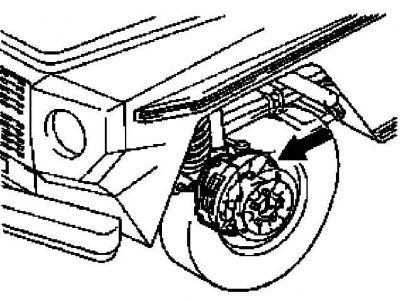
Visual inspection of the condition of the brake pads
Arrow - Direction of View
1. Visual assessment of the condition of the pads can be made through the opening in the wheel disk and the inspection window in the brake mechanism (arrow). In parallel, it makes sense to assess the condition of the brake disk.
2. Prepare replacement components if necessary.
Removal and installation
Attention! Brake pads must be changed as a set for both wheels of the same axle at the same time!
Brakes with fixed calipers
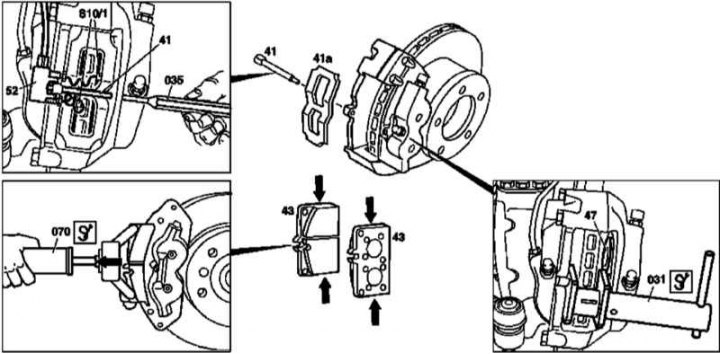
Brake Pad Installation Details for Fixed Calipers (1 of 2)
41 - Mounting pin; 41a - Spring plate; 43 - Pads; 47 - Wheel cylinder piston; 52 - Contact block; 031 - Wringer; 035 - Punch; 070 - Puller; S10/1 - Left front brake pad wear sensor
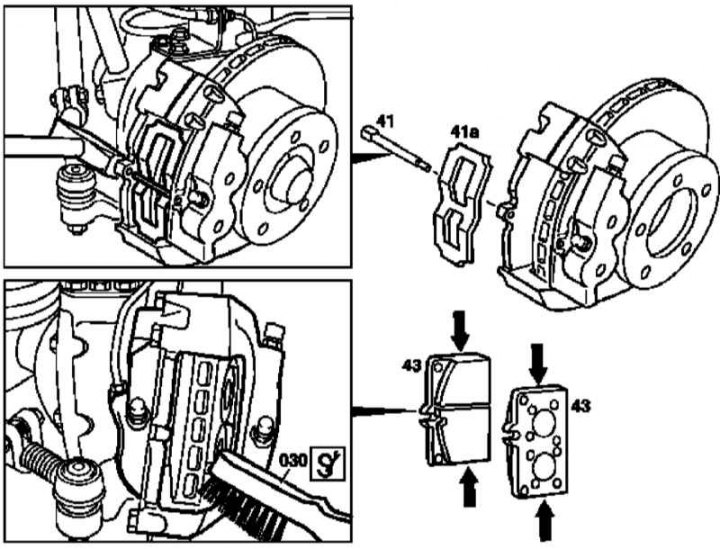
Brake Pad Installation Details for Fixed Calipers (2 of 2)
030 - Caliper Cleaning Brush
1. Release the brake pad wear sensor from the contact block (52) (S10/1 or S10/2).
2. Using a punch (035), remove the mounting pin (41).
3. Remove the steel spring plate (41a).
4. Using the puller (070), remove the brake pads (43).
Text republished from the website [mercedesman.ru]
5. Separate the friction lining wear sensor from the pad (S10/1 or S10/2).
Note: Defective sensors should be replaced.
6. Using a special device (031), press the piston (47) of the wheel cylinder - first pump out some liquid from the reservoir, ensuring a certain reserve volume for raising the level.
Note: The opposite pair of pistons should be blocked from being pushed out using wooden spacers.
7. Proceed in a similar manner to press the opposite pistons, being careful not to bend the heat shield.
8. Clean the guide surfaces of the caliper using a special brush (030).
9. Installation is carried out in the reverse order - before installing the pads, lightly lubricate their side surfaces (arrows) with a special paste. Make sure that the mounting pin is seated in the caliper until it stops - use the drift again.
10. Finally, check the brake fluid level in the reservoir and make the appropriate adjustments if necessary.
Braking mechanisms with floating calipers
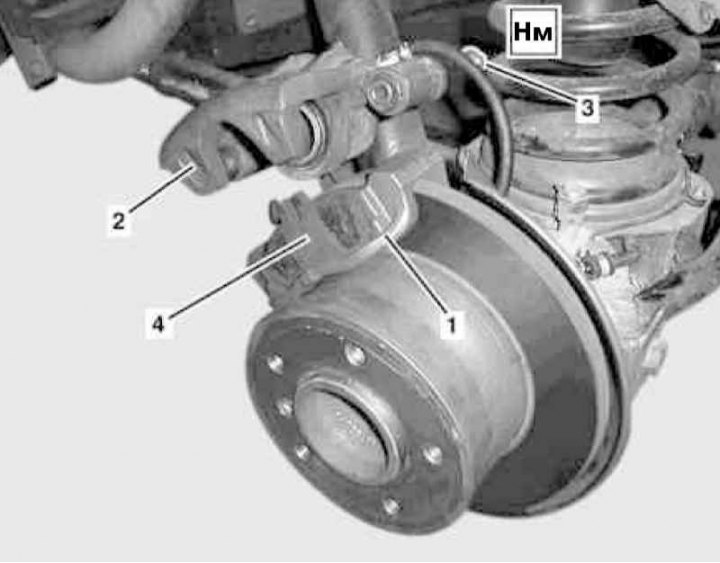
Details of installation of brake pads in floating type calipers (rear axle)
1 - Anchor bracket; 2 - Support; 3 - Bolts; 4 - Pads
1. Remove the bolts (3) from the anchor bracket (1).
2. Without disconnecting the brake hose, remove the caliper (2).
3. Remove the brake pads (4).
4. Press the pistons into the cylinders - make sure that the liquid does not squeeze out over the edge of the master cylinder reservoir; if necessary, pump out the excess.
5. Clean the caliper using a special brush.
6. Installation is carried out in the reverse order. Do not forget to check and, if necessary, adjust the fluid level in the master cylinder reservoir.