
Cars BMW Cars Volkswagen Cars Chevrolet Cars Land Rover Cars Lada Cars Honda Cars Peugeot
English Русский
Български
Беларускі
Український
Српски
Hrvatski
Română
Polski
Slovenský
Magyar
Bookmark News and articles Sitemap Feedback Site search
MercedesMan.ru


A-Class C-Class E-Class G-Class M-Class S-Class Others
W463 (1999-2019)
  • Main
  • G-Class
  • W463 (1999-2019)
  • Chassis
  • Brake system
  • Removal and installation the brake booster and the BAS diaphragm stroke sensor

Removal and installation the brake booster and the BAS diaphragm stroke sensor (Mercedes-Benz G-Class W463)

0
Contents: Assembling the vacuum booster ↡ BAS diaphragm stroke sensor ↡
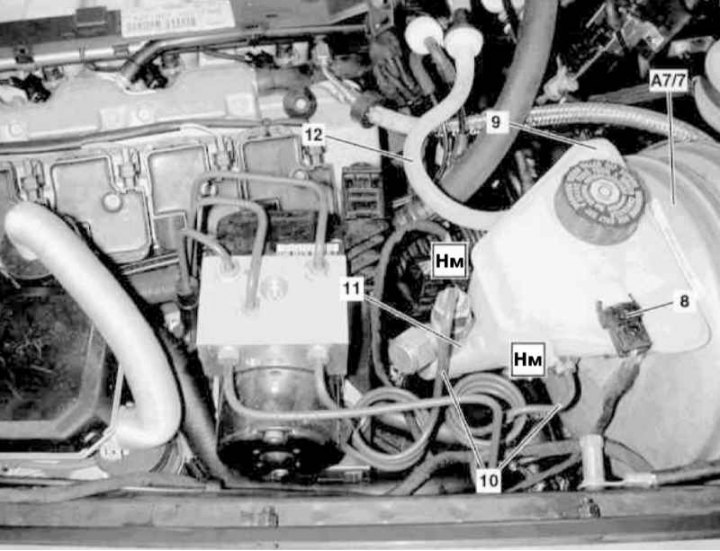
Assembling the vacuum booster


Brake Booster Installation Details (1 of 4)

Brake Booster Installation Details (1 of 4)
8 - Brake fluid level sensor wiring connector; 9 - Brake fluid reservoir; 10 - Brake lines; 11 - GTZ; 12 - Vacuum line; A7/7 - Brake booster
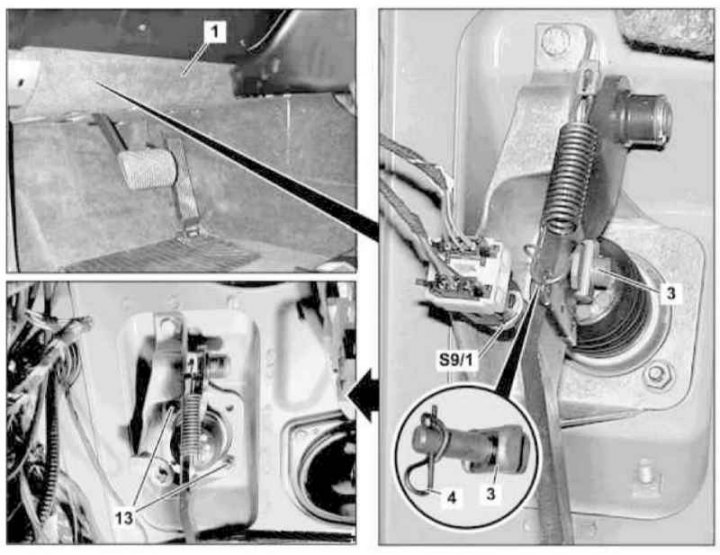

Brake Booster Installation Details (2 of 4)

Brake Booster Installation Details (2 of 4)
1 - Cover on the left under the instrument panel; 3 - Mounting bolt; 4 - Cotter pin; 13 - Nuts; S9/1 - Brake light switch sensor
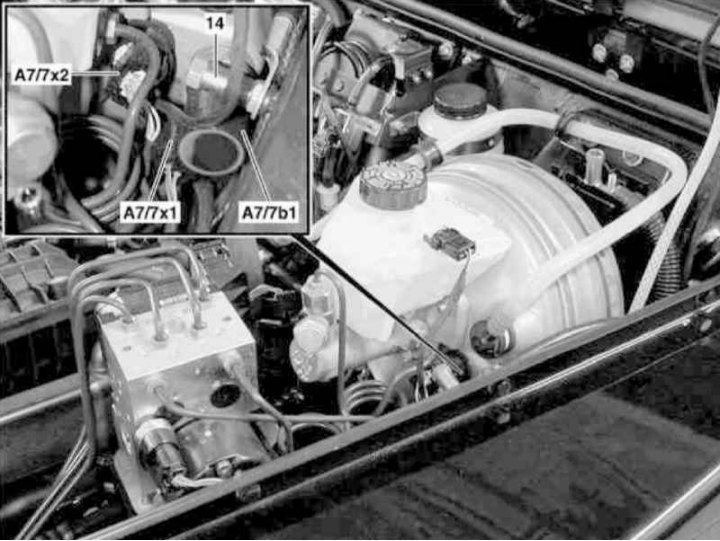

Brake Booster Installation Details (3 of 4)

Brake Booster Installation Details (3 of 4)
14 - Clamp bolt; 16b - Retaining ring; A7/7x1 - BAS diaphragm stroke sensor wiring connector; A7/7x2 - BAS Release Solenoid Valve/Sensor Wiring Connector; A7/7b1 - BAS diaphragm stroke sensor
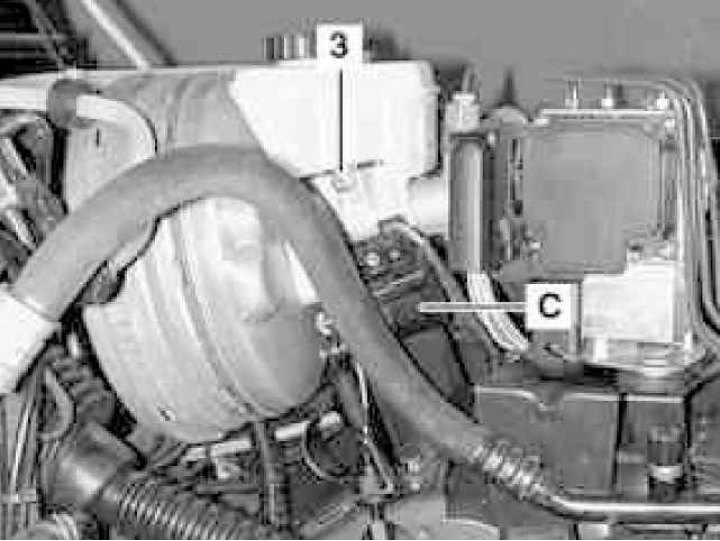


Brake Booster Installation Details (4 of 4)

Brake Booster Installation Details (4 of 4)
3 - Mounting bolt
C — Control unit


1. Disconnect the connector (8) of the brake fluid level sensor wiring on the brake fluid reservoir (9).

2. Disconnect the brake lines (10) from the brake master cylinder (11).

3. Disconnect the connector (A7/7x2) of the BAS solenoid valve/switch-sensor wiring, and the connector (A7/7x1) of the BAS diaphragm stroke sensor.

4. In order to expand the free space, unscrew the clamp bolt (14) of the ground terminal for starting the engine from an external power source.

5. After releasing the vacuum by pressing the foot brake pedal several times, disconnect the vacuum line (12) from the brake booster (A7/7) - assess the condition of the rubber bushing securing the line, and replace it if necessary.

6. To increase the free space, remove the control unit (C) and move it to the side without disconnecting any communication lines.

7. Remove the cover (1) on the left under the instrument panel.

8. Turn to the left, pull and remove the brake light switch sensor (S9/1).

9. Remove the cotter pin (4) and remove the bolt (3) securing the pusher to the foot brake pedal. Assess the condition of the bolt, and if necessary, prepare a replacement element - the cotter pin must be replaced without fail.


10. Remove the nuts (13) - all self-locking fasteners must be replaced without fail.

11. Remove the brake booster (A7/7) complete with the brake master cylinder (11).

12. Installation is carried out in the reverse order - lubricate the assembly seating surface with sealant before installation.

13. Finally, bleed the brake system (see Section Bleeding the brake system), inspect its hydraulic system for signs of developing leaks and check the correct operation of the brake lights.

BAS diaphragm stroke sensor


1. The installation details of the BAS diaphragm stroke sensor are shown in the illustration Brake booster installation details (3 of 4)

2. By pressing the foot brake pedal several times, relieve the residual vacuum in the brake booster system in order to release the sensor sealing ring.

Note: If the o-ring becomes trapped in the booster assembly, the sensor must be replaced.


(Publication taken from an online resource: «www.mercedesman.ru»)

3. In order to expand the free space, unscrew the clamp bolt (14) of the ground terminal for starting the engine from an external power source.

4. Disconnect the connector (A7/7x1).

5. Using a suitable tool, remove the retaining ring (16b) - the ring must be replaced without fail.

6. Pull the sensor (A7/7b1) out of its socket.

7. Installation is carried out in the reverse order - make sure that the sealing and retaining rings are seated correctly. Before inserting the sensor into the sealing ring, moisten it from the front with soapy water.

8. Start the engine, press the foot brake pedal several times, then turn off the ignition again and make sure there are no signs of air being sucked in through the sensor.
This article is available at: russian, bulgarian, belarusian, ukrainian, serbian, croatian, romanian, polish, slovak, hungarian
The article has been verified: Polyakov Zakhar Grigorievich
Share with friends:
◀ Previous
G-Class W463 / Brake system
Next ▶

Removal and installation the brake fluid reservoir and the brake master cylinder (BMC)
Checking the proper functioning of the brake booster
Checking the brake system for leaks
Brake system specifications
General information about the brake system and safety precautions
Removal and installation a vacuum pump (diesel engines)
Removal and installation ABS/EBV/ESP control modules
Removal and installation of the ABS hydraulic modulator / 4-ETS
Removal and installation ABS wheel sensors
Removal and installation ABS wheel sensor rotors
More similar articles for repairing other models

☛ Brake booster vacuum — check Mercedes W168 (1997-2004)
☛ Checking the brake booster Mercedes W203 (2000-2007)
☛ Vacuum brake booster — removal and installation Mercedes W123 (1976-1985)
☛ Removal and installation the brake booster and the BAS diaphragm… Mercedes W163 (1997-2005)
☛ Emergency Brake Booster (BAS) Mercedes W140 (1991-1998)
☛ Brake booster — general information Mercedes Sprinter (1995-2000, diesel)
Link in different formats to this article
Comments and feedback from visitors
No comments yet


How much will 32 + 23 ?


W463 (1999-2019) 
  • General information
  • Introduction to the guide
  • Controls and instruments
  • Driving and operation
  • Maintenance
  • Power unit
  • Engine repair
  • Cooling system
  • Heating and ventilation
  • Power system (gasoline)
  • Fuel system (diesel)
  • Exhaust system
  • Ignition and control system
  • Charging and starting system
  • Transmission
  • Automatic gearbox
  • Transfer case
  • Axles front and rear
  • Chassis
  • Brake system
  • Front suspension
  • Rear suspension
  • Steering
  • Body
  • Exterior (external elements)
  • Interior (internal elements)
  • Doors, locks and windows
  • Electrical equipment
  • Equipment and devices
  • Switches in salon
  • Headlights and lighting
  • Audio system and navigation
  • Electrical circuits
 
MercedesMan.ru © 2017–2026 · Mobile version · Read about Mercedes · Sitemap: EN BG BY UA RS HR RO PL SK HU · Feedback · Site search · Bookmark A-Class (W168) · C-Class (W201) · C-Class (W202) · C-Class (W203) · E-Class (W123) · E-Class (W124) · E-Class (W210) · G-Class (W463) · M-Class (W163) · S-Class (W116, petrol) · S-Class (W126, petrol) · S-Class (W140) · S-Class (W220) · Sprinter · Vito 1 · Vito 2 · Vario 814D ·
 
We only use cookies without which some of the site's features may not be available.