



Braking system with ABS and ASR
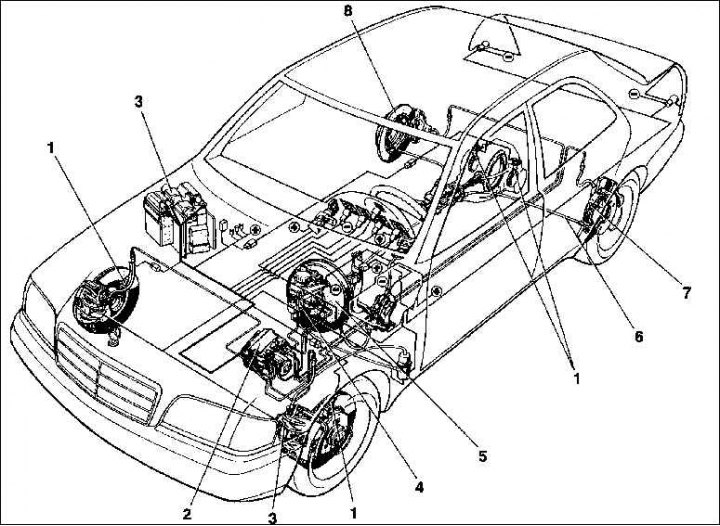
1. Speed sensor; 2. Hydraulic block; 3. Front brake mechanism; 4. Master brake cylinder; 5. Brake booster; 6. Parking brake cable; 7. Parking brake drums; 8. Rear brake discs
The hydraulic brake system with foot drive consists of a master brake cylinder, a hydraulic brake booster, and disc brakes on the front and rear wheels. The brake system has two circuits. One of the circuits covers the front wheels, the second – the rear wheels. If one of the circuits fails, for example, due to a leak, the car can be braked using only the second circuit. The pressure in both circuits is created in the dual master brake cylinder by pressing the brake pedal.
The brake fluid reservoir is located above the master cylinder and supplies brake fluid to the entire system.
The brake booster accumulates part of the suction vacuum obtained by the engine. Since the diesel engine does not generate sufficient suction vacuum, diesel models have a special vacuum pump for the brake system. In this case, the force is transmitted to the brakes via the vacuum through the corresponding valve.
The front disc brakes are equipped with a floating caliper disc mechanism. In this case, only one piston is needed to press both brake pads against the brake disc. The rear axle has fixed caliper brake mechanisms, which provide the required deceleration. In order to press the brake pads in the case of a mechanism with fixed calipers, two pistons are needed.
The parking brake is operated by a cable and acts only on the rear wheels. Since disc brakes are not very suitable as parking brakes, two brake drums are additionally located on the rear wheels, built into the brake discs. The brake drums are used exclusively for parking.
When cleaning the brake system, dust from the wear of the linings flies, which is harmful to health. Therefore, when cleaning the brakes, be careful not to inhale the brake wear products. Brake linings are part of the "Permission to operate the vehicle under these conditions", in addition, they differ depending on the model. It is recommended to use only branded brake linings.
Note: After installing new pads, they must be run in. During the running-in period, (about 200 km) avoid unnecessary abrupt braking.
Working on the brake system requires thorough cleanliness and precise adherence to technology. If you have no experience, contact a workshop.
Caution! If you feel different pedal travel when braking, especially when turning, you should check the brake discs for lateral runout on the outside diameter. Excessive lateral runout can be caused by increased bearing play. Therefore, check this play first and adjust it if necessary. If this does not improve sufficiently, replace the brake disc.