



Contents: Removal ↡ Installation ↡ Brake booster control ↡ Parking brake ↡ Removal the brake cable ↡ Removal the pedal device ↡ Installation ↡
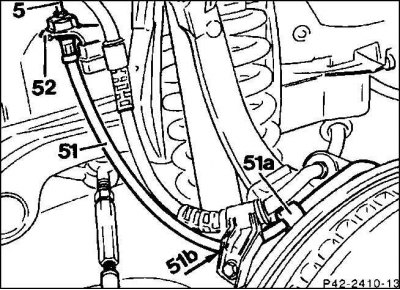
Front axle brake hose |
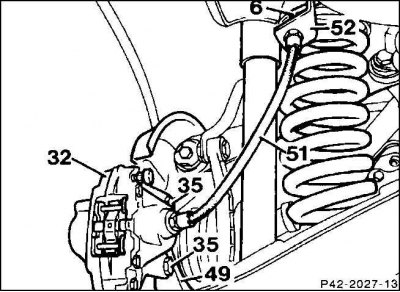
Rear axle brake hose |
Removal
1. Raise the car.
2. Remove the union nut from the brake line.
Caution! Brake fluid will leak out. Close the brake line connection towards the brake master cylinder with a suitable plug to prevent the brake fluid from leaking out of the reservoir completely. After reassembly, the brake system must be bled. A special device is required to bleed the brakes of vehicles with ASR, so contact a repair shop. Collect the brake fluid in containers intended exclusively for it.
[Article borrowed from the web portal www.mercedesman.ru]
3. If possible, route the new brake fluid line in the same location.
4. When connecting the pipe, wet the conical mating surface with a few drops of brake fluid and tighten to a torque of 15 N·m.
5. Unscrew the brake pipe (5) or (6) from the brake hose (51). Use an open-end spanner 9x11, holding the brake hose with an open-end spanner. Close the connection element with a plug.
6. Disconnect the brake hose holder (51a).
7. Unscrew the brake hose (51) from the caliper.
Installation
1. Install only brake hoses approved by the company.
2. Tighten the brake hose to the caliper to 20 Nm.
3. Screw the brake hose to the brake pipe with a torque of 15 N·m. The brake hose must not be twisted during installation. Secure the lock washer to the holder with a twelve-sided wrench. Insert the brake hose into the lock washer so that it does not hit anything when the steering wheels are fully turned left or right. 4 - brake pipe, 13 - union bolt, 59 - brake hose holder.
Caution! After repair, the holder (52) may be bent. Carefully straighten it, as even a slight change in the position of the holder on the base of the frame may change the route of the brake hose, as a result of which it may wear out when in contact with other parts of the car.
4. Bleed the brakes.
Attention! Conduct a safety check:
- are all brake lines/hoses tightened?;
- are the bleed screws tightened?;
- is the brake fluid level ok;
- with the engine running, check for leaks. To do this, press the brake pedal with a force of 200 to 300 N (20–30 kg) for about 10 seconds. The pedal should not move. Check the tightness of all connections.
5. Finally, make a few braking attempts on a quiet street.
Brake booster control
The brake booster is checked if too much force must be applied to the brake pedal to achieve sufficient braking effect.
1. With the engine stopped, press the brake pedal hard at least 5 times, then start the engine with the brake pedal loaded. The brake pedal should give noticeably under your foot.
2. If not, unscrew the vacuum hose from the brake booster, start the engine, and check for vacuum by placing your fingers on the end of the vacuum hose.
3. If there is no vacuum, check the hose for leaks and damage, replace it if necessary. Tighten all hose clamps securely.
4. If there is a vacuum, measure it and replace the brake booster if necessary (work in a repair shop).
Parking brake
Pedal/Cable Front Drive
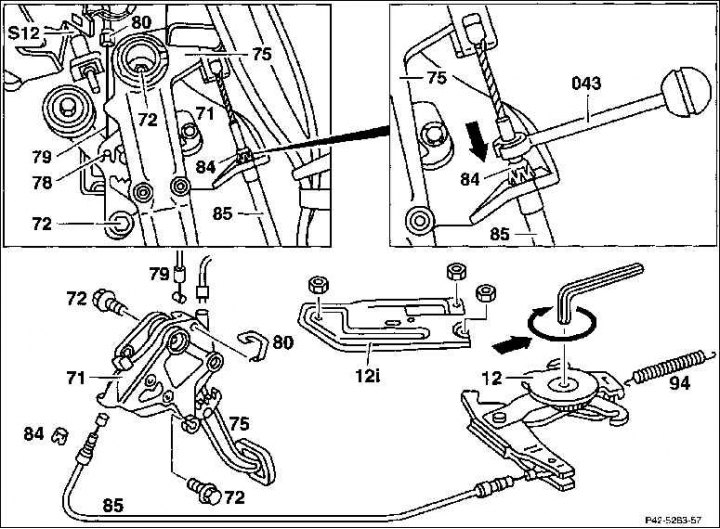
12i. Protective cover; 12. Automatic cable length equalizer; 94. Return spring; 85. Front brake cable; 75. Movable bar; 84v. Tension ring; 043. Spreader; 71. Body; 73. Hex bolts; S12. Parking brake switch plug; 80. Spring clamp; 79. Traction; 71. Pedal; 94. Return spring
Removal the brake cable
1. Remove the rear seat.
2. Remove the protective cover (12i).
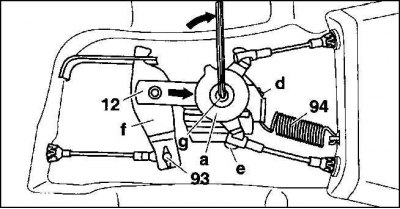
3. Tighten the automatic cable length equalizer (12). To do this, use an Allen key to turn the crank (g) approximately 1/2 turn to the right and at the same time push it back in the longitudinal slot until it locks into the spring housing (a) in the spring clamp (g). (e - equalizer lever, f - intermediate lever, 93 - safety pin.)
4. Unhook the release spring (94).
5. Disconnect the brake cable (85) from the movable bar on the pedal, press together the clamping ring (85b) with the expansion device (043) and pull out the cable. If there is no expansion device available (special tool), the cable can be removed by removing the tension ring. When installing, insert the tension ring into the cable groove.
Removal the pedal device
1. Remove the housing from the pedal unit and unscrew the hex bolts (72).
2. Disconnect the connector of the parking brake control switch (S12). To do this, lift the pedal assembly slightly.
3. Remove the spring clip.
4. Disconnect the manual adjustment cable (79) and remove the pedal assembly.
Installation
1. Installation is carried out in the reverse order of disassembly of the pedal device.
2. Before installing the protective cover, loosen the cable length equalizer. To do this, lift the spring clamp with a screwdriver. After this, the cable length equalizer is installed automatically.
3. Apply the parking brake several times, it will adjust itself.