



Warning! Do not reuse used brake fluid! Used brake fluid is easily distinguished from fresh brake fluid by its darker color.
Warning! Never drain brake fluid into the sewer or dispose of it in household waste containers! Information on the rules for disposal of technical fluids can be obtained at service stations.
General information
The tools required to perform the described procedure include the following:
- Open-end wrench for unscrewing the air bleed nipple;
- Transparent plastic hose with an internal diameter of 6 mm and a container for collecting brake fluid;
- The required amount of brake fluid corresponding to Specifications;
Hydraulic fluid absorbs moisture from the atmosphere through the pores of the brake hoses and the ventilation hole of the master brake cylinder (MBC) reservoir, as a result of which its boiling point gradually drops during vehicle operation, which is associated with the risk of reducing the efficiency of the brake mechanisms as a result of active vaporization in the hydraulic tract under high braking loads.
Brake fluid should be replaced at least once every two years, preferably in the spring.
Note: When operating the vehicle in hilly areas, the brake fluid should be changed more frequently.
At the service station, air is usually removed from the brake system using a special device, however, if necessary, the brake system can also be bled using the foot brake pedal - an assistant will be required. A description of the brake system bleeding procedure is given in Chapter Brake and auxiliary systems.
Procedure execution order
Using a reserve tank and a pumping device
1. Unscrew the brake master cylinder reservoir cap.
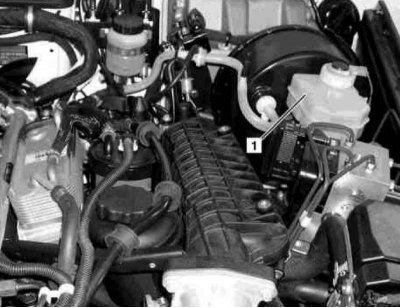
2. Using a syringe or rubber bulb, pump out the liquid from the reservoir.
3. Following the manufacturers instructions, connect a reserve tank of brake fluid and a device for bleeding the system to the reservoir (see Chapter Brake and auxiliary systems).
4. Proceed in the same way as when replacing the differential lock drive hydraulic fluid (see Section Replacing differential lock fluid), alternately drain the old brake fluid through the bleed valves first of the drum, then of the disc brake mechanisms.
5. Disconnect the reserve tank and the bleeding device, then screw on and tighten the master cylinder reservoir cap.
Without using a reserve tank and a pumping device
1. The brake fluid is replaced during the process of bleeding the hydraulic circuit (see Chapter Brake and auxiliary systems), - bleeding should be carried out until clean, fresh brake fluid free of air bubbles begins to flow out of the brake valves.
After performing the replacement
1. Make sure that the brake pipes and hoses are securely fastened in all the provided clamps. Check that the nipple connections and bleeder valves are securely tightened. Check the fluid level in the master cylinder reservoir.
2. With the engine running, check the tightness of the system. To do this, press the brake pedal about 10 times with a force of 200-300 N (corresponds to 20-30 kg). The brake pedal should not go back. Check all connections for leaks.
3. Finally, check the brakes on a road with light traffic. To do this, you need to make at least one strong braking, checking the ABS operation (a sign of ABS activation is intense pulsation of the foot brake pedal when braking).
Note: The ABS effect is most noticeable on roads without asphalt concrete pavement.
(Publication taken from an online resource: «MercedesMAN.ru»)