



Note: Please also refer to the materials in the corresponding Section of the Chapter Engine electrical systems.
Caution! Replace spark plugs only when the engine is cold or slightly warm. Removing spark plugs when the engine is hot carries the risk of damaging the threads in the alloy cylinder head(s).
Depending on the type, spark plugs should be replaced every 96,000 km or 160,000 km. Before starting work, prepare all the necessary tools (some spark plug manufacturers supply special tools for measuring spark plug gaps):
- Spark plug wrench 16 mm, for example, HAZET 900AKF. Mercedes-Benz service stations use spark plug wrench 3122B for this purpose;
- Additionally, it is recommended to purchase special pliers, for example, HAZET 1849, which make it easier to unscrew the spark plugs. Mercedes-Benz uses the 3277A assembly key for this;
- Replacement spark plugs (by number of cylinders), - cm. Specifications.
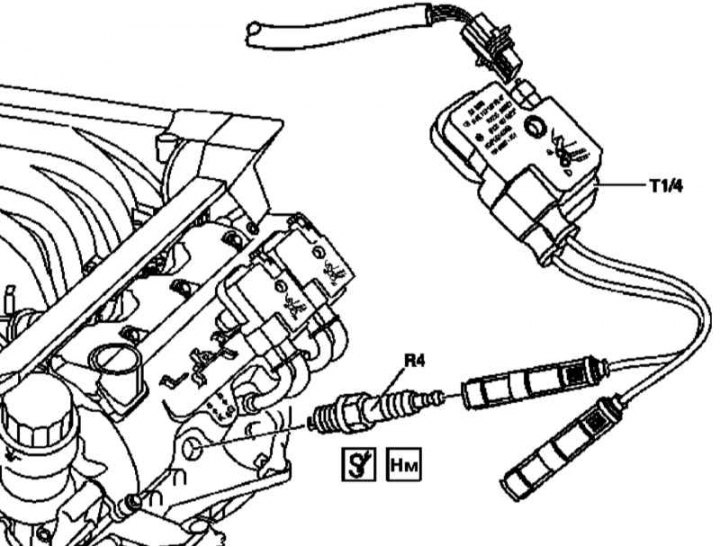
Details of spark plug installation on gasoline engines
1. Adjustment of the interelectrode gaps on the spark plugs should be done immediately before screwing them in.
Attention! Make sure that the spark plugs you purchase match the engine type of your vehicle!
2. Wait until the engine has cooled down completely - use the free time to check the condition of the spark plugs and measure their interelectrode gaps.
Note: New spark plugs usually have their electrode gaps set correctly at the factory.
3. Check the spark plug gaps by inserting a special wire gauge of the appropriate thickness into the space between the spark plug electrodes - the gauge should only lightly touch each of the electrodes. If necessary, bend the curved part of the electrode accordingly using a regulator equipped with notches.
Note: When adjusting the spark plug gap, bend only the base of the ground electrode, without touching its end. If the ground electrode is offset relative to the center electrode, adjust its position using the same adjuster.
Attention! Do not attempt to adjust the position of the central electrode under any circumstances!
4. Remove the upper section of the air cleaner (see Chapter Fuel and exhaust systems).
5. Disconnect the high-voltage wiring from the spark plugs.
6. Remove the ignition coils (T1/4) (see Chapter Engine electrical systems) and remove the spark plugs (R4).
7. Evaluate the spark plugs removed from the engine using the condition chart (see the photographic insert in Chapter Engine electrical systems). By analyzing the appearance of spent spark plugs, you can assess the general condition of the engine.
8. Assess the condition of the porcelain spark plug insulators - if cracks are detected, the spark plug must be replaced.
9. If signs of thread damage are detected, the spark plug must also be replaced.
Note: A special tool is available to check the condition of the threaded part of spark plugs, usually included in repair kits (for example BERU).
10. Using a special drill, a damaged threaded hole in the cylinder head can be drilled, which does not require dismantling. After this, a special one is installed in the head.
11. Before screwing in the spark plug, lightly lubricate its threaded part with a copper-containing anti-seize compound. Use your fingers to tighten the spark plug into the receiving hole in the niche, then tighten it using a spark plug wrench, if possible equipped with a torque gauge (see Fig. Specifications).
Note: To avoid distortion of the spark plug when screwing it in, pull a small piece of fuel hose onto its tailpiece, which will act as a universal joint and, in the event of distortion, will easily rotate on the spark plug, thereby preventing the possibility of damaging the thread.
13. Install the ignition coils (T1/4) in place (see Chapter Engine electrical systems).
14. Before connecting the high-voltage (HV) wire to the spark plug (models with separate coils) carefully check the latter for damage, signs of internal contact corrosion. Measure the resistive resistance of the wire - if the measurement result exceeds 30 kOhm/meter, replace the entire wire set.
15. Using a rotary and reciprocating motion, tightly seat the wire tip onto the spark plug screwed into the cylinder head.
16. Proceeding in a similar manner, connect the wiring to the remaining spark plugs - try not to mix up the firing order.