



Before removing air from the hydraulic system, clean the pipeline connections from dirt and foreign objects.
If one brake cylinder or caliper is replaced, it is necessary to bleed the corresponding front or rear hydraulic system circuits. The manufacturer recommends bleeding the hydraulic system in the following order: rear right, rear left, front right, front left.
Place a transparent plastic hose on the air bleed nipple of the corresponding caliper, and lower the other end of the hose into a glass container filled with brake fluid.
The assistant should press the brake pedal all the way down, unscrew the air bleed nipple half a turn and observe the flow of fluid through the hose.
After the air bubbles stop releasing, press the brake pedal all the way down again and tighten the air bleeder screw. Slowly release the brake pedal.
Perform similar work in the above sequence with the remaining calipers.
Check the brake fluid level. It is not allowed to add brake fluid from a glass container that was used to remove air, or to add brake fluid that has been stored in an open container for a long time, since it contains a large amount of air and moisture.
After completing the work, press the brake pedal several times. If after the second or third press the pedal force increases, this means that there is air in the hydraulic system and the air removal work must be repeated. Fig. 263 shows the main brake cylinder and reservoirs.
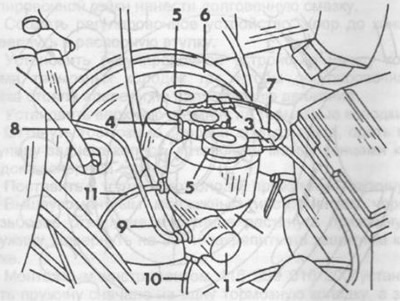
Fig. 263. Master brake cylinder.
1 - master brake cylinder,
2 - tank,
3 - plug connection,
4 - cover,
5 - cover,
6 - brake force booster,
7 - hose,
8 - vacuum hose,
9 - pipeline to the brake caliper of the right front wheel,
10 - pipeline to the brake caliper of the left front wheel,
11 - pipeline to the rear wheel brakes.
Original can be found on the website: mercedesman.ru