
Cars BMW Cars Volkswagen Cars Chevrolet Cars Land Rover Cars Lada Cars Honda Cars Peugeot
English Русский
Български
Беларускі
Український
Српски
Hrvatski
Română
Polski
Slovenský
Magyar
Bookmark News and articles Sitemap Feedback Site search
MercedesMan.ru


A-Class C-Class E-Class G-Class M-Class S-Class Others
W123 (1976-1985) W124 (1984-1995) W210 (1996-2002)
  • Main
  • E-Class
  • W210 (1996-2002)
  • Chassis
  • Brake system
  • Bleeding the brake system

Bleeding the brake system (Mercedes-Benz E-Class W210)

0
Signs of air in the brake system: after repair, the brake pedal moves all the way to the floor or is pressed with dips during operation; the pedal stroke is very long and becomes shorter after repeated pressing. Bleeding the brake system must be carried out after any repair of the brake hydraulic drive. When the brake fluid leaks, air will definitely get into the system. Bleeding the brake system on cars with the ESP system should be done at a service station. To do this, the bleeding program is launched in the ESP control unit.

At the service station, brakes are bled using a special device, but this operation can also be performed in the traditional way.

Sequence of works


1. Mark the brake fluid level in the reservoir.

2. Add new brake fluid to the reservoir and continue adding it as needed throughout the entire period of work. Otherwise, air will enter the system again and the work will have to be started over again.

3. Remove the rubber cap from the bleed nipple of the rear right wheel brake master cylinder.
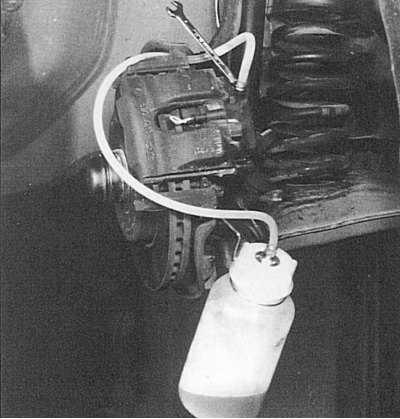
Fig. 8.21. Bleeding the front wheel brake mechanism

Fig. 8.21. Bleeding the front wheel brake mechanism


4. Clean the nipple of the fitting, put a clean transparent plastic hose on it and lower its free end into the container (plastic bottle), half filled with brake fluid (Fig. 8.21).

5. Carefully loosen the bleed nipple with a ring spanner by half a turn.

6. Ask an assistant to slowly press the brake pedal all the way down to pump the brake fluid and any air out of the system. Watch the hose and the container with the brake fluid as you do so – you should notice air bubbles coming out of the fluid. Hold the brake pedal in the pressed position.

7. Close the bleed nipple, then remove your foot from the pedal. This will prevent air from entering the system through the nipple thread. Release the pedal slowly.

8. Repeat this operation until no more air bubbles are released into the fluid - this means that the air has been removed from the system. Constantly monitor the brake fluid level in the reservoir. Finally, tighten the nipple (do not tighten too much) and put a rubber cap on the nipple.

9. Repeat the same operation on the other bleed nipples in the following order: left rear wheel, right front and then left front.

10. If there was a lot of air in the system, repeat the entire procedure again.

11. After completing the work, check the fluid level in the tank again and, if necessary, add fresh fluid to the proper level.

12. Check the operation of the brakes during the test (careful) trips.
This article is available at: russian, bulgarian, belarusian, ukrainian, serbian, croatian, romanian, polish, slovak, hungarian
The article has been verified: Polyakov Zakhar Grigorievich
Share with friends:
◀ Previous
E-Class W210 / Brake system
Next ▶

Removal brake pipes
Removal the brake hose
Removal the brake disc
Removal the brake caliper
Replacing rear brake pads
Replacing brake fluid
Adjusting the parking brake
Removal the parking brake pads
Replacing the parking brake cables
Possible malfunctions of the brake system, their causes and methods of elimination
More similar articles for repairing other models

☛ Brake system — bleeding Mercedes W168 (1997-2004)
☛ Bleeding the brake system Mercedes W202 (1993-2000)
☛ Bleeding the brake system Mercedes W463 (1999-2019)
☛ Bleeding the brake system Mercedes W163 (1997-2005)
☛ Bleeding the brake hydraulic system Mercedes W116 (1972-1980, petrol)
☛ Brake System Maintenance — General Information Mercedes Sprinter (1995-2000, diesel)
Link in different formats to this article
Comments and feedback from visitors
No comments yet


How much will 34 + 43 ?


W210 (1996-2002) 
  • General information
  • Vehicle description
  • Working conditions and tools
  • Car care
  • Diesel engines
  • Engine repair
  • Lubrication system
  • Cooling system
  • Injection system
  • Supply system
  • Exhaust system
  • Gasoline engines
  • Engine repair
  • Lubrication system
  • Cooling system
  • Control system
  • Power and exhaust system
  • Transmission
  • Clutch
  • Mechanical gearbox
  • Automatic gearbox
  • Drive shafts
  • Chassis
  • Car suspension
  • Steering
  • Tires and wheels
  • Brake system
  • Body
  • Exterior (external elements)
  • Interior (internal elements)
  • Doors and windows
  • Heating and ventilation
  • Electrical equipment
  • Equipment and devices
  • Power devices
  • Lighting and signaling
  • Electrical circuits
W124 (1984-1995) 
  • General information
  • Governing bodies
  • Driving and operation
  • Weekly care
  • Maintenance (gasoline)
  • Maintenance (diesel)
  • Troubleshooting
  • Power unit
  • I4 petrol engine
  • V6 petrol engine (SOHC)
  • V6 petrol engine (DOHC)
  • Diesel engines
  • Engine overhaul
  • Cooling system
  • Heating and ventilation
  • Fuel system (carburetor)
  • Injection system «Bosch CIS-E»
  • Injection system «Bosch HFM»
  • Diesel fuel system
  • Supply system
  • Starting and charging system
  • Ignition system (I4)
  • Ignition system (V6)
  • Preheating
  • Transmission
  • Clutch
  • Mechanical gearbox
  • Automatic gearbox
  • Drive shafts
  • Chassis
  • Brake system
  • Car suspension
  • Steering
  • Body
  • Exterior (external elements)
  • Interior (internal elements)
  • Doors, locks and windows
  • Electrical equipment
  • Equipment and devices
  • Switches
  • Headlights and lighting
  • Electrical circuits
W123 (1976-1985) 
  • General information
  • Introduction to the guide
  • Power unit
  • Engine device
  • Repair M102 engines
  • Repair M110 and M123 engines
  • Cooling and lubrication (M102)
  • Cooling (M110 and M123)
  • Ignition system
  • Power system «Stromberg»
  • Power system «Solex 4A1»
  • Fuel injection «K-Jetronic»
  • Fuel injection «L-Jetronic»
  • Transmission
  • Clutch
  • Mechanical gearbox
  • Automatic gearbox
  • Cardan and rear axle
  • Chassis
  • Front suspension
  • Rear suspension
  • Steering
  • Brake system
  • Body
  • Exterior (external elements)
  • Interior (internal elements)
  • Doors, locks and windows
  • Electrical equipment
  • Equipment and devices
  • Power devices
  • Electrical circuits
 
MercedesMan.ru © 2017–2026 · Mobile version · Read about Mercedes · Sitemap: EN BG BY UA RS HR RO PL SK HU · Feedback · Site search · Bookmark A-Class (W168) · C-Class (W201) · C-Class (W202) · C-Class (W203) · E-Class (W123) · E-Class (W124) · E-Class (W210) · G-Class (W463) · M-Class (W163) · S-Class (W116, petrol) · S-Class (W126, petrol) · S-Class (W140) · S-Class (W220) · Sprinter · Vito 1 · Vito 2 · Vario 814D ·
 
We only use cookies without which some of the site's features may not be available.