



Sequence of works


1. Raise and secure the vehicle, remove the rear wheel.
2. Remove the brake disc.
3. Remove the rear seat cushion.
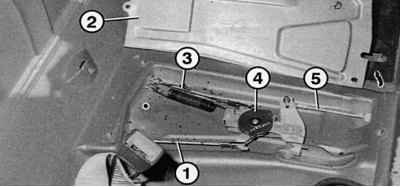
Fig. 8.25. Parking brake parts: 1 – brake cable to the rear right wheel; 2 – protective cover; 3 – brake cable to the rear left wheel; 4 – automatic equalizer (under the rear seat cushion); 5 – cable to the parking brake pedal
4. Remove the protective cover 2 (Fig. 8.25) in the center above the automatic equalizer 4.
5. Pre-tension the equalizer by inserting an Allen key into the center of the equalizer and turning it about half a turn to the right (see fig. 8.25). At the same time, press down so that the eccentric lock snaps into place with the spring. The engagement is then released again with a screwdriver.
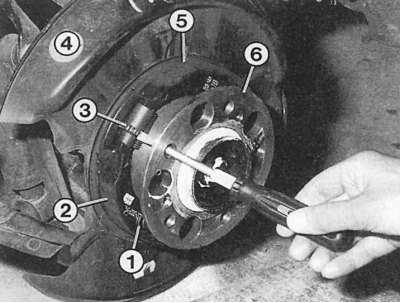
Fig. 8.26. Rear wheel brake mechanism with brake disc removed: 1 – spring; 2, 5 – brake pads; 3 – brake mechanism adjustment gear, adjustable from the outside with a screwdriver; 4 – protective shield; 6 – rear wheel drive shaft flange
6. Through the large holes in the flange of the rear wheel drive shaft, release both springs 1 (Fig. 8.26) of brake shoes 2 and 5 and the lower return spring.
7. Release the brake pads from the lower return spring, move them apart and remove the spring.
8. Release the adjusting device spring, separate the pads and remove them.
9. Before assembly, which is carried out in the reverse order, apply copper grease to the corresponding bearing and sliding surfaces and to the threads of the adjustment mechanism.
10. Assemble and install the brake mechanism.
11. If during assembly you are unsure about the correct position of the parts, remove the brake disc from the other rear wheel and compare the discs.
12. Release the equalizer tension (as described above).
13. Adjust the parking brake.