
Cars BMW Cars Volkswagen Cars Chevrolet Cars Land Rover Cars Lada Cars Honda Cars Peugeot
English Русский
Български
Беларускі
Український
Српски
Hrvatski
Română
Polski
Slovenský
Magyar
Bookmark News and articles Sitemap Feedback Site search
MercedesMan.ru


A-Class C-Class E-Class G-Class M-Class S-Class Others
W123 (1976-1985) W124 (1984-1995) W210 (1996-2002)
  • Main
  • E-Class
  • W210 (1996-2002)
  • Chassis
  • Brake system
  • Checking the condition of the brake discs

Checking the condition of the brake discs (Mercedes-Benz E-Class W210)

0
Contents: Brake disc sizes ↡ Recommendations for maintenance and…↡
Fig. 8.11. Front wheel brake mechanism with ventilated discs: 1 – bracket; 2 – caliper bracket; 3 –…

Fig. 8.11. Front wheel brake mechanism with ventilated discs: 1 – bracket; 2 – caliper bracket; 3 – bleed nipple with protective cap; 4 – inner shoe; 5 – connection of brake pad wear sensor


For this operation, it is necessary to remove the wheels. The front wheels are equipped with ventilated brake discs, which, thanks to this design, dissipate heat from friction well (Fig. 8.11). The rear wheels are equipped with solid discs (without ventilation holes). When checking the pads, you should always inspect the brake discs, at least when replacing the pads. Discs with scratches, grooves from wear, in addition to deterioration of braking characteristics, lead to increased wear of the pads.

Sequence of works


1. The bluish color of the disc is not a sign of malfunction.


2. Pay attention to the scratches and wear marks on the disc. They appear from dirt or excessively worn pads. If the scratch depth is more than 0.5 mm, the disc needs to be replaced. Ventilated discs with thread-like scratches up to 25 mm long may not need to be replaced. However, if they increase, replacement is required.

3. Check the disc runout - it should not touch the pads when they are slightly brought together.
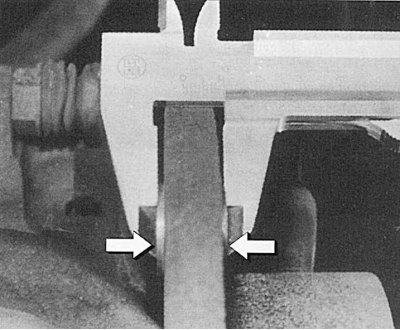
Fig. 8.12. Measuring the thickness of a disk using two coins (arrows)

Fig. 8.12. Measuring the thickness of a disk using two coins (arrows)


4. Check the thickness of the disc in several places. It is best to measure with a caliper, having first placed two coins under its jaws on the disc (Fig. 8.12) – if the disc is worn, the measurements will be more accurate. Do not forget to subtract the thickness of the coins from the result obtained.

5. Brake discs cannot be processed.

6. Worn discs should always be replaced in pairs.

Brake disc sizes


The dimensions of brake discs for vehicles with diesel engines are presented in Table 8.1.

Table 8.1. Dimensions of brake discs for vehicles with diesel engines
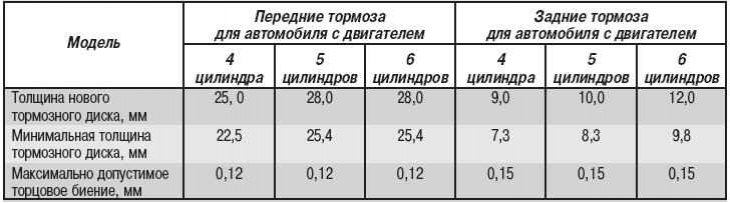


Table 8.1. Dimensions of brake discs for vehicles with diesel engines

The dimensions of brake discs for cars with petrol engines are presented in Table 8.2.


Table 8.2. Dimensions of brake discs for cars with gasoline engines
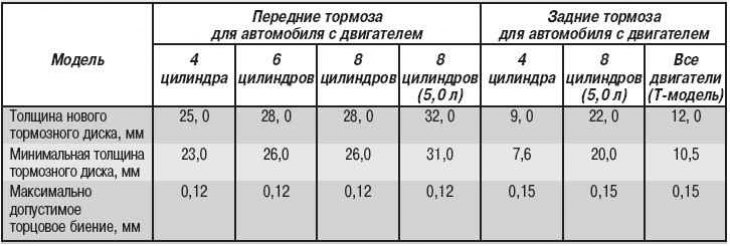


Table 8.2. Dimensions of brake discs for cars with gasoline engines

Recommendations for maintenance and repair of the brake system


1. If you open a closed hydraulic brake system somewhere, the working fluid will leak out. This will interfere with the work, and then you will need to top up the brake fluid. You can avoid this as follows: before starting work, first open the nipple for bleeding the brake mechanism of the corresponding wheel. Press the brake pedal and hold it. To do this, you can use a wooden stick of appropriate length, which should be clamped between the pedal and the driver's seat. The pistons in the master cylinder in this position block the holes for supplying brake fluid, so it does not leak out.

2. When repairing brake calipers or pistons, never use oil or any other substance for lubrication. Brake fluid should not come into contact with them. In addition, the lubricant will become more liquid when heated and may get onto the working surfaces of the brake mechanism. Special lubricants are required, which are usually included in the spare parts kit. When installing a piston in a brake cylinder, for example, a special paste for a brake cylinder (from ATE) is used. This substance is also applied to the inside of the new protective boot.


3. A brake caliper that was completely free of brake fluid during disassembly may cause certain difficulties when bleeding the system. Even if you press the brake pedal repeatedly, the fluid may not flow into it. In this case, proceed as follows: after installing the caliper, do not secure the upper end of the brake hose to the brake system pipeline. Pump brake fluid through the open bleed nipple until it begins to flow out of the upper end of the brake hose. Then secure the brake hose and screw on the bleed nipple. Then bleed the system. To pump in brake fluid, use a new plastic container filled with brake fluid and connected to the bleed nipple through a transparent hose. In this case, it is necessary to lift the container and pump brake fluid without air bubbles into the brake mechanism.

4. Be careful when handling brake fluid. It is aggressive towards paintwork and is very toxic. Do not allow it to get into your mouth or into open wounds.

5. Brake fluid drained from the system cannot be reused. Do not use fluid from a container that has been open for a long time. Used brake fluid must be disposed of properly.

6. After working with the brake hydraulic drive, check the pressure: to do this, press the brake pedal hard several times. Then, with the engine running, press the pedal hard again (200–300 N). The pressure in the system should be maintained, i.e. the pedal resistance should not decrease.

7. Rubber parts of the brake system that have been contaminated with oil must be replaced.

Caution! After completing the work, press the brake pedal several times to set the pads to the normal position. If this is not done, the brakes will not work during the first braking. It is necessary to carefully run in the new brake pads. To do this, lightly press the pedal several times to brake the car from a speed of 80-40 km/h.
This article is available at: russian, bulgarian, belarusian, ukrainian, serbian, croatian, romanian, polish, slovak, hungarian
The article has been verified: Polyakov Zakhar Grigorievich
Share with friends:
◀ Previous
E-Class W210 / Brake system
Next ▶

Checking the thickness of the pads
Checking the brake booster
Checking the brake system for leaks and damage
Checking the brake fluid level
Parking brake system
Replacing the front brake pads
Replacing rear brake pads
Removal the brake caliper
Removal the brake disc
Removal the brake hose
More similar articles for repairing other models

☛ V-belt — checking condition Mercedes W168 (1997-2004)
☛ Checking the thickness of brake discs and their lateral runout Mercedes W202 (1993-2000)
☛ Checking the condition and replacing brake pads Mercedes W463 (1999-2019)
☛ Checking the condition of tires and their pressure, designating tires… Mercedes W163 (1997-2005)
☛ Checking the thickness of brake discs Mercedes W126 (1979-1991, petrol)
☛ Checking the thickness of the friction linings of the brake pads and… Mercedes Vito 2 (2003-2014, diesel)
Link in different formats to this article
Comments and feedback from visitors
No comments yet


How much will 31 + 43 ?


W210 (1996-2002) 
  • General information
  • Vehicle description
  • Working conditions and tools
  • Car care
  • Diesel engines
  • Engine repair
  • Lubrication system
  • Cooling system
  • Injection system
  • Supply system
  • Exhaust system
  • Gasoline engines
  • Engine repair
  • Lubrication system
  • Cooling system
  • Control system
  • Power and exhaust system
  • Transmission
  • Clutch
  • Mechanical gearbox
  • Automatic gearbox
  • Drive shafts
  • Chassis
  • Car suspension
  • Steering
  • Tires and wheels
  • Brake system
  • Body
  • Exterior (external elements)
  • Interior (internal elements)
  • Doors and windows
  • Heating and ventilation
  • Electrical equipment
  • Equipment and devices
  • Power devices
  • Lighting and signaling
  • Electrical circuits
W124 (1984-1995) 
  • General information
  • Governing bodies
  • Driving and operation
  • Weekly care
  • Maintenance (gasoline)
  • Maintenance (diesel)
  • Troubleshooting
  • Power unit
  • I4 petrol engine
  • V6 petrol engine (SOHC)
  • V6 petrol engine (DOHC)
  • Diesel engines
  • Engine overhaul
  • Cooling system
  • Heating and ventilation
  • Fuel system (carburetor)
  • Injection system «Bosch CIS-E»
  • Injection system «Bosch HFM»
  • Diesel fuel system
  • Supply system
  • Starting and charging system
  • Ignition system (I4)
  • Ignition system (V6)
  • Preheating
  • Transmission
  • Clutch
  • Mechanical gearbox
  • Automatic gearbox
  • Drive shafts
  • Chassis
  • Brake system
  • Car suspension
  • Steering
  • Body
  • Exterior (external elements)
  • Interior (internal elements)
  • Doors, locks and windows
  • Electrical equipment
  • Equipment and devices
  • Switches
  • Headlights and lighting
  • Electrical circuits
W123 (1976-1985) 
  • General information
  • Introduction to the guide
  • Power unit
  • Engine device
  • Repair M102 engines
  • Repair M110 and M123 engines
  • Cooling and lubrication (M102)
  • Cooling (M110 and M123)
  • Ignition system
  • Power system «Stromberg»
  • Power system «Solex 4A1»
  • Fuel injection «K-Jetronic»
  • Fuel injection «L-Jetronic»
  • Transmission
  • Clutch
  • Mechanical gearbox
  • Automatic gearbox
  • Cardan and rear axle
  • Chassis
  • Front suspension
  • Rear suspension
  • Steering
  • Brake system
  • Body
  • Exterior (external elements)
  • Interior (internal elements)
  • Doors, locks and windows
  • Electrical equipment
  • Equipment and devices
  • Power devices
  • Electrical circuits
 
MercedesMan.ru © 2017–2026 · Mobile version · Read about Mercedes · Sitemap: EN BG BY UA RS HR RO PL SK HU · Feedback · Site search · Bookmark A-Class (W168) · C-Class (W201) · C-Class (W202) · C-Class (W203) · E-Class (W123) · E-Class (W124) · E-Class (W210) · G-Class (W463) · M-Class (W163) · S-Class (W116, petrol) · S-Class (W126, petrol) · S-Class (W140) · S-Class (W220) · Sprinter · Vito 1 · Vito 2 · Vario 814D ·
 
We only use cookies without which some of the site's features may not be available.