



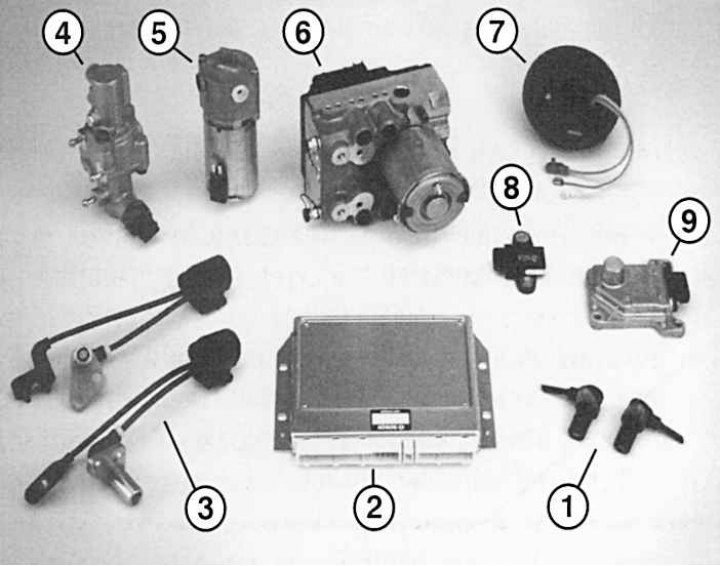
Fig. 8.5. Elements of the Mercedes-Benz ESP system: 1 – rear wheel speed sensors; 2 – control unit; 3 – front wheel speed sensors; 4 – piston block with pressure sensor; 5 – supercharger pump; 6 – hydraulic block; 7 – steering wheel position sensor; 8 – Lateral acceleration sensor; 9 – sensor of angular displacement relative to the vertical axis
The electronic stabilization program based on the ABS/ASR systems reduces the risk of skidding. When cornering at high speed or during abrupt alignment maneuvers, the ESP system recognizes the risk of skidding (Fig. 8.5).
To do this, it receives information from sensors about the angle of rotation of the steered wheels and, based on the speed of the vehicle, determines the speed of its displacement relative to the vertical axis. Unstable positions of the vehicle are immediately detected. By braking individual wheels and controlling the engine torque, the vehicle is kept on a given trajectory. For example, if there is a risk of the front wheels skidding outward in a turn, the rear wheel inside the turning radius is braked, and the vehicle's position is stabilized. If there is a risk of the rear end skidding in a fast turn, the system brakes the front wheel passing the outer turning radius.
The operation of the ESP system is indicated by a lighted indicator in the instrument cluster. In this case, the driver must adjust the driving style to the road conditions to reduce the risk of skidding.
Original source of information: www.MercedesMan.ru