
Cars BMW Cars Volkswagen Cars Chevrolet Cars Land Rover Cars Lada Cars Honda Cars Peugeot
English Русский
Български
Беларускі
Український
Српски
Hrvatski
Română
Polski
Slovenský
Magyar
Bookmark News and articles Sitemap Feedback Site search
MercedesMan.ru


A-Class C-Class E-Class G-Class M-Class S-Class Others
W123 (1976-1985) W124 (1984-1995) W210 (1996-2002)
  • Main
  • E-Class
  • W210 (1996-2002)
  • Chassis
  • Brake system
  • Anti-lock braking system (ABS)

Anti-lock braking system (ABS) (Mercedes-Benz E-Class W210)

0
Contents: ABS control unit (Fig. 8.1) ↡ Hydraulic block ↡ Wheel speed sensors ↡ Relay ↡ Malfunction of the ABS system ↡
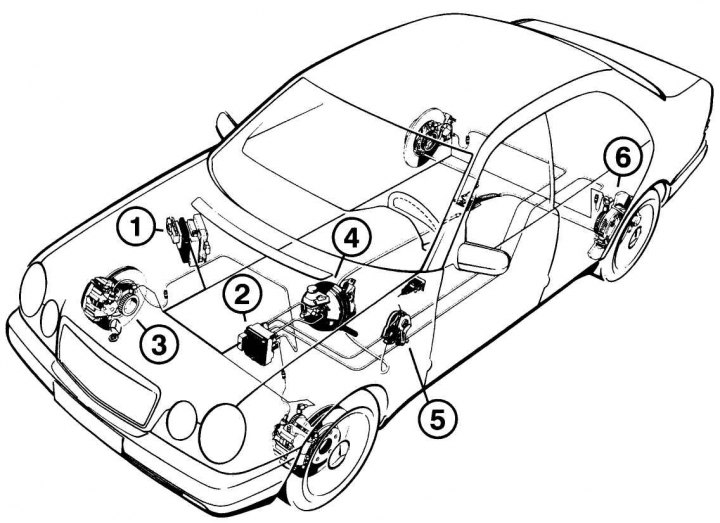
Fig. 8.1. Diagram of individual elements of the ABS system: 1 – control unit; 2 – front wheel brake…

Fig. 8.1. Diagram of individual elements of the ABS system: 1 – control unit; 2 – front wheel brake mechanism with speed sensor; 3 – hydraulic block; 4 – main brake cylinder with booster; 5 – parking brake mechanism; 6 – rear wheel brake mechanism with speed sensor
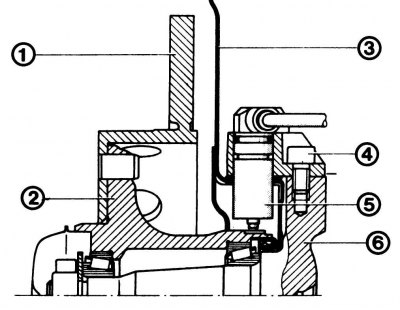

Fig. 8.2. Installing speed sensors on the front wheels: 1 – brake disc; 2 – front wheel hub; 3 –…

Fig. 8.2. Installing speed sensors on the front wheels: 1 – brake disc; 2 – front wheel hub; 3 – shield; 4 – Allen bolt, 25 Nm; 5 – rotation speed sensor; 6 – steering knuckle
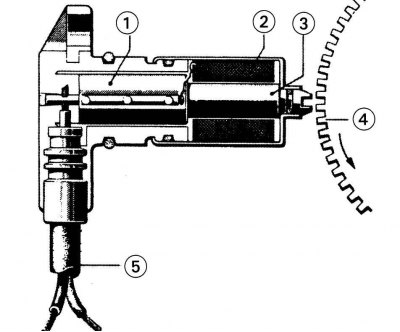

Fig. 8.3. Measuring wheel speed: 1 – rotation speed sensor; 2 – coil; 3 – magnetic core; 4 –…

Fig. 8.3. Measuring wheel speed: 1 – rotation speed sensor; 2 – coil; 3 – magnetic core; 4 – toothed rotor; 5 – coaxial wire


ABS control unit (Fig. 8.1)


The information from the wheel speed sensors is constantly processed and compared with the programmed values. If the difference in values indicates a risk of locking when braking one or more wheels, the control unit activates the hydraulic unit, which reduces the operating pressure in the brake system of the corresponding wheel until it has free play and is braked again. Depending on the road surface conditions, this cycle takes place in a matter of milliseconds during one braking operation.

Hydraulic block


This is the main unit of the ABS system, installed in the front left part of the engine compartment. It includes an electric pump and a valve block with magnetic valves. When you press the brake pedal, the main brake cylinder under pressure supplies brake fluid through the valve block to the wheels. At the same time, the valve block regulates the pressure in each of the hydraulic drives of the system, connecting the front wheel and the rear wheel located diagonally from it. When ABS is turned on, the control unit sends a command in the form of an electrical signal: "Reduce the pressure of the working fluid". In this case, the brake fluid in a small circle through the valve block goes back to the reservoir. The operation of the pump can be noticed by a slight pulsation of the brake pedal.

Wheel speed sensors


Each sensor 5 (Fig. 8.2) is installed on its own wheel, at a small distance from the toothed disk (pulse rotor), fixed directly to the hub.

The toothed projections of the disk 4 (Fig. 8.3), depending on the rotation frequency of the wheel (speed), pass faster or slower past the magnetic core 3 of the sensor 1. Each tooth of the disk, when passing, induces a short increase in voltage in the coil 2. Its frequency depends on the rotation frequency of the rotor and, accordingly, the wheel. The electrical signal is sent to the control unit via the coaxial wire 5.


(Material based on data from the portal: MERCEDESMAN)

Thus, information about the wheel speed is transmitted as an electrical signal to the control unit.

Relay


The operation of the magnetic valves and the electric pump is controlled by the corresponding relays. They are mounted on the holder under the ABS control unit.

Malfunction of the ABS system


The ABS system indicator light comes on when the ignition is switched on and goes out if the engine is running, no later than 2 seconds later. If the light remains on, there is a fault in the ABS system. However, you can continue driving - the brakes will function as in a car without ABS. To fix the fault, contact a Mercedes service center, where they will diagnose the system control unit using a special device.
This article is available at: russian, bulgarian, belarusian, ukrainian, serbian, croatian, romanian, polish, slovak, hungarian
The article has been verified: Polyakov Zakhar Grigorievich
Share with friends:
◀ Previous
E-Class W210 / Brake system
Next ▶

Service brake system
Brake system — general description
Traction control system (ASR)
Electronic throttle control
BAS (Brake-Assist) system
Electronic Stability Program (ESP)
Operation of ABS/ASR/BAS/ESP systems
More similar articles for repairing other models

☛ General description of the braking system Mercedes W168 (1997-2004)
☛ Anti-lock braking system (ABS) wiring diagram Mercedes W203 (2000-2007)
☛ Anti-lock brake system (ABS) Mercedes W463 (1999-2019)
☛ Anti-lock brake system (ABS) Mercedes W163 (1997-2005)
☛ Anti-lock braking system (ABS) Mercedes W220 (1998-2005)
☛ Anti-lock braking system ABS Mercedes Vito 1 (1996-2003)
Link in different formats to this article
Comments and feedback from visitors
No comments yet


How much will 38 + 44 ?


W210 (1996-2002) 
  • General information
  • Vehicle description
  • Working conditions and tools
  • Car care
  • Diesel engines
  • Engine repair
  • Lubrication system
  • Cooling system
  • Injection system
  • Supply system
  • Exhaust system
  • Gasoline engines
  • Engine repair
  • Lubrication system
  • Cooling system
  • Control system
  • Power and exhaust system
  • Transmission
  • Clutch
  • Mechanical gearbox
  • Automatic gearbox
  • Drive shafts
  • Chassis
  • Car suspension
  • Steering
  • Tires and wheels
  • Brake system
  • Body
  • Exterior (external elements)
  • Interior (internal elements)
  • Doors and windows
  • Heating and ventilation
  • Electrical equipment
  • Equipment and devices
  • Power devices
  • Lighting and signaling
  • Electrical circuits
W124 (1984-1995) 
  • General information
  • Governing bodies
  • Driving and operation
  • Weekly care
  • Maintenance (gasoline)
  • Maintenance (diesel)
  • Troubleshooting
  • Power unit
  • I4 petrol engine
  • V6 petrol engine (SOHC)
  • V6 petrol engine (DOHC)
  • Diesel engines
  • Engine overhaul
  • Cooling system
  • Heating and ventilation
  • Fuel system (carburetor)
  • Injection system «Bosch CIS-E»
  • Injection system «Bosch HFM»
  • Diesel fuel system
  • Supply system
  • Starting and charging system
  • Ignition system (I4)
  • Ignition system (V6)
  • Preheating
  • Transmission
  • Clutch
  • Mechanical gearbox
  • Automatic gearbox
  • Drive shafts
  • Chassis
  • Brake system
  • Car suspension
  • Steering
  • Body
  • Exterior (external elements)
  • Interior (internal elements)
  • Doors, locks and windows
  • Electrical equipment
  • Equipment and devices
  • Switches
  • Headlights and lighting
  • Electrical circuits
W123 (1976-1985) 
  • General information
  • Introduction to the guide
  • Power unit
  • Engine device
  • Repair M102 engines
  • Repair M110 and M123 engines
  • Cooling and lubrication (M102)
  • Cooling (M110 and M123)
  • Ignition system
  • Power system «Stromberg»
  • Power system «Solex 4A1»
  • Fuel injection «K-Jetronic»
  • Fuel injection «L-Jetronic»
  • Transmission
  • Clutch
  • Mechanical gearbox
  • Automatic gearbox
  • Cardan and rear axle
  • Chassis
  • Front suspension
  • Rear suspension
  • Steering
  • Brake system
  • Body
  • Exterior (external elements)
  • Interior (internal elements)
  • Doors, locks and windows
  • Electrical equipment
  • Equipment and devices
  • Power devices
  • Electrical circuits
 
MercedesMan.ru © 2017–2026 · Mobile version · Read about Mercedes · Sitemap: EN BG BY UA RS HR RO PL SK HU · Feedback · Site search · Bookmark A-Class (W168) · C-Class (W201) · C-Class (W202) · C-Class (W203) · E-Class (W123) · E-Class (W124) · E-Class (W210) · G-Class (W463) · M-Class (W163) · S-Class (W116, petrol) · S-Class (W126, petrol) · S-Class (W140) · S-Class (W220) · Sprinter · Vito 1 · Vito 2 · Vario 814D ·
 
We only use cookies without which some of the site's features may not be available.