



Contents: Anti-lock braking system (ABS) ↡ Anti-Slip Regulation (ASR) ↡ Electronic Stability Program (ESP) ↡ Brake Assist System (BAS) ↡ Instructions related to…↡
The hydraulic brake system consists of a master cylinder, a vacuum brake booster, an anti-lock braking system and front and rear wheel brakes.
The braking system is divided into two circuits operating diagonally. One hydraulic circuit acts on the front right and left rear wheels, and the other on the front left and rear right.
This ensures that the vehicle stops with sufficient efficiency in the event of failure of one of the circuits, for example, in the event of a leak in one of the circuits of the service brake system.
Pressure for both circuits is created by a dual (tandem) master brake cylinder when the brake pedal is pressed (see illustration 1.0).
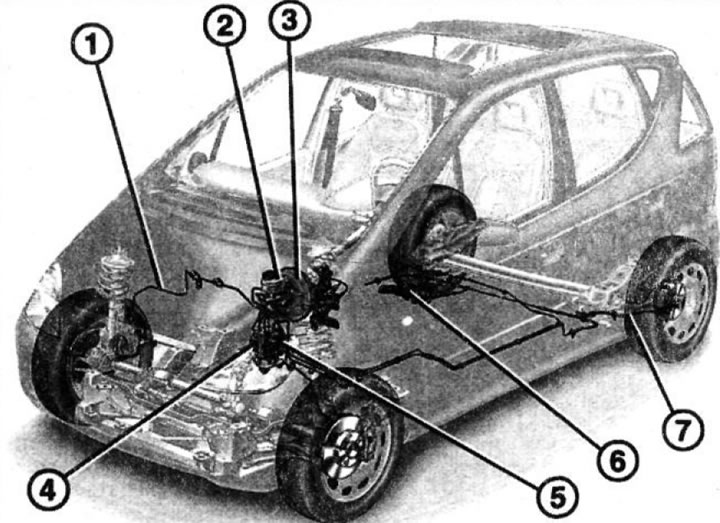
1.0 Brake system of A-class cars
1 - brake line
2 - brake fluid expansion tank
3 - brake drive vacuum booster
4 - ABS hydraulic unit
5 - ABS control unit
6 - parking brake lever
7 - Parking brake cable
The expansion tank with brake fluid is located in the engine compartment above the main brake cylinder behind the windshield washer fluid tank. It supplies the entire brake system with brake fluid.
The amount of brake fluid in the expansion tank must be checked regularly.
The brake booster uses the vacuum in the intake manifold of a gasoline engine and increases the force applied when the brake pedal is pressed.
Due to the fact that a diesel engine has almost no vacuum on the intake manifold, cars with a diesel engine are equipped with a special brake booster vacuum pump.
The vacuum pump is mounted on the right side of the engine cylinder block and is driven by the camshaft.
A-class cars are equipped with disc brakes at the front and drum brakes at the rear.
Cars with an engine power of over 90 hp, as well as cars with an extended body base, also have disc brakes on the rear axle.
These disc brakes have a floating caliper with one piston, which is enough to press both brake pads to the brake disc. The parking brake acts through a cable drive on the brake mechanisms of the rear wheels.
The rear brake pads are self-adjusting, so adjusting the parking brake is only necessary in rare cases, such as after repairs.
Vehicles with disc brakes are additionally equipped with two brake drums for the parking brake shoes, which are integral with the brake discs.
Attention! Work on the brake system requires careful observance of cleanliness and precision. If the necessary experience is not available, it is better to entrust such work to a specialized workshop.
Caution! When driving on wet roads, the brakes must be applied from time to time to clean the brake discs. Although the water is thrown off the brake discs by centrifugal forces, a thin layer of rubber wear products, grease and other contaminants remains on them, which impairs the response of the brakes.
Burnt dirt on the brake pads and clogged water drainage grooves in the pads will cause the brake discs to become ridged, which can reduce brake performance.
Attention! When cleaning the brake system, dust is formed. This dust is harmful to human health. Therefore, when cleaning the brake system, use a respirator to prevent brake dust from getting into the respiratory tract.
Anti-lock braking system (ABS)
The anti-lock braking system prevents the wheels from locking during sudden braking. Thanks to this, the car remains controllable even under full braking.
The ABS control unit receives a signal about the number of wheel revolutions from sensors installed on all four wheels. As soon as one of the wheels is on the verge of locking, this is registered by the corresponding sensor and reported to the ABS control unit.
In response to this, the brake pressure in the corresponding brake caliper is reduced and thus the wheel does not lock.
This process is repeated during hard braking until the car comes to a complete stop for each wheel separately until the brake pedal is released or until the car comes to a near stop.
Anti-Slip Regulation (ASR)
Electronically controlled traction control system (or torque control system) when starting off, it brakes the slipping wheels and transfers torque to those wheels that are firmly connected to the surface.
The system monitors the rotation of the wheels and applies the brakes, increasing the pressure in the brake mechanism of the wheel that begins to slip.
In this way, the traction force is used to the maximum extent by wheels that have good traction on the ground or road surface.
In extreme cases, if three wheels are slipping, the force is transferred to the only non-slipping one. As soon as one of the wheels is on the verge of slipping, the orange ASR indicator light with a triangle symbol starts flashing on the instrument panel.
The traction control system can, if necessary, perform engine braking. In this case, the electronic accelerator control unit activates the actuator electric motor, which closes the throttle valve.
This happens when one of the wheels starts to slip and is automatically braked, while the second rear wheel at that moment approaches the slip limit.
The electronic control unit of the traction control system recognizes that the engine traction force is too high at this moment.
Within milliseconds, the system's electronic control unit changes the position of the throttle valve to limit the supply of fuel to the engine. This happens even when the driver fully depresses the accelerator in extreme cases.
As the fuel supply decreases, the engine traction force decreases and both rear wheels can rotate normally. If the engine is cold at this point, the ignition timing is additionally adjusted.
The traction control system can be switched off using the switch located on the central console. In this case, the ASR indicator light on the instrument panel lights up.
Warning! When driving on sand, gravel or deep snow, it may be necessary to drive with wheel slip and without engine braking. In such cases, ASR can be switched off by pressing the switch on the center console. The system will still monitor rear wheel slip when the vehicle is moving at medium speed.
Electronic Stability Program (ESP)
A-class cars are equipped as standard with an automatic stability program (ESP), which is based on the capabilities of the ABS and ASR systems and complements them, reducing the risk of skidding, even in cases where the accelerator pedal is not pressed or braking is not performed.
When driving around a corner at high speed or when performing abrupt maneuvers, the automatic stability control system recognizes the vehicle's "intention" to lose stability.
To this end, the ESP control unit takes into account the information from the sensors about the steering angle and, based on the vehicle speed, calculates the angular velocity (rotation speed) the vehicle relative to the vertical axis and instantly determines the moment when the vehicle may lose stability.
By regulating the pressure in the brake mechanisms of the corresponding wheels, as well as braking the engine, ESP ensures that the car immediately returns to a position in which its stability is not threatened.
If, for example, when driving on a sharp turn there is a risk of skidding of the front wheels of the car, the system deliberately brakes the rear wheel located on the inside line of the turn and thereby stabilizes the car. If there is a risk of skidding of the rear wheels, the front wheel moving along the outside line of the turn is braked.
The ESP function is indicated by the signal lamp on the instrument panel lighting up. In such cases, the driver must take into account the traffic situation and change the speed of movement.
Brake Assist System (BAS)
MERCEDES-BENZ A-class vehicles are equipped with a brake booster as standard.
The need to install such a booster is caused by the fact that most drivers in a critical situation brake too late or with less force than necessary, which increases the braking distance. Based on how sharply the brake pedal is applied, BAS determines the occurrence of a dangerous situation.
Within milliseconds, it creates the necessary pressure in the braking system and reduces the braking distance at a vehicle speed of 100 km/h by 45% compared to the braking distance of a vehicle without a booster.
The BAS/ESP indicator light comes on when the ignition is turned on and goes out after the engine starts.
Instructions related to ABS/ASR/ESP/BAS systems
A safety switch in the electronic control unit ensures automatic shutdown of the system if a defect occurs (for example, a broken wire) or when the voltage in the on-board network drops (when battery voltage is less than 10.5 V).
This condition is indicated by the orange ABS warning light on the instrument panel.
In this case, ASR, ESP and BAS are switched off, which is confirmed by the ESP warning light coming on. At the same time, the normal braking system continues to function and the car behaves like a car without ABS.
If the ESP warning light comes on and stays on while driving, this indicates a defect in the BAS or ESP system. They are switched off, but the braking system remains normal.
Caution! If the brake system warning light comes on while driving (red with an exclamation mark), then you should immediately stop and find out the reason. The main reasons for the light to come on are low brake fluid in the expansion tank or driving with the parking brake applied.
If the ABS warning light comes on while driving, do the following:
1. Stop, turn off and start the engine again.
2. Check the battery voltage. If it is less than 10.5 volts, charge the battery.
Caution! If the ABS warning light comes on at the start of driving and goes out after some time, this indicates that the battery voltage was too low, but then increased during driving as a result of recharging from the generator.
3. Check that the terminals on the battery poles are securely fastened.
4. Raise the vehicle on jack stands and remove the wheels. Check the wheel speed sensor wires for external damage (grinding).
Further ABS testing should be performed in a workshop. The ABS control unit performs a self-diagnostic program and all faults are recorded. These faults can be read in a workshop using a special tester and then eliminated.
Attention! When working with electric welding, the plug of the electronic ABS control unit must be disconnected. The plug is located in the engine compartment on the passenger side under a removable cover, disconnect the plug only when the ignition is off. When performing paintwork, the control unit can be exposed to short-term high temperatures not exceeding +90°C.