



2. Loosen the wheel mounting bolts. The car must stand on its wheels when performing this operation.
3. Place the vehicle on jack stands and remove the wheels.
Warning! Jacking up the vehicle and placing it on stands may pose a risk of injury. Read the provisions of Chapter "Jacking up a car".
4. Measure the thickness of the brake discs. Take the measurement at the thinnest point of the disc. Workshops use a special gauge for this, for example, HAZET-4956-1 or a micrometer, since wear of the disc causes its surface to deflect.
Attention! The thickness of the brake disc can be measured with a regular caliper, but in this case, a lining of the appropriate thickness, for example, two coins, must be placed on both sides of the disc (see illustration). To accurately determine the thickness of the brake disc, you need to subtract the thickness of the coins or spacers from the obtained value.
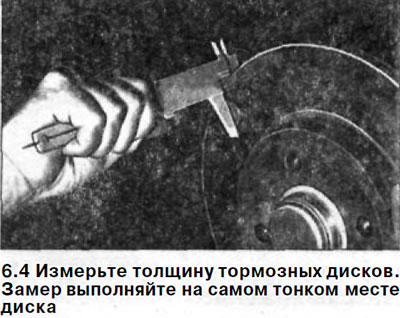
Attention! Measure the thickness of the brake disc at several points.
The dimensions of the brake discs are indicated in "Specifications".
If significant cracks or grooves with a depth of more than 0.5 mm are detected, the brake disc must be replaced.
(Article text obtained from the website: www.MercedesMan.ru)
Attention! Ventilated brake discs with cracks no thicker than a hair and up to 25 mm long do not need to be replaced with new ones.
5. Install the wheels in accordance with the marks made during removal. Before doing this, lubricate the centering seat of the wheel disk on the hub with a thin layer of bearing grease. Do not lubricate the wheel mounting bolts. Replace rusted bolts with new ones.
6. Screw in the wheel mounting bolts and lower the vehicle.
7. Tighten the wheel mounting bolts in a cross pattern to a torque of 110 Nm.