Cars BMW Cars Volkswagen Cars Chevrolet Cars Land Rover Cars Lada Cars Honda Cars Peugeot
English Русский
Български
Беларускі
Український
Српски
Hrvatski
Română
Polski
Slovenský
Magyar
Bookmark News and articles Sitemap Feedback Site search
MercedesMan.ru


A-Class C-Class E-Class G-Class M-Class S-Class Others
Sprinter (1995-2000, diesel) Vito 1 (1996-2003) Vito 2 (2003-2014, diesel) Vario 814D (1996-2003, diesel)
  • Main
  • Mercedes-Benz
  • Sprinter (1995-2000)
  • Power unit
  • Engine repair
  • Flywheel or drive disc (automatic transmission models)

Flywheel or drive disc (automatic transmission models) (Mercedes-Benz Sprinter 903)

0
The engine is equipped with a combined flywheel with a torsional vibration damper (damper). The purpose of such a flywheel design is to smooth out and prevent the transmission of torsional vibrations that occur on the crankshaft during engine operation due to the alternation of the working stroke in the engine cylinders. This significantly reduces the noise level caused by torsional vibrations. The front part of the flywheel is rigidly fixed to the crankshaft. A torsional vibration damper consisting of a system of spring dampers is mounted on it. The rear of the flywheel is attached to this vibration damper. Thus, it has no rigid connection with the front part of the flywheel, and therefore with the crankshaft. The clutch, which is also installed here, is also separated from the engine by this torsional vibration damping system.

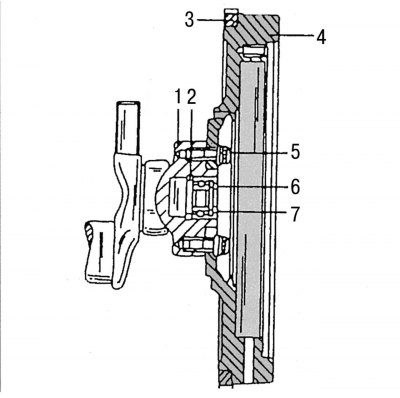
Figure 84. Flywheel design (models with manual transmission): 1 — crankshaft flange; 2 - distance…

Figure 84. Flywheel design (models with manual transmission): 1 — crankshaft flange; 2 - distance ring; 3 - toothed ring for starting the engine with a starter; 4 — flywheel; 5 - flexible bolts M10x22 mm; 6 - ball bearing; 7 - retaining ring
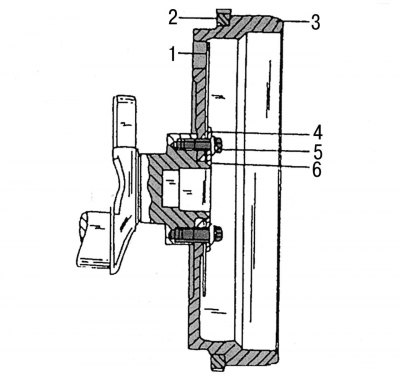

Figure 85. Flywheel design on vehicles with automatic transmission: 1 - torque converter drive…

Figure 85. Flywheel design on vehicles with automatic transmission: 1 - torque converter drive disk; 2 - toothed ring for starting the engine with a starter; 3 — flywheel; 4 - spacer washer; 5 - flexible bolt; 6 — crankshaft
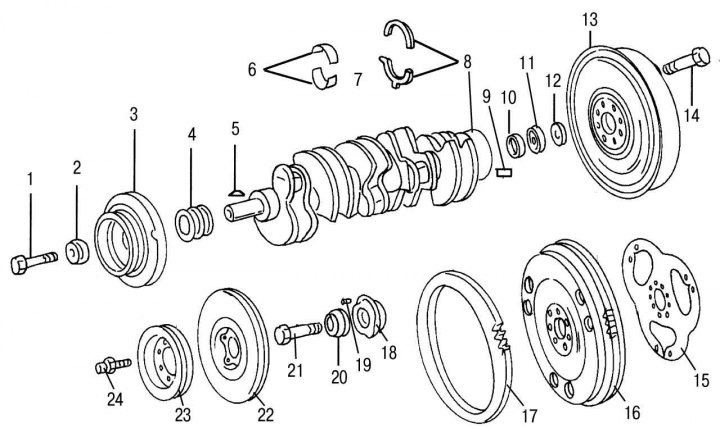


Figure 76. Crankshaft and its mating parts using the example of engine 602 (similar parts are used…

Figure 76. Crankshaft and its mating parts using the example of engine 602 (similar parts are used on the 601 engine): 1 - bolt for fastening the chain drive sprocket to the crankshaft; 2 — washer of the chain drive sprocket mounting bolt; 3 - torsional vibration damper (if it is installed); 4 - twin drive sprocket; 5 — key; 6 — crankshaft bearing shells; 7 — crankshaft; 8 - adjusting thrust half rings, 5 size groups; 9 — landing pin; 10 - spacer washer; 11 - radial ball bearing; 12 - washer; 13 - combined dual mass flywheel; 14 — flywheel mounting bolt; 15 - locking plate; 16 - flywheel, standard version; 17 — flywheel ring gear; 18 — vibration damper hub (if it is installed); 19 - mounting pin; 20 - washer; 21 — bolt securing vibration damper/belt pulley to hub (if it is installed); 22 — vibration damper hub (if it is installed); 23 - Belt pulley (if it is installed); 24 — bolt for fastening vibration damper and belt pulley


Before replacing the flywheel, you should measure its height in order to obtain a new flywheel of the same design. Figures 84 and 85 show the flywheels in question. Figure 76 also shows the shape of the flywheel and drive disk.


The flywheel or drive disk together with the ring gear for starting the engine from the starter can be changed without subsequent balancing of the crankshaft. The toothed ring gear of the drive disk or flywheel can also be replaced with a new one, and although this work is best done at a service station, below is a description of how to perform this work. There is no need to remove the engine before performing it.

To remove the combined flywheel, perform the following operations:
  • remove gearbox;

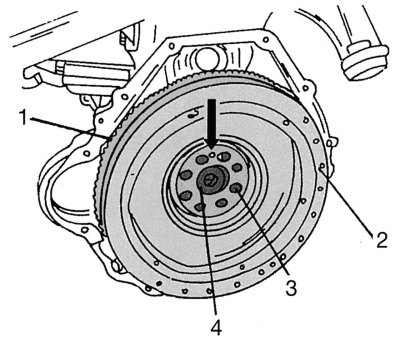
Figure 86. Fastening the flywheel to the crankshaft (the arrow shows the centering hole): 1 -…

Figure 86. Fastening the flywheel to the crankshaft (the arrow shows the centering hole): 1 - toothed crown; 2 - flywheel; 3 - flexible bolts M10x22 mm; 4 - ball bearing

  • holding the flywheel from turning with a screwdriver inserted between the teeth of the ring gear or a bolt inserted into the hole in the cylinder block flange, unscrew all eight flywheel bolts in order. When subsequently installing the flywheel or drive disk, ensure that the hole drilled in the flywheel and located between the two bolts and the hole on the crankshaft flange are always located opposite each other. Figure 86 shows the location of such a hole. A similar hole is made on the drive disk;
  • remove the flywheel or drive disk. There are spacer washers installed under the drive disk, which are also released after unscrewing the bolts;
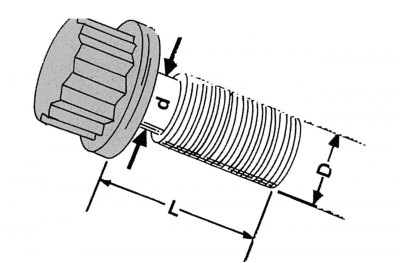
Figure 87. Basic dimensions for checking the condition of flexible bolts: L — bolt length; d —…

Figure 87. Basic dimensions for checking the condition of flexible bolts: L — bolt length; d — diameter of the flexible part of the bolt; D — diameter of the threaded part of the bolt


  • measure the diameter of the thin part of the bolts. If the measurement result on any of the bolts is less than 8.1 mm, then that bolt should be replaced. Measurements are taken as shown in the figure 87;
  • check the condition of the flywheel and replace the ring gear. If there are signs of wear or burns on the flywheel, it should be subjected to restorative repairs. At the specialized Mercedes-Benz service station there is all the necessary data on the measurements and control carried out. To replace the ring gear, you will need a heating device with a temperature control range of up to 220°C.

The flywheel ring gear must be replaced in the following sequence:
  • mark the position of the ring gear on the flywheel and clamp the flywheel in a vice;
  • drill a hole between the two teeth of the crown to the flywheel, but without cutting into the flywheel with the drill;
  • use a chisel to chip off the old toothed crown;

Caution! Protect your eyes from possible debris when working with the flywheel.

  • thoroughly clean the seat of the crown on the flywheel;
  • heat the new crown to the specified temperature (see above) and quickly place it on the flywheel using pliers. Using a soft metal mandrel and a hammer, adjust the position of the ring gear on the flywheel. This work must be done very quickly.
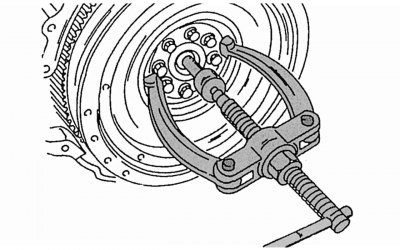
Figure 88. Pressing out the crankshaft ball bearing

Figure 88. Pressing out the crankshaft ball bearing


(Publication reprinted from this resource: «mercedesman.ru»)

To replace the toothed ring on the drive disk, it is necessary to remove the toothed ring together with the steel ring from the drive disk. During subsequent assembly, install the new part in such a way that all holes for the mounting bolts of the ring gear and torque converter on the steel ring and on the drive disk coincide.

A ball bearing is installed on the crankshaft flange. On vehicles with a manual transmission, there are 6 bearings behind this bearing (see figure 84) a safety ring 7 is pressed in, which is covered on both sides with washers made of Viton synthetic material for protection. There is a spacer washer behind the bearing. To press out the bearing together with the retaining ring, use the puller shown in the figure 88.

If the bearing is removed, it is necessary to press the safety ring onto the engine under the manual transmission.
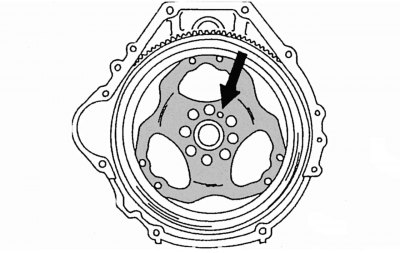
Figure 89. Location of the centering hole on the drive disk

Figure 89. Location of the centering hole on the drive disk


The installation of the flywheel or drive disk must be carried out as follows:
  • place the flywheel or drive disk against the crankshaft flange and turn it until the centering holes align with each other. When installing the flywheel, refer to the drawing 86, and when installing the drive disk - to Figure 89, which shows the location of the centering holes. When installing the drive disc, a protective disc should be placed on it;
  • tighten the mounting bolts to a torque of 30–40 N·m. You will need an Allen key to tighten these bolts. Finally, tighten the bolts another 90–100°, which corresponds to approximately 1/4 of a turn. The required tightening angle must be maintained in order to utilize the elastic action of the flexible bolts.
This article is available at: russian, bulgarian, belarusian, ukrainian, serbian, croatian, romanian, polish, slovak, hungarian
The article has been verified: Levin Kirill Glebovich
Share with friends:
◀ Previous
Mercedes Sprinter / Engine repair
Next ▶

Installing the crankshaft
Checking the crankshaft
Removal the crankshaft
Crankshaft and Flywheel — General Information
Changes in the design of the cylinder block introduced as a result of modernization
Belt pulley and torsional vibration damper of the crankshaft
Rear crankshaft oil seal and its holder
Front crankshaft oil seal
Camshaft Drive Mechanism — General Description
Removal and installation the camshaft drive chain tensioner
More similar articles for repairing other models

☛ Automatic transmission Mercedes W168 (1997-2004)
☛ Adjusting the manual transmission control drive Mercedes W203 (2000-2007)
☛ Removal the flywheel (drive disk) Mercedes W123 (1976-1985)
☛ Starting the movement and switching the automatic transmission Mercedes W463 (1999-2019)
☛ Removal and installation the flywheel/drive disc Mercedes W163 (1997-2005)
☛ Flywheel or drive discs (automatic transmission) Mercedes W116 (1972-1980, petrol)
Link in different formats to this article
Comments and feedback from visitors
No comments yet


How much will 38 + 17 ?


Vario 814D (1996-2003, diesel) 
  • General information
  • Maintenance
  • Power unit
  • Engines 602.984/985
  • Engines 904.908/914/923/936
  • Transmission
  • Clutch
  • Manual gearbox 711.613
  • Manual gearbox 710.64/66
  • Manual gearbox 715.051
  • Automatic gearbox 723.345
  • Power take-off box
  • Chassis
  • Front suspension
  • Rear suspension
  • Steering
  • Brake system
  • Body and electrical equipment
  • Interior (internal elements)
  • Exterior (external elements)
  • Heater and air conditioner
  • Electrical diagrams
Vito 2 (2003-2014, diesel) 
  • General information
  • User manual
  • Maintenance
  • Diesel engine OM646
  • Engine repair
  • Cooling and lubrication system
  • Power and exhaust system
  • Transmission
  • Clutch
  • Car gearbox
  • Chassis
  • Front suspension
  • Rear suspension
  • Steering
  • Brake system
  • Body
  • Body elements
  • Electrical equipment
  • Equipment and devices
  • Security systems
  • Electrical circuits
Vito 1 (1996-2003) 
  • General information
  • User manual
  • Maintenance
  • Petrol engines 2.0 l
  • Engine repair
  • Lubrication system
  • Cooling system
  • Power and control system
  • Petrol engines 2.8 l
  • Engine repair
  • Lubrication system
  • Cooling system
  • Power and control system
  • Diesel engines 2.3 l
  • Engine repair
  • Cooling system
  • Lubrication system
  • Turbocharging and recycling
  • Power and control system
  • Diesel engines 2.2 l
  • Engine repair
  • Cooling system
  • Lubrication system
  • Turbocharging and recycling
  • Power and control system
  • Transmission
  • Clutch
  • Mechanical gearbox
  • Automatic gearbox
  • Chassis
  • Front suspension and wheels
  • Rear suspension
  • Steering
  • Brake system
  • Body
  • Exterior (external elements)
  • Interior (internal elements)
  • Electrical equipment
  • Equipment and devices
  • Heater and air conditioner
  • Electrical circuits
Sprinter (1995-2000, diesel) 
  • General information
  • Introduction to the guide
  • Maintenance
  • Power unit
  • Engine repair
  • Lubrication system
  • Cooling system
  • Power and exhaust system
  • Transmission
  • Clutch
  • Mechanical gearbox
  • Automatic gearbox
  • Front axle
  • Rear axle and cardan
  • Chassis
  • Car suspension
  • Steering
  • Brake system
  • Tires and wheels
  • Electrical equipment
  • Equipment and devices
  • Headlights and lighting
  • Power devices
  • Electrical circuits
 
MercedesMan.ru © 2017–2026 · Mobile version · Read about Mercedes · Sitemap: EN BG BY UA RS HR RO PL SK HU · Feedback · Site search · Bookmark A-Class (W168) · C-Class (W201) · C-Class (W202) · C-Class (W203) · E-Class (W123) · E-Class (W124) · E-Class (W210) · G-Class (W463) · M-Class (W163) · S-Class (W116, petrol) · S-Class (W126, petrol) · S-Class (W140) · S-Class (W220) · Sprinter · Vito 1 · Vito 2 · Vario 814D ·
 
We only use cookies without which some of the site's features may not be available.