
General information
Attention! There must not be any foreign objects in the driver's footwell that could restrict the freedom of movement of the pedals! When using non-standard mats or mats, it is necessary to ensure sufficient pedal travel.
Full load on the engine should be given only after it has been preheated to normal operating temperature, which occurs quite quickly during movement.
When starting off on a slippery road surface, avoid turning any of the wheels for a long time, as this may damage the power unit.
Engine starting
Description of procedures for starting gasoline and diesel engines are given in subsection Engine cranks but won't start.
Starting off
To disengage the AT selector lever lock, depress the foot brake pedal.
Move the lever to position «D» or «R».
Note. Do not rush, wait until the final transmission is switched on - what has been said especially applies to the cold season.
Release the parking brake, - control lamp
 on the instrument cluster (see illustration The design of the instrument cluster).
Release the foot brake pedal and gently depress the gas. Be aware that on cold gasoline models, automatic shifting occurs at slightly higher than normal engine speeds, thereby accelerating the warm-up process to normal operating temperature of the catalytic converter.
When the corresponding function of the on-board computer is activated, the doors should automatically lock shortly after starting the vehicle.
5-speed automatic transmission shift control
Gear shifting while the car is moving is performed automatically depending on the selected position of the AT selector lever, the choice of the transfer case mode («H» or «L») , the degree of depressing the gas pedal and the current speed.
Automatic transmission shifts are automatically adapted to individual driving habits by adjusting shift points. The adaptation process goes on continuously, taking into account the current values of the operating parameters of the power unit, the characteristics of the movement, as well as the actions of the driver. Information about the selected AT transmissions is displayed in the corresponding field of the base page of the multifunction display (see illustration The layout of the display fields of the base page of the multifunctional display of the on-board computer).
A description of the procedures for starting the engine and starting the car from a place is given in the previous subsections (see above).
When driving, it should be borne in mind that moderately depressing the gas pedal ensures an earlier upshift of the transmission, while strongly depressing the shift occurs later.
Pressing the gas pedal to the floor (overcoming the point of resistance) leads to automatic downshifting of the AT (kickdown mode), providing the car with increased dynamic qualities. When the pedal is released, the transmission returns to the original higher gear that meets the characteristics of the current speed mode.
When temporarily stopping, do not remove the selector lever from the position «D», while holding the vehicle stationary using the foot or parking brake.
When maneuvering in tight spaces, adjust your speed by gradually releasing the foot brake. Try to lightly depress the gas pedal and do not «play» her.
When towing a trailer in hilly terrain, select the AT limit modes (3 or 2, depending on the steepness of the slopes), in especially dangerous areas, activate the step-down («L») transfer case mode.
The positions of the selector lever AT with an electronic selector module equipped with the function of sequential switching of operating ranges in the mode «D»
Attention! When driving on a slippery road surface, do not brake with the transmission by activating the limit modes («3», «2» or «1»), as this can lead to loss of traction of the wheels with the road! Remember that engine braking is always associated with a sharp increase in its speed, which is fraught with serious internal damage to the power unit.
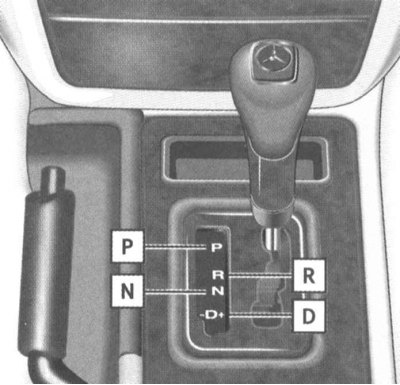
Positions of the lever of the selector of ranges АТ (switching indication is displayed in the corresponding field of the base page of the multifunctional display, see Section Emergency Brake Assist (BAS))
The transmission range selector lever can be in one of four fixed positions. The engine can only be started in positions «P» or «N» lever. If the stop is made when the AT is in the range of motion «D», or in the mode «N», you must fully release the gas pedal and depress the brake pedal for reliable braking of the car.
When switching AT, move the lever along the guide groove.
When the key is removed from the ignition lock, the selector lever is locked in position «R». In this case, the withdrawal of the lever from the position «R» impossible even when depressing the brake pedal. A description of the lever lock emergency disengagement procedure is given below. To avoid damage to the AT, move the lever to the position «R» only after the vehicle has come to a complete stop.
Note. Removing the key from the ignition lock becomes possible only after moving the selector lever to the position «R» and releasing the foot brake pedal.
Standard Ranges
Position «R». In this position of the selector lever, the transmission is locked, providing additional protection for the parked vehicle. Always move the selector lever to the position «R» when turning off or starting the engine. To move the range selector lever out of position «R», it is necessary to depress the brake pedal, after releasing the gas pedal. Move the selector lever to the right and move it out of position «R».
Position «R». Techniques for controlling the range selector lever when moving it out of position «R» into position «R» (Reverse) described above. Switching the lever to position «R» out of position «N» (neutral) do it only after the car has come to a complete stop, - if the attempt fails, depress the foot brake pedal and slowly move the lever first back to the position «N», then to position «R».
Position «N». use position «N» (neutral) when starting a stalled engine while driving and during short stops of a car with a running engine. If for any reason you need to move away from the vehicle, first move the range selector lever to the position «R». When pulling the lever out of position «N» depress the foot brake pedal.
Attention! Translation of the transmission into position «N» while driving, there is a risk of serious internal damage to the gearbox! Use this position only if the vehicle is in danger of skidding when driving on slippery road surfaces with the anti-skid system disabled (ESP), as well as, if necessary, connecting a transfer box.
Position «D». In this position, the range selector lever must be constantly when the car is moving in normal road conditions - automatic switching of the AT between five forward gears is provided in accordance with changes in the speed mode and the degree of depressing the gas pedal. For a sharp acceleration of the car when the transmission is operating in the range «D» squeeze the gas pedal to the stop. The transmission will then automatically shift to the next lower gear (kickdown mode).
Note. If the speed is low, switching can occur immediately two steps down.
Ranges for driving in special conditions
When turned on «D» transmission provides the ability to manually switch it to ranges for movement in special conditions («4», «3», «2» And «1»).
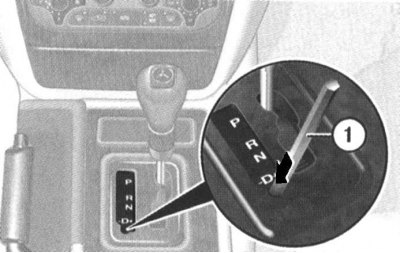
Emergency disengagement of the selector lever lock in position «R»
Slight lever pull to the left («D-») leads to a transition to an adjacent lowering AT range. While holding the lever in position «D-» the transmission is switched to a range that provides optimal dynamic qualities of the car in accordance with the active current gear. Information about changing ranges is displayed in the indication field on the tachometer dial, to the left of the clock display.
Note. When pushing the lever to the position «D-» while driving at an excessively high speed, the transmission shift is blocked in order to prevent an unacceptable increase in engine speed.
Pressing the lever into position «D+» causes the transmission to move to a higher range adjacent to the current one. Holding the lever in position «D+» allows you to return to standard mode «D».
Note. With buck mode enabled («L») transfer case, engine protection is provided by upshift locks.
Position «4». If the range selector lever is in the «4», the automatic transmission functions in the same way as the case of switching the range «D». The difference is that the transition to fifth gear is excluded.
Position «3». In this position, the transmission shift stroke is limited to third gear. The mode can be used to implement engine braking. Turning on the range «3» also useful for avoiding unnecessary automatic transmission cycling between third and fourth gears - such cyclic transmission shifts can occur, for example, when driving in heavy traffic with frequent slowdowns and stops.
Position «2». When the range is turned on «2» the automatic transmission will always operate in second gear. It is recommended to use this limitation when towing a trailer in hilly terrain or when applying engine braking on a steep downhill. When the vehicle is stopped, the transmission does not shift into first gear. The constant engagement of the second gear provides good traction dynamics of the car on the slopes and the possibility of intensive engine braking on steep descents. Range «2» can also be used when starting off on slippery road surfaces, or when driving in deep snow, helping to prevent severe slipping of the vehicle's drive wheels. It is recommended to use the range «2» when driving over steep passes, when towing a trailer in hilly terrain, and for engine braking on particularly steep descents.
Position «1». When the range is turned on «1» the automatic transmission will always operate in first gear. If the inclusion of the range «1» produced at speeds over 50 km/h, the transmission will first shift to second gear. The inclusion of an intermediate stage allows you to eliminate sharp and unexpected engine braking. The mode can be used when driving with a trailer on particularly steep descents and long passes.
Emergency disengagement of the selector lever lock in position «R»
The need to disable the lock selector lever AT in position «R» occurs in the event of a breakdown of the locking mechanism, as well as when it is required to tow a faulty vehicle.
Disabling can be done with a regular ballpoint pen or any other object of a suitable shape. After wringing out the plug, insert a pen into the hole under the selector switch indicator panel and, pressing it down, remove the lever from the parking position. Remove the pen.
Note. To replace the plug, lightly push the lever in the direction of the position «D».
Emergency mode
The transition of the transmission to the emergency mode of operation is evidenced by the deterioration of the dynamic characteristics of the car and the failure of the transmission to switch. It is not excluded the possibility of switching to 2nd gear or reverse gear.
In such a situation, stop driving, park in a safe place, move the selector lever to the position "R" and turn off the engine.
After waiting at least 10 seconds, restart the engine and move the selector lever to the «D», - 2nd gear is engaged. Moving the lever to position «R» causes reverse gear to be engaged.
The car should be immediately driven to the nearest Mercedes-Benz service station for a detailed diagnosis of the AT and the necessary remedial repairs.