



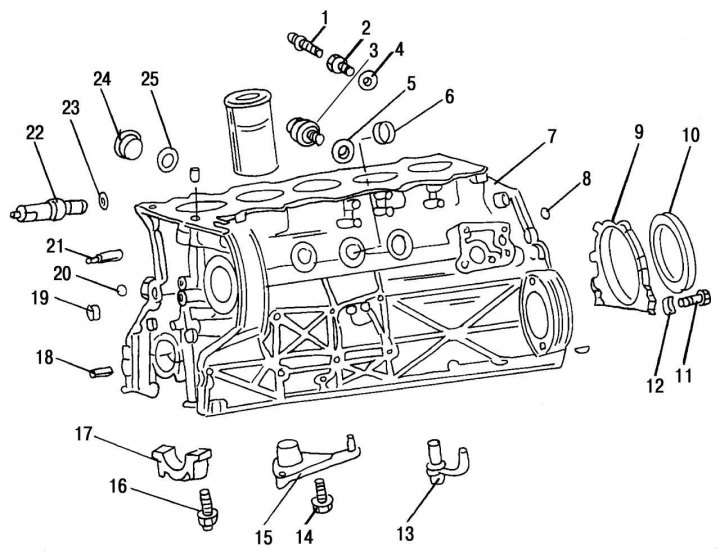
Figure 65. Parts installed on the cylinder block: 1 — connecting nipple; 2 - threaded nozzle; 3 - connecting nipple for draining coolant, on the right side; 4, 5 - sealing rings; 6 — cylinder block plug; 7 — cylinder block; 8 - ball blocking the oil line at the rear; 9 — flange of the rear crankshaft seal; 10 — rear crankshaft oil seal; 11 — bolt for fastening the flange of the rear crankshaft seal to the cylinder block; 12 - elastic washer; 13 - Oil spray nozzle for piston cooling system, new design; 14 - Hexagon head bolt; 15 — oil spray nozzle of the piston cooling system, obsolete design; 16 — main bearing cap mounting bolt; 17 — main bearing cap; 18 — seat bushing of the camshaft drive mechanism cover; 19 - plug for closing the oil channel in front; 20 - ball that locks the oil line in front; 21 — nipple for connecting the chain lubrication supply tube; 22 — chain lubrication supply tube; 23 — sealing ring of the oil spray nozzle on the block; 24 - screw plug on the left side; 25 - sealing ring
Figure 65 shows a disassembled cylinder block of a 2.9L diesel engine with the removed parts identified. When completely disassembling the cylinder block, it is necessary to thoroughly clean all cavities and oil channels, removing deposits and foreign particles.
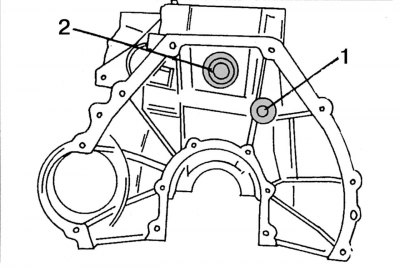
Figure 66. Rear of the cylinder block showing the location of the steel ball (1) blocking the main oil line and the cylinder block plug (2)
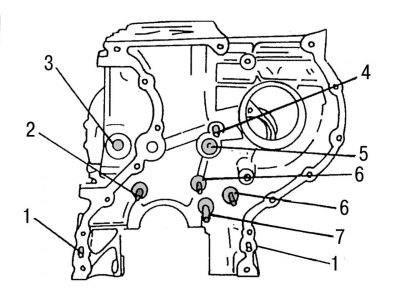
Figure 67. Front of the cylinder block: 1 - spring tension pin; 2 - chain guide support pin; 3 - steel ball with a diameter of 17 mm; 4 - oil spray nozzle; 5 — cylinder block plug; 6 — chain tensioner shoe support pin; 7 — support pin of the oil pump drive chain tensioner
Particular care should be taken to ensure that the flushing fluid is completely removed. Be sure to blow out all cavities and channels with compressed air. The main oil channel is closed on the end faces by steel balls with a diameter of 17 mm on the front side and a diameter of 15 mm on the rear side of the cylinder block. For a more thorough cleaning of the main oil line, these balls must be removed. The balls can be reused if their surfaces are not visibly damaged. The location of these balls is shown in the figure 66 and 67. In addition, Figure 67 shows parts of the cylinder block, which should also be carefully checked for signs of wear. For subsequent installation of balls that close the oil channel to the required depth, a special mandrel is required, included in the spare parts specification under number 601 589 08 15 00.
[Text republished from the website MercedesMAN.ru]
Note: If oil leaks occur from under the balls on the front or rear sides of the cylinder block and if it is impossible to purchase the above-mentioned special mandrel, the oil channels can be blocked with threaded plugs. Screw in a M18x1.5mm plug (parts specification number 000906 018 000) from the front and a M16x1.5mm plug (parts specification number 000906 016 002) from the rear. The appropriate threads must be cut in the cylinder block channels beforehand: 10 mm deep from the front and 14 mm deep from the rear. After cutting the threads, clean the channels from any remaining chips. Before tightening the rear plug, lubricate its threaded part with Loctite. Tightening torque 50 Nm.
If you intend to replace the steel balls with new ones without removing the engine from the car, then you need to do the following:
- remove oil pump;
- remove gearbox and flywheel;
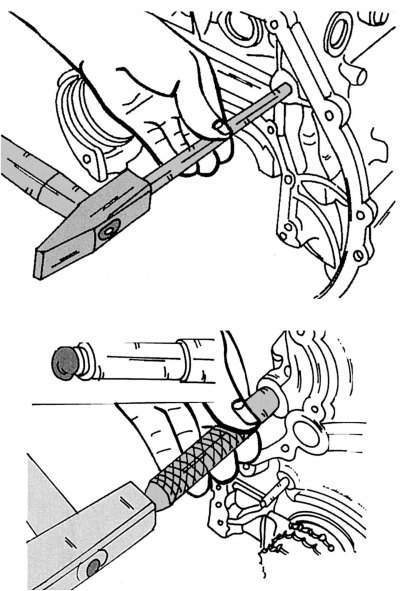
Figure 68. Pressing out the steel ball from the cylinder block (top) and its subsequent installation (bottom)
- knock out the balls with a steel rod of 14 mm diameter and 550 mm length from the back side as shown in the figure 68;
- thoroughly clean the oil channel;
- lubricate the spherical recess of the special mandrel with plastic grease and insert the ball into it;
- insert the mandrel with the ball into the corresponding hole of the oil channel and press the ball until it stops (see figure 68, below);
- install the oil pump, flywheel, gearbox and start the engine. Inspect the engine for oil leaks.