



Contents: Valve springs ↡ Valve guide bushings ↡ Valve seats ↡ Valves ↡ Cylinder head ↡ Camshaft ↡ Replacing the valve stem seals (the…↡
All cylinder head components should be checked for wear. The mating surface of the cylinder head must be thoroughly cleaned (sometimes there are stuck fragments of the gasket). The condition of the cylinder head is checked according to the instructions below.
Valve springs
To properly check the condition of valve springs, a special spring tester is required. If you don't have one, you can make a simple comparison of the old and new valve springs. To do this, take the old and new valve springs and clamp them in a vice. Slowly squeeze the jaws of the vice and observe the degree of compression of both springs. If they compress equally, this indicates that the old spring is in good condition. But if the working spring has a high compression ratio (looks shorter than new), then this is a clear sign of fatigue wear - such a spring should be replaced. The valve springs are replaced as a complete set.
The springs prepared for installation are placed on a flat and smooth surface (on glass) so that the tightly closed coils are at the bottom. A metal corner is placed on top of the springs and the gap between the upper coil of the spring and the plane of the corner is checked. This gap should not exceed 2.0 mm. Otherwise, the springs must be replaced.
Valve guide bushings
The valve guides, made of cast iron, have different diameters for the intake and exhaust valves. The exhaust valve guides have a larger inside diameter and are shorter, making them easy to sort. Using a rag soaked in gasoline, pull it through the bushings to clean the bushings. The best way to clean the valve stems is with a rotating wire brush attached to a power drill.
The wear of the guide bushings is checked using a calibrated mandrel. If the reject gauge of the mandrel fits freely into the guide bushing, then such bushing should be replaced with a new one. To remove the bushings, use a special mandrel with a ledge. If it is possible to use guide bushings of the 1st standard size, then a special mandrel is used for their installation, with the help of which the guide bushing is pressed into the seat until the retaining ring enters the groove on the cylinder head. When installing guide bushings of repair size groups, the mounting sockets must first be processed with manual broaching reamers. Since the guide bushings must be cooled with dry ice before pressing in, we recommend that you take the cylinder head to a service station to have new guide bushings installed.
Before replacing the valve guides, first check the general condition of the cylinder head. After pressing in, the bushings are bored to the required dimensions: 8.00–8.015 mm for intake valves and 9.00–9.015 for exhaust valves. The exhaust valve guides are longer.
When replacing the guide bushings, it is necessary to replace the valves and grind the valve seats.
Note: Valve seat grinding is only performed after replacing the valve guides. If it suddenly turns out that the seats can no longer be bored, then the guide bushings should not be changed.
Valve seats
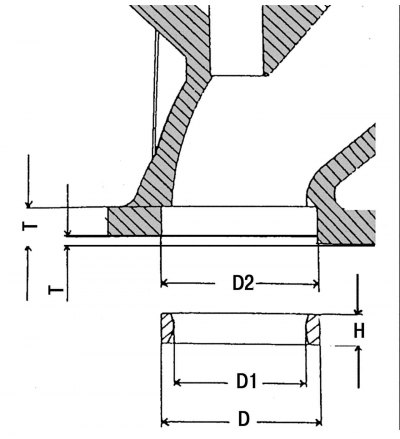
Figure 37. Main dimensions of valve seats: D — outer diameter of the valve seat; D1 — internal diameter of the valve seat; D2 — seat for valve seat in cylinder head; H — valve seat height; T is the distance between the plane of the cylinder head and the upper edge of the valve seat; H=6.97—7.00 mm — for all valves; T=2.37—2.25 mm — for intake valves; T=2.44—2.25 mm — for exhaust valves
If the camshaft bearings are badly worn, then in this case there is no need to bore the valve seats, but the cylinder head assembly should be replaced. Valve seats are checked for wear or pitting. Minor wear can be removed by milling with a 45 degree conical cutter. If the valve seat has become very wide due to extensive wear, then such seats must be replaced. The valve seats are pressed into the cylinder head, and it is best to remove them by drilling or unscrewing them using special boring tools. When doing this, you must be very careful not to damage the cylinder head. Measure the diameter of the base hole D1 (figure 37) and, if necessary, bore to the next repair size. Valve seats with repair allowances can be bored until the prescribed overlap of 0.068–0.10 mm is ensured. Inlet valve seats have a larger diameter.
Heat the cylinder head in a water bath to 90°C, and cool the valve seat on dry ice, after which it can be pressed into the seat using a special mandrel. It is recommended to carry out this operation at a service station.
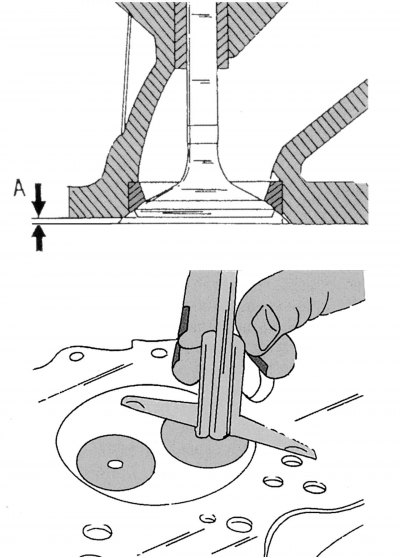
Figure 38. Determining size A
Machine the valve seat with a suitable countersink and grinding wheel on a valve grinder. Using the valve, measure the maximum distance A as shown in the lower part of the figure 38. When installing a new valve and valve seat, the distance A should be 0.1–0.5 mm. The wear limit is 1.0 mm.
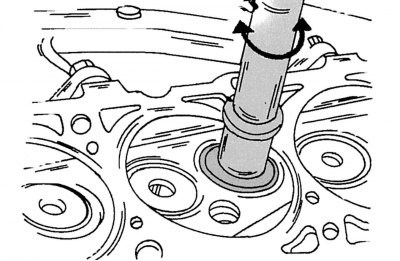
Figure 39. Grinding the valves to the seats
After processing, measure the width of the valve seat sealing belt. If the width of the sealing belt of the inlet valve seat differs from 2.5 mm, and the width of the outlet valve seat differs from 3.5 mm, then such seats must be processed with a 15-degree cutter in the upper part and a 60-degree cutter in the lower part. Milling is stopped as soon as the width of the valve seat sealing belt enters the above limits. After milling, it is necessary to grind the valve seats. To do this, a small amount of grinding paste is applied to the valve seat. A suction cup is attached to the top of the valve head, with the help of which the valve is given rotational movements first in one direction, then in the other (figure 39). From time to time it is necessary to turn the valve a quarter of a turn and then grind it again with rotational movements. If necessary, add grinding paste to the valve seat. After lapping, remove any remaining paste from the valve and seat and check the fit of the valve on the seat and head. On both parts, the resulting matte belt should be clearly visible, which determines the width of the valve seat sealing belt.
Using a pencil, draw a few lines on the resulting matte belt at intervals of 1 mm along its perimeter. After this, lower the valve into the seat and rotate it 90° around the stem, lightly pressing the valve against the seat.
Remove the valve from the seat and check that the pencil marks have disappeared. If the width of the valve seat sealing belts is within the prescribed limits, the cylinder head can be installed on the engine. Otherwise, it is necessary to continue processing and grinding the seats or replace the cylinder head.
Valves
Due to the use of hydraulic valve clearance compensators, the ends of the valve stems of the intake and exhaust valves are specially treated to withstand increased loads. Minor damage to the valve heads can be repaired by grinding them against the seats as described above. More serious damage to the sealing surfaces can be repaired on a valve grinder. On ground valves, the thickness of the edges of their plates should not be less than 0.5–0.7 mm for inlet valves and 0.5–0.6 mm for outlet valves.
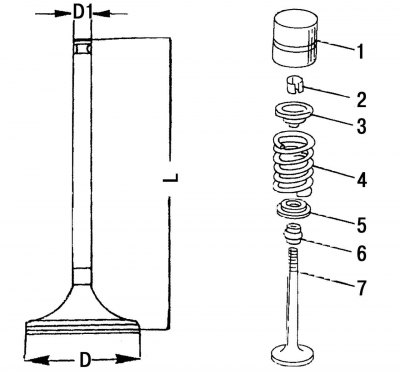
Figure 40. Main dimensions of valves: D — diameter of the valve plate (head); D1 — valve stem diameter; L — valve length; 1 - pusher; 2 - conical crackers; 3 — valve spring plate; 4 - valve spring; 5 - lower support plate of the valve spring; 6 - oil deflector cap; 7 — valve
These engine types use valves without sodium filling, as was the case with other Mercedes-Benz engine types. Figure 40 shows the valve dimensions. Valves whose dimensions do not correspond to the specified dimensions must be replaced with new ones.
When ordering valves, you must always indicate their purpose (inlet or outlet), and also that these valves are designed for diesel engines.
In some cases, it is possible to replace only the exhaust valves if, for example, their edges are burnt out.
Cylinder head
Thoroughly clean the mating surfaces of the cylinder head and cylinder block, and then check the cylinder head for deformation. To do this, place a ruler on the mating surface of the cylinder head and use a feeler gauge to measure the gap under the ruler in the longitudinal, transverse and diagonal directions. If during the measurement the gap between the ruler and the cylinder head surface in the longitudinal direction exceeds 0.10 mm, then this cylinder head should be sent to a specialized service station. When installing the ruler in the transverse direction of the cylinder head, there should be no clearance under the ruler. Cylinder heads can be ground as long as the appropriate valve height adjustment allows it (size A in figure 38).
It is also necessary to check the height of the protruding part of the pre-chambers for diesel fuel injection (601 engine). The edge of the pre-chambers should protrude by 7.6–8.1 mm.
At the service station, the prescribed size of the protruding part of the pre-chambers can be set using a set of sealing gaskets of different thicknesses installed under the pre-chambers. This work must be carried out at a service station, since it requires a special tool for pressing out and pressing in pre-chambers.
Camshaft
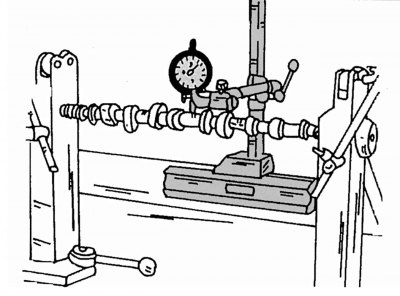
Figure 41. Checking the camshaft deformation
The following text describes the work associated with checking and monitoring the condition of the camshaft. For a design description of the camshaft, see. section 2.12.6. Install the camshaft on prisms placed under the outer bearing journals, or clamp it between the centers of the lathe, as shown in the figure 41, and bring the feeler gauge of the measuring indicator to the middle support neck. Then, slowly turning the camshaft, you need to watch the arrow readings. If the arrow deviates beyond the 0.01 mm division, this will mean that the shaft is deformed and must be replaced.
Replacing the valve stem seals (the cylinder head is installed on the engine)
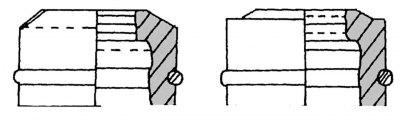
Figure 42. Shape of oil deflector caps placed on valve stems: on the left - for graduation; on the right - for intake valves
The valve stem seals can be found in the repair kit. The repair kit includes protective bushings that are placed on the intake valve stems during installation. The valve stem seals for the intake and exhaust valves differ from each other in both their diameters and shapes, so it is impossible to confuse them (figure 42).
A special tool is usually used to install the caps. If you don't have one at hand, you can use a thin tube, but be very careful not to damage the sealing cuffs and the tightening springs of the caps. When installing oil deflector caps on valve stems, the valve crackers and valve springs must be removed from the latter. To prevent the valve from falling into the cylinder, the piston of that cylinder must be at TDC. On four-cylinder engines, this operation is significantly simplified due to the fact that each time two pistons are at TDC. On five-cylinder engines, this work is a little more difficult to perform, since each time it is necessary to turn the engine crankshaft at a certain angle, setting the piston of the next cylinder to TDC. Replacement of oil deflector caps must be performed as follows (we recommend that you entrust this work to an experienced specialist).
(Original material on the website mercedesman.ru)
Turn the engine until the piston of the first cylinder is at TDC.
Remove the camshaft (subsection 2.12.6).
Remove the valve crackers from the first cylinder as described in subsection 2.4.2. On a four-cylinder engine, you can remove the crackers and valve springs from the valves of the fourth cylinder at the same time.
Carefully, so as not to damage the valve stems and tappet holes, pull off the old oil deflector caps with pliers.
Lubricate the new valve stem seals with oil and carefully push them down the valve stems. Don't forget to put protective bushings on the intake valve stems. Place the oil deflector caps tightly onto the valve guide bushings.
Install the valve springs with the color markings facing down and install the valve keepers, making sure that the keepers are seated well in the grooves and conical recesses of the upper valve spring support plates.
Slightly lift the camshaft drive sprocket to prevent the chain from disengaging and turn the crankshaft of the four-cylinder engine half a turn. After this, you can similarly replace the valve stem seals on the valves of the second and third cylinders. When working on a five-cylinder engine, the crankshaft must be turned until the piston of the next cylinder reaches TDC. The sequence of subsequent cylinders whose piston passes TDC is: 2–4–5–3. As noted above, this work requires special care.
Note: The valve spring compressor must be tightened very slowly as some valve springs tend to hang up in the grooves. Avoid situations where, due to rapid clamping of the device, the valve rests against the piston with its plate. The tool should act only on the valve spring, compressing and moving it downwards.