



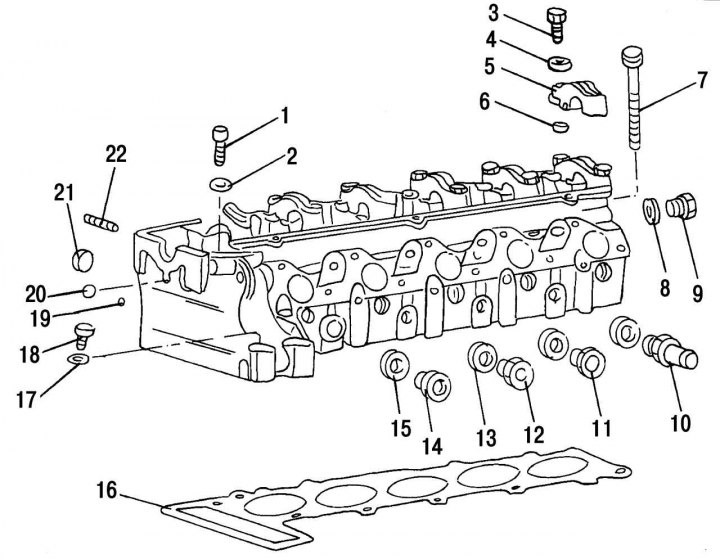
Figure 34. Cylinder head details of a 2.9L engine: 1 - cylinder head mounting bolt located in the drive chain housing; 2 - elastic washer; 3 — bearing cap mounting bolt to cylinder head; 4 — bearing cap mounting bolt washer; 5 — camshaft bearing cap; 6 — landing sleeve; 7 — cylinder head mounting bolt; 8 - sealing ring; 9 — rear oil channel plug; 10 — nipple for connecting heater pipes; 11 - threaded adapter; 12 — adapter for connecting a temperature sensor; 13 — sealing ring; 14 — adapter for connecting a temperature sensor; 15 - sealing ring; 16 - cylinder head gasket; 17 — washer of the bolt securing the fuel filter to the cylinder head; 18 — bolt securing the fuel filter to the cylinder head; 19 - ball for closing the cooling system channels; 20 - ball closing the oil channel in front; 21 - cork; 22 — exhaust manifold mounting stud
- remove all parts from the cylinder head (figure 34);
- remove the camshaft. To do this, you need to unscrew all the bolts securing the camshaft bearing caps, after which the shaft can be separated from the cylinder head. The bearing caps are stamped with numbers that must match the numbers stamped on the cylinder head;
- a special valve puller is required to remove the valves. Any device capable of compressing the valve spring by acting on its upper plate can be used for this purpose. After compressing the valve spring, it is necessary to remove the crackers using tweezers or a magnet. If there are no special devices for compressing the valve springs, then the cylinder head should be placed on a smooth and level surface of the workbench so that the valves are supported from below. After this, take a piece of pipe with a diameter smaller than the diameter of the upper plate of the valve spring, place it on the upper plate of the valve spring and hit the upper end of the pipe with a hammer. In this case, the crackers will jump out of the cone of the plate and remain inside the pipe. When striking, do not lift the hammer above the pipe so that the crackers do not jump out and get lost;
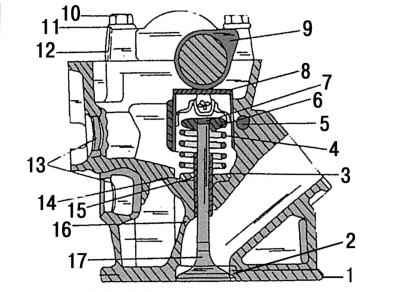
Figure 35. Cylinder head and intake valve: 1 - cylinder head; 2 — inlet valve seat; 3 - oil deflector cap; 4 - valve spring; 5 - oil line; 6 - upper valve spring plate; 7 - crackers; 8 — valve tappet with hydraulic clearance compensator (hydraulic pusher); 9 — camshaft; 10 — bolt M8x45 for fastening the camshaft bearing cover; 11 - washer; 12 — camshaft bearing cap; 13 - cylinder head plugs; 14 — valve spring thrust ring; 15 - retaining ring; 16 — inlet valve guide bushing; 17 — inlet valve
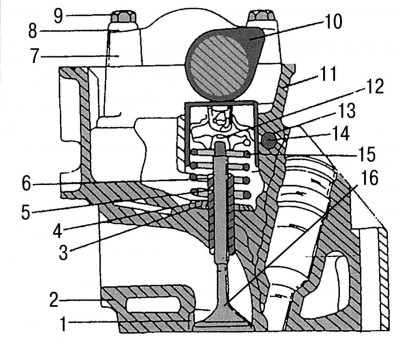
Figure 36. Cylinder head and exhaust valve: 1 - exhaust valve seat; 2 — cylinder head; 3 - retaining ring; 4 — valve spring thrust ring; 5 — exhaust valve guide bushing; 6 - oil deflector cap; 7 — camshaft bearing cap; 8 - washer; 9 — bolt M8x45 of the camshaft bearing cover; 10 — camshaft; 11 — valve tappet with hydraulic clearance compensator (hydraulic pusher); 12 - crackers; 13 — retaining ring; 14 - oil channel; 15 - valve spring; 16 - exhaust valve
- remove the upper valve spring support plates and the valve springs themselves. Each valve has one spring, which is color-coded. During subsequent assembly, it is necessary to use valve springs with the same marking. Remove the lower valve spring support plates. Figures 35 and 36 show the valves installed on the engine;
- using a screwdriver or pliers, carefully remove the oil-deflecting caps;
- remove the de-clamped valves from the guide bushings and place them on a sheet of cardboard with the corresponding marking of the number of each valve.